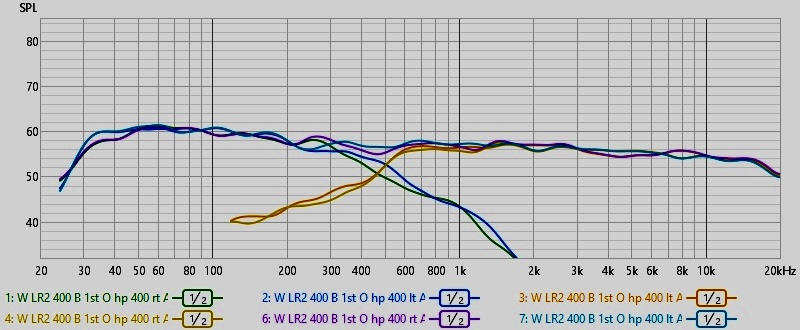
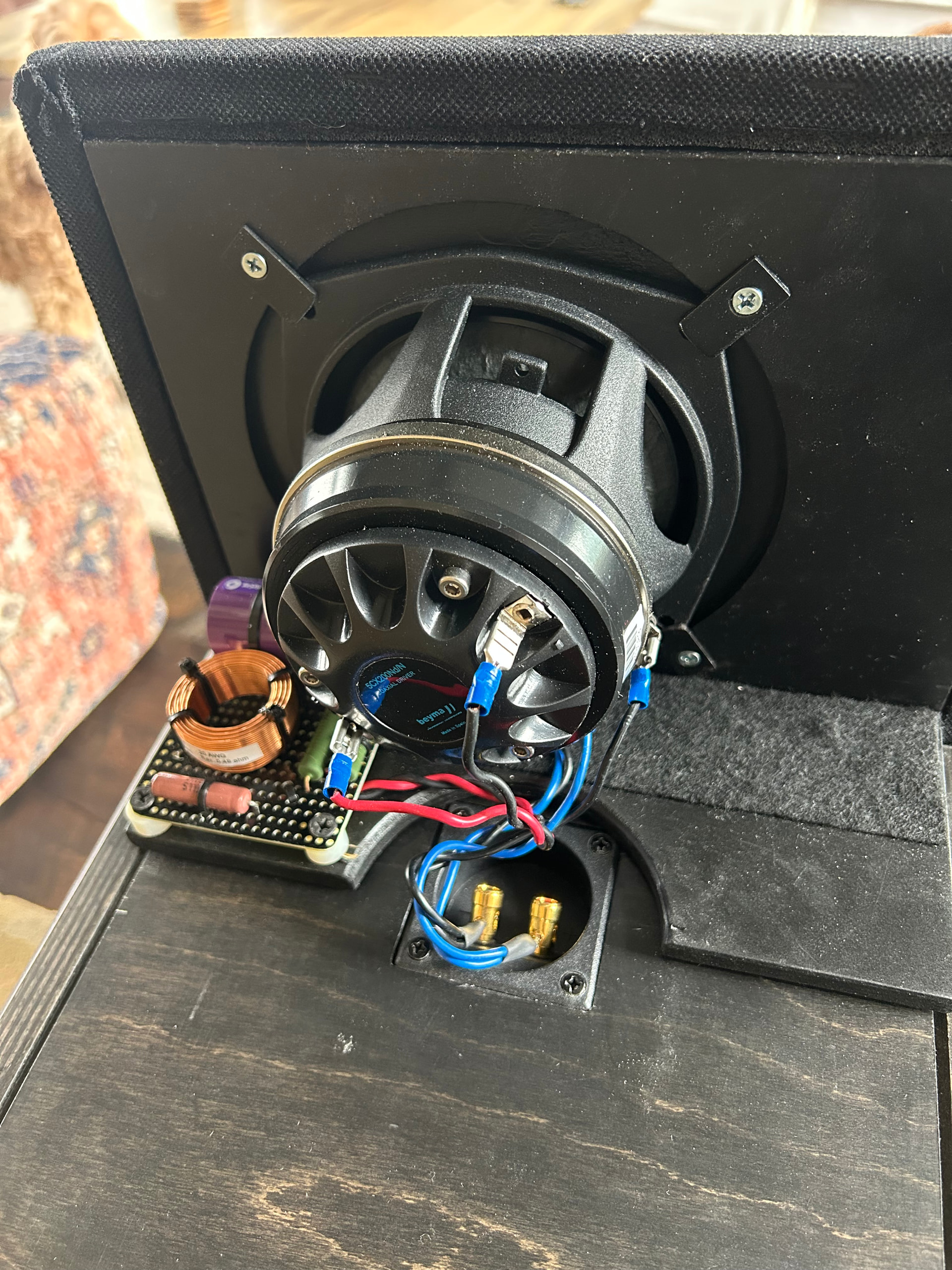
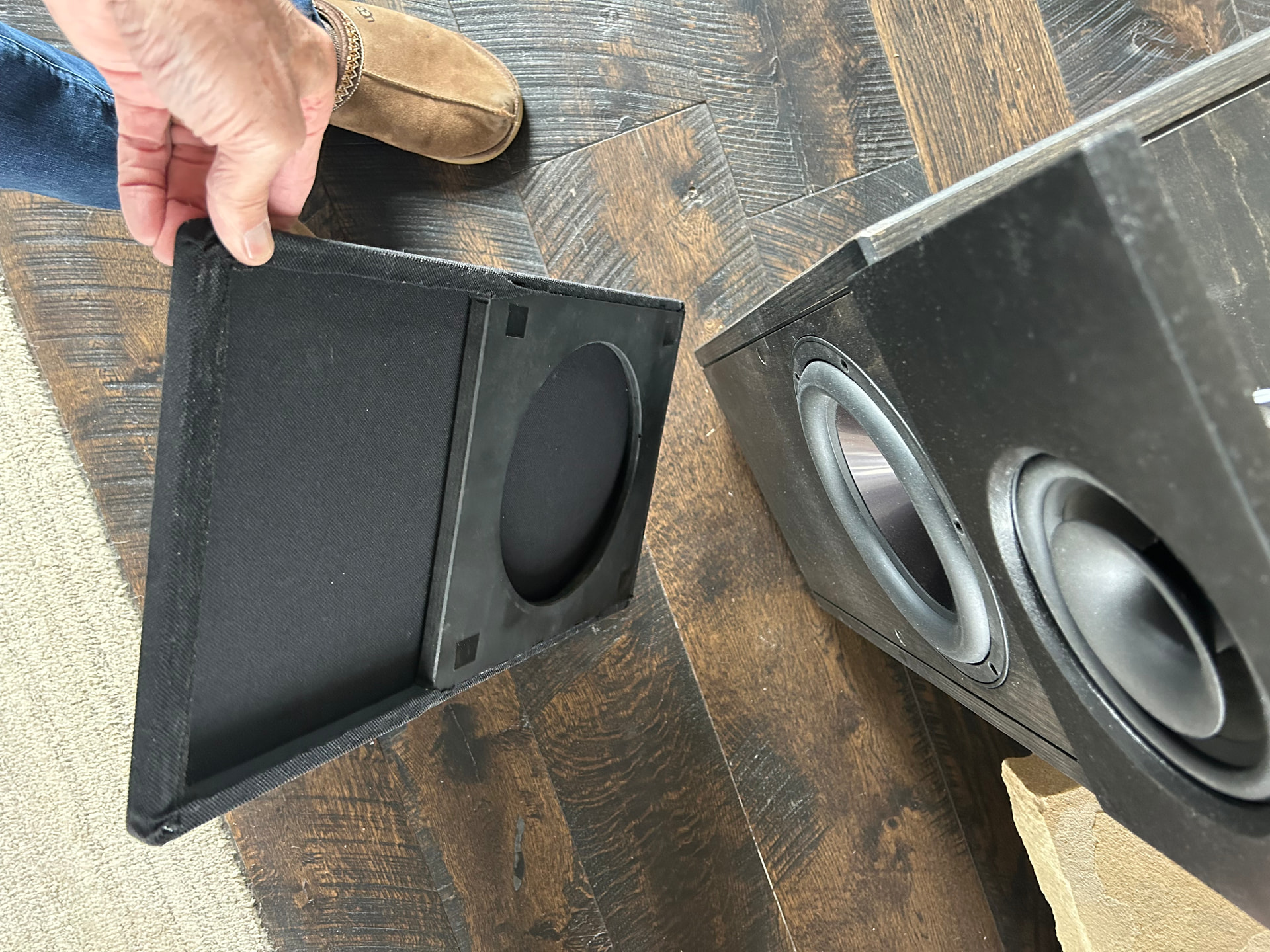
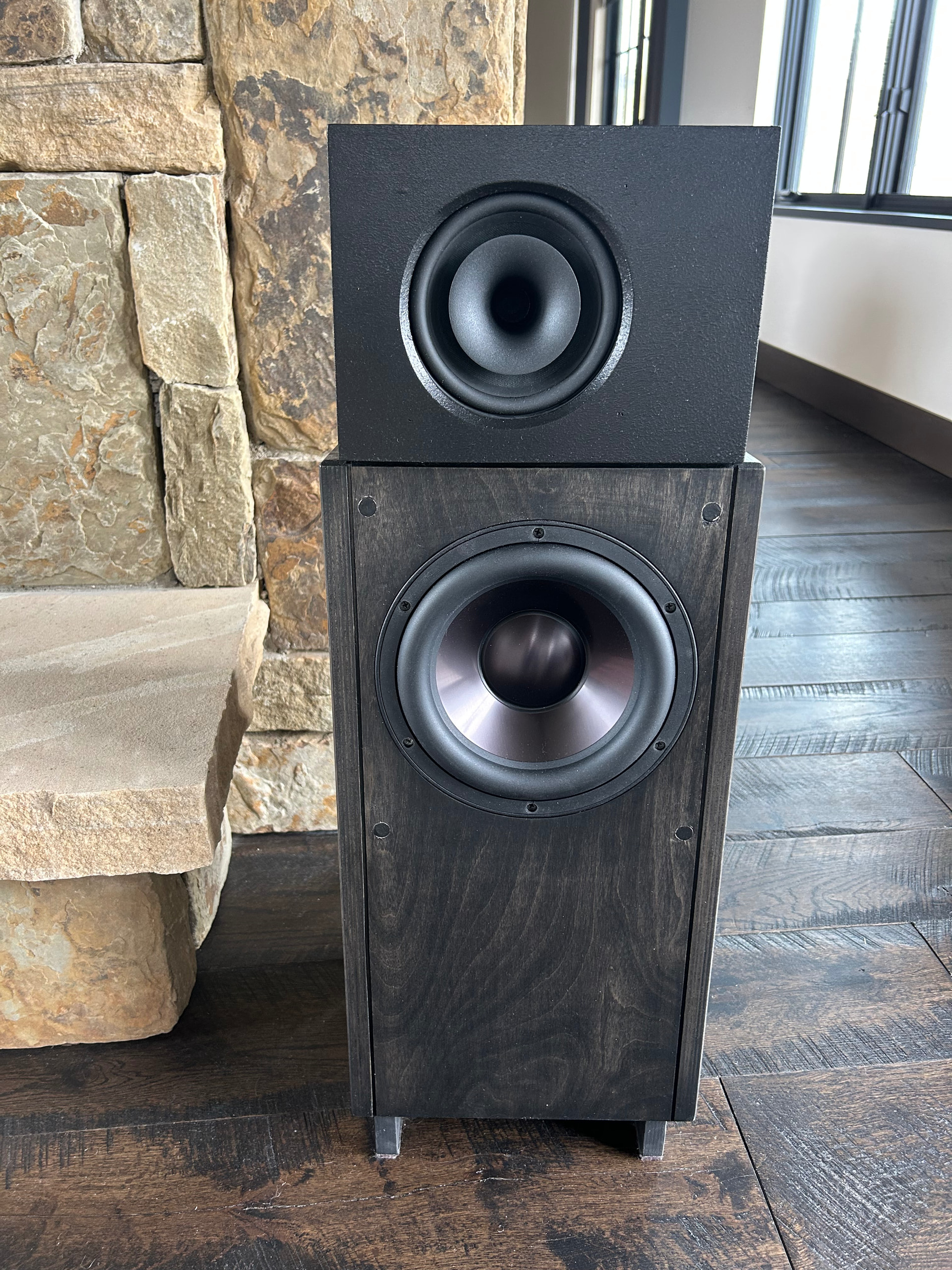
Now working on the third iteration for the top box, revisiting my beyma 5CX200Nd from a previous build. Looking at an open baffle L structure to sit on top of my 1.5 way dual 8 in sealed woofer box. Latest iteration was with the ESS Heils crossing ~850- 910Hz, and I had recently moved the inductor for the rear firing .5 woofer from ~ baffle step frequency down to just support where a single sealed 8in would start rolling off on its own, so I doubled the inductor value. The idea was to provide double the Sd and therefore have reduce excursion / distortion at lower end eq’d levels, and limit mid-upper bass frequency interactions. A bit more complicated than a PR, but more controlled low-end response, and providing a smoother roll-off down below fs than PR/ported designs.
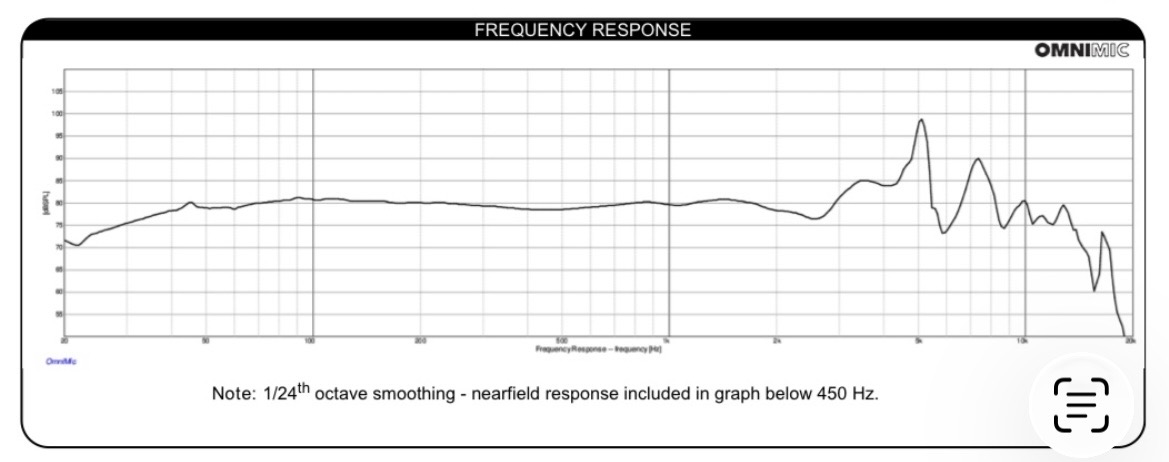
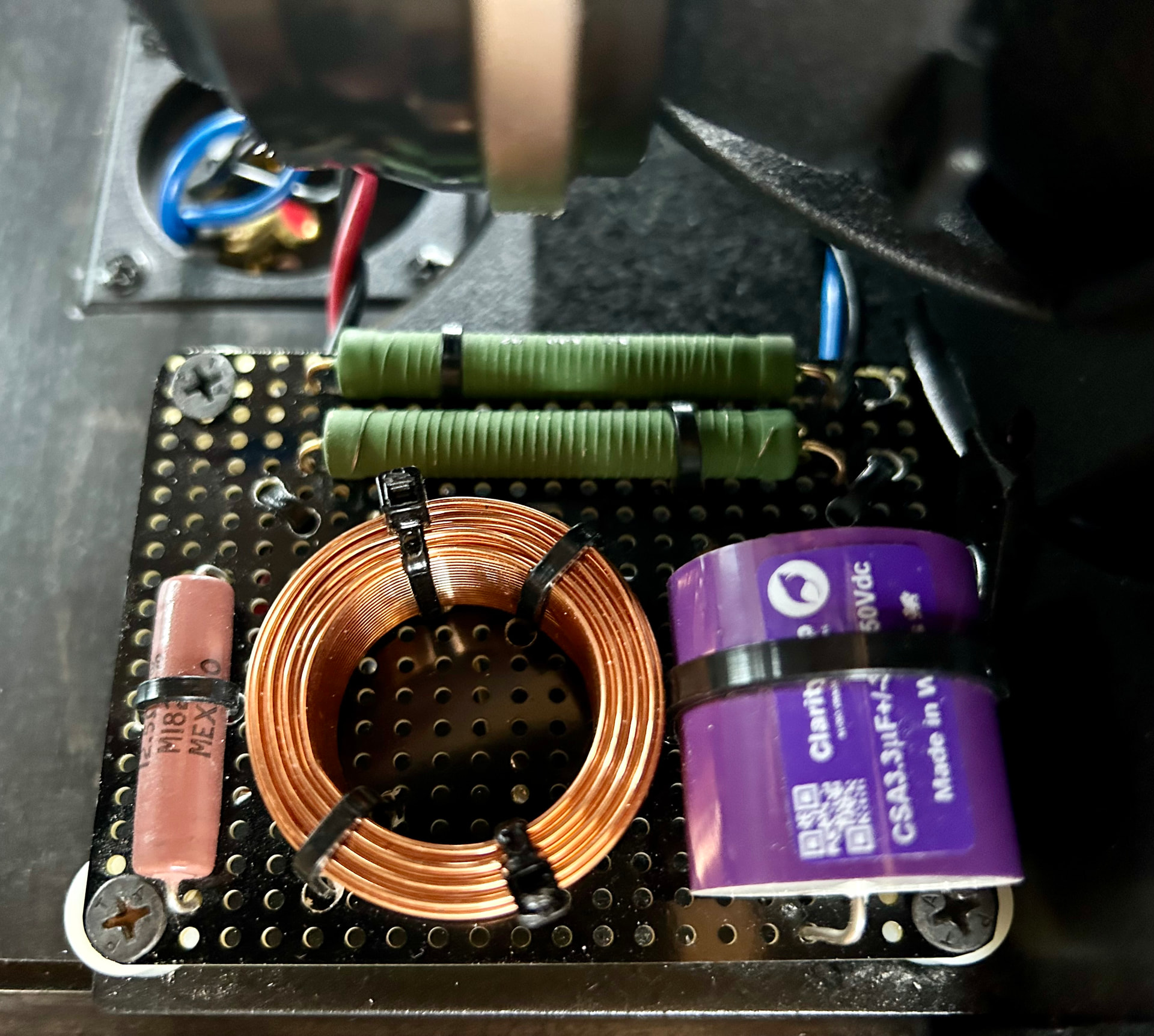
I’m always looking for the ‘simple’ implementation but haven’t yet been comfortable with a 1st order mid / tweeter crossover, due to limits of the tweeter. I’ve been intrigued with the Classic Seas A25 with its woofer running full range with a simple 1st order HP on a tweeter and am a fan of dipoles (Maggie’s). With this beyma at the outset I wanted to run it open/baffle format for a far as it would go both directions as it had a measured decent smoothish roll-off going from 4kHz out thru 12kHz+ (the tweeter is a sealed compression driver with its own horn / not playing off of a moving waveguide as with many coaxial designs). Additionally, running bi-amped with a minDSP for Xover between the 1.5 way woofer and the top (passive btwn the mid and tweeter of the coaxial) it provides an advantage of placing any modifying filters before the coaxial as a unit, and as such not messing with relative phase of the drivers. Fortunately, the beyma measured well enough to not need a notch filter by itself. I built a simple 2nd order passive HP with a Lpad circuit for the tweeter, running the midrange without a filter (initially selecting reversed connection for the tweeter showing additive at crossover).
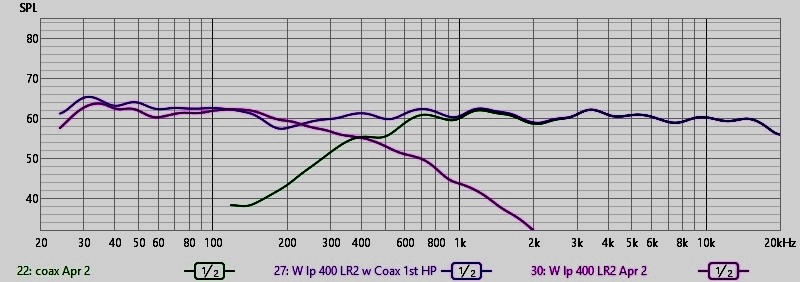
Additionally, running the coaxial with the modified Amp Camp Amp (thanks again Tom) by placing an active HP filter ~400Hz it saves the amp from producing/ amplifying ~45% of the low-end audio power signal just to be subsequently scrubbed off as heat with a post-amp passive filter, as the Pass Amp Camp Amp is an ~ 5W 4ohm / 9W 8ohms ‘beast’. The coaxial, on its open baffle, starts rolling due to baffle width and height, ~ 600 to 400ish Hz so adding an active 1storder HP at 400Hz (before the amp) seemed to make sense, netting something looking like a 2nd order HP. I just quickly set up a 2nd order LR LP at 400hz for the 1.5way woofer box to get some initial readings.
I had the beymas in the basement and wanted to play - ha.
It’s early on but the Heils sound really open and airy - probably the best high-end I’ve heard. The midrange, even with the Heils crossing down lowish, is then handled by the 8 in forward firing woofer. I’m a ‘midrange first’ fan, as my Audio Nirvanas were excellent in this extended mid-upper range. Although (with a little eq) the AN’s played through the 18+kHz the Heils play the very upper frequencies better - less stress sounding (if that makes any sense).
So I thought I’d give the beymas a go, and with a minimalist filter set-up. I’ve got a lot of listening and tweaking yet to do.
Actually, for *my applications, the 210HOs have worked out quite well through the midrange. By itself (i.e. without any tuning) it’s fairly well behaved out through ~1800+Hz, with breakup not really being seen until 3.5, 5.0 and 7.3kHz. With my Heils I cross ~ 850-900Hz (a full octave below any issues with the 210). I selected the 210’s not only biz of their low-end and small(er) box capabilities, but also for their somewhat unusual upper-mid extension, for a subwoofer. Many subs are worthless much above 300Hz.
*I’ve settled in on bi-amping and active LPass for the woofers. I find it (active) pliable and more precise (and possibly cheaper in the long-run – cost of big inductors) than passive… while it does reduce the portability of the speakers, of course. That being said, just because you can doesn’t mean you should… what I mean is ‘less is more’ and ‘do less harm’ when it comes to tunning (active or passive). One big shift I have made, when looking at implementing active and passive EQ filters, is to do so bring in the measured response after the crossover has been applied. I.e. in the example of working with the woofer, measure its response (in the box at 30in and/or at listening area), post (after) it’s low-pass filter. In my latest build with the open baffle mounted beyma coaxial crossing to my 1.5 way sealed woofer box (.5 way on back) I am using an active 2nd order LR lowpass at 400Hz on the 1.5way. So, when I bring this measured response into REW I set a targeted response with a 2nd order LT LPass and then equalize to this target (where the high frequencies have been rolled off by the target filter). What this does is to clearly show just how far down (dB) the cone breakup of the woofers actually are, post filter, and how much filtering is / may be actually necessary. Compare to what I initially did was to bring in the measured response (no low pass) and then EQ it with multiple ‘hammers’ to get it smooth (say out through 8-10kHz for a woofer), and then apply the LPass filter (which in the case of the 210s would be probably 3 or 4 overlapping tuning filters in the higher range). With my newly learned approach, EQing to a LPass curve (above target frequency) requires maybe 1 or perhaps 2 filters, and with much less attenuation to get to target- thinking less is more. Begs the question, how far from the crossover frequency (an octave, two, or ?) and at what point down dB do we need to be critical about ?
Anyway, I’ve found these 210’s to be very workable. Both crossing over to Heils (850-900ish Hz) and easily with my current build with crossover area of 400-500 Hz.
After a bit of tuning and listing, FWIW my objective / subjective comparisons between the ESS Heils as the top-end ~850-900Hz up, vs the beyma coaxials ~480Hz up, both set as dipole / open baffle designs atop of 1.5way dual 8in sealed woofer boxes.
Both the ESS Heils and the beyma coaxial provide the opportunity to avoid crossing in the 2-4kHz range, a big plus for me. As I probably have stated before, I conjecture the sensitivity of crossover issues in this range may have played a role in the old BBC dip preference designs (?). Without such need to attenuate this range for crossover issues, I’m finding very slight broad increases in the 1-3+kHz range support vocals, and vocal imaging (IMO).
Additionally noted, my build is a close-to-floor speaker with a slight tilt-up, aligning towards the listening location ear height. So, with the Heil design, the midrange radiates primarily from the slightly lower placed woofers. With the beymas the mids are concentric with the tweeter, and as such the mids (especially the vocals) feel / sound a bit more coherent. Gotta give the Heils kudos over their frequency range; seemingly effortless high-end and transparent. But overall I’m impressed with the beymas in this set-up (with the mid running w/o filter above the woofers, open from ~480Hz upward, with a simple 2ndorder LR on the tweeter, crossing – 4.5kHz), and leaning towards the beyma as my overall preference.
 ).
).