I really don’t disagree with anything he said.
I really don’t disagree with anything he said.
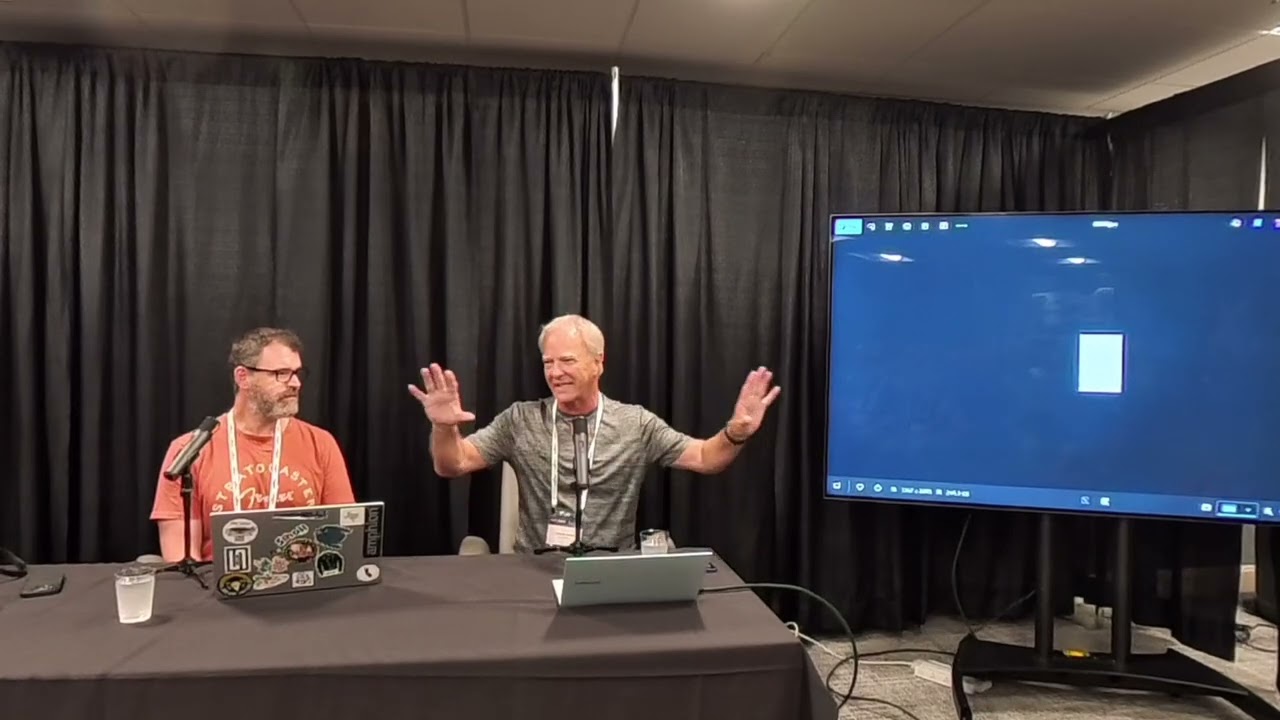
Interesting conversation. Too bad the audio quality was so poor. As a result, I had trouble understanding some sections. The two microphones up front sounded like they were simply connected to speakers located along the sides or back of the room, which added a boomy type echo to their voices before the sound reached the recording microphone. People in attendance who asked questions actually sounded much better than either Randy or Andrew because they were much closer to the recording mic.
Listening on my phone, that was not my experience.
It was distracting, if only because I deal with audio for video every day. I’m guessing whoever posted this (Stereophile…really?) shot it on their phone from the front row. They could have processed it to make it sound better. We use the Adobe Podcast app at work.
Andrew, in typical English gentleman fashion, is being nice,
He could have gone a lot further…
@tktran303 , I think I know what you are getting at, but not sure. Could you elaborate a little on this? Andrew mentions various issues associated with using commercial recordings to test and determine the preferred shape of the Harmon curve. He also indicated that there appear to be multiple Harmon curves, not just one. My takeaway was that he seemed to be both in agreement and disagreement with Floyd Tool at the same time.
Whilst measurements are important for the driver designer to the applications designer, (i.e. taking good (better) data and making (more) sense of it) the whole “music as the artist intended” or “perfect sound reproduction forever” is codswallop because of the circle of confusion, listening in rooms, individual ears, and differing tastes.
As a musician all I care about is if you’ll listen (and pay me a little/lot) , as a mastering engineer all I care about is that it sounds nice across all playback systems.
Reviewers who take the outputs of the Klippel Near Field Scanner and anechoic CTA2034A graphs as gospel don’t understand it’s limitations.
***
Listen with your ears, enjoy with your heart. In a maddening world, DIYers should focus on enjoying one’s hobby with others.
Bravo! Thanh.
Well stated - concise, clear & on the mark.

I rely on measurements to a certain point to help train my ears. I took a long break from speaker design while my kids were young. I had never used crossover design software two years ago. I had a basic understanding. Vituix Cad has helped me to gain a greater understanding of how passive crossovers work. However I still need to decide when to make concessions on my on axis magnitude response to consider the other things. And then determine how much weight to give these other things by listening.
I think that was the point. It is not just measurements, but your experience interpreting the measurements. You know what to do when you see certain things come up. But different folks like different things, so that is where someone like him can have some fun trying different arrangements. But he obviously feels the weight of his previous successes. The problem is you can’t just do the same thing twice… OK maybe you can twice, but three times? No, then folks start calling you a one trick pony.
I agree with Drew and me. I most often agree with me. Too often.
I watched most of it. The deviations of his measured loudspeaker are reality. I think that was over blown. Klippel does indeed have many limitations and glosses over most of them.I agree it is very easy to make measurements now, and if you get to careless be led astray by them. Here’s my own 2 cents. Chasing 1 or 2 db differences while measuring can be possible. Whilst in a real room, moving your head will generate that difference or even more. Happily under music conditions our ear/brain system id more than able to average it out and we get to enjoy our tunes. I started out in this when you needed a paper chart recorder and a sweep generator. THat we even have poorly designed loudspeakers any longer is out of choice. Not for lack of potential ability to engineer good ones. Lastly. Record stuff you know the sound of. Use your phone, record your loved one, your car door slamming, your kids, dog etc. And play them back on your system. You know these sounds intimately. They will instantly tell you if you have it “right”. There are so few recordings that are not engineered, it is sad. People have for the greater part been decoupled from what instruments actually sound like.
That is the reason I have issues with the whole “neutral” preference. Trumpets do not sound “neutral”, they sound “brassy”. Neutral tonal balance can sometimes reduce realistic dynamics.
Would that not be compression in the recording? Then relying on the speaker to boost the dynamics back up afterwards?
I don’t listen to a lot of music with the trumpet because my favorite instrument is the saxophone. Do you have 3 test tracks featuring the trumpet that you would recommend?
For trumpets and brass, and depending on your musical preferences, Rossini’s ‘William Tell’ overture or Sibelius’ “Finlandia” played by the Chicago Symphony Orchestra and almost any conductor could work for you. Fritz Reiner’s records on RCA from the late 1950s sound great.
To my ears, the CSO’s hall produces perhaps the best, most natural orchestral brass sound I’ve heard on record or CD. The London Symphony comes close to that level. I’m basing my opinion of ’natural’ on attending concerts by the Melbourne Symphony and Australian Youth Orchestras.
Miles’ Kind of Blue’ is beautifully recorded for trumpet and sax. Almost anything on the Blue Note jazz label would make a good test track(s) for brass, I suggest Lee Morgans “Sidewinder’. The trumpet sounds on those albums make an interesting comparison: Miles’ laid back tone contrasts with Lee Morgan’s much brighter sound. Neither should sound harsh.
However, these are just my preferences: I don’t like a brass sound which is too bright, although as Wolf says, trumpets - especially in a jazz band - do sound bright live. Old age!
Geoff
Honestly, I don’t know if that is compression in the recording or not. What I do know is how i listen for good trumpet sound when voicing. Usually, too much or ‘over the top’ sound is too much. Just below there is where I like it. I know these are arbitrary output levels, and hard to describe, but it’s how I do it.
What I’ve mainly used and listened intently with in the past are:
Doc Severinsen - Trumpet Spectacular, Telarc
– His trumpet in this recording seems to have some additional reverb added where it is less direct than average brass. It’s clean and balance is set just below where I find most trumpet lead men are recorded. If he sounds in front, the speaker will be bright on everything else.
Scorpions and Berliner Philharmoniker - Moment of Glory
– this recording to me sounds balanced the way I want orchestra to be. Trumpets are slightly out on top and brassy, and the trombones have the right weight. ‘Send Me an Angel’ is my favorite.
Wynton Marsalis - Classic Wynton
– Most of these are classics snd easy to recognize.
Seal - Soul
– this album has a very good orchestral section too.
Miles Davis - Kind of Blue is soft and fuzzy by comparison to the above, but his level is where it should be.
True; it has the softest trumpet sound in my collection; Miles’ other albums have a quite different sound, but Kind of Blue is one of my favourite sounding jazz records.
For a more typical ‘jazz trumpet sound’, Coltrane’s ‘Blue Train’ is well worth a listen or ten.
Geoff