Wow that’s a huge kick right in the danny ball sack. I wonder if danny boy will rebute.
Very interesting, well argued and based on science, thanks for linking; I’m sure that the man “with the charming Southern accent” will respond.
Therefore one has a much larger profit motive than the other
1 Like
Goes without saying.
I haven’t watched Danny’s review of the speaker in question. But I have watched his reviews and his raised issues with Maggies, and there is definitely opportunity for improvement. I’m an old fan of Maggies since my first main system. If I hadn’t gotten hooked into this hobby and/or they (the Maggies) had a bit more WAF I’d definitely heed his comments regarding crossover / overlapping issues… And, no I wouldn’t order his crossover - what fun would that be… but yes take the general issues he’s raised into account and measure and build as a DIYer.
To be fair, I have seen Danny improve quite a few popular commercial designs. Some are surprisingly bad. But he’s pairing fairly expensive parts (which helps his bottom line) with cheap drivers and many times unbraced cabinets.
2 Likes
Ascend Acoustics, we are pleased to offer you a 30-day money back guarantee*.
If for any reason during this 30-day trial period you are not completely satisfied with your purchase, you may return these items for a complete refund.
There’s a line from a film which PWRRYD put me onto: “you can’t polish a turd”.
Anything else aside, I don’t see the point in spending expensive parts with cheap drivers. I’ve watched many of Danny’s videos and sometimes the ‘upgrades’ seem to produce good results, at least, according to his methodology.
However, there must be issues where,for example, the new parts are hard to assemble and fit into the old cabinets, if only because the volume has changed.
The Sierra-2 speaker from Ascend is a notoriously difficult case. It’s a 2-way speaker that really wants to be a 3-way instead. The RAAL tweeter doesn’t like to cross over low, and rewards the slightest crossover point movement with narrow-bandwidth THD spikes, so the woofer’s response has to be extended up to mate with it. This means that the woofer - a big 6” in the case of the Ascend - has to operate like a wide-band driver, playing up into its breakup region. This is why the woofer was updated from the original Curv cone to the current design - to try to improve its upper range extension. That and possibly some uncontrolled surround/cone-edge resonance is why there is a dip in the woofer’s response, which becomes worse when the woofer’s corner gets moved lower, but it will never get ‘better’ because there isn’t enough energy from the tweeter to fill in the dip.
Normally with a two-way speaker, there is enough low-distortion overlap between the woofer’s and tweeter’s response that the crossover point can be shifted a little bit this way, a little bit that way, and that gives the flexibility to correct on-axis response issues and optimize dispersion. But the Ascend Sierra-2 does not have that flexibility, because both of its drivers are operating on the ragged edge. That is why I think this speaker is probably not ‘fixable’ in its other remaining foibles beyond making the on-axis response measure quite flat as Ascend has done.
Where Danny is stuck now is making the case that better crossover parts can improve a speaker to an extent that justifies the price of his upgrade kit, in ways that don’t show up in the ASR measurements, because the optimal filter design is probably the one that Ascend is already using, and only certain crossover parts can be targeted for improvement. ASR is doubling down on its existing methods (even though they already don’t reveal the differences between crossover parts, and CEA-2034 is structured to make any speaker that isn’t a Harman speaker measure poorly), and Danny will likely double down on his own methods. I don’t think that the amount of smoothing used in GR’s crossover measurements is a key point here except that ASR never misses an opportunity to poke Danny in the eye; smoothing can serve a legitimate purpose to reduce distracting artifacts in the frequency response so the overall tonality can be seen, and it can reduce the number of questions asked by novices watching his videos, but most guidelines I have read for speaker measurements require 40ppd or greater frequency resolution (1/12 octave or better).
I interpret this as just the latest chapter in a long grudge between Dave Fabrikant and Danny Richie, one in which ASR is only too happy to play a supporting role because it toots their horn.
4 Likes
A few years ago I contacted Dennis Murphy to ask him about that RAAL 64-10X. I had a line on some at a very reasonable price. I wanted to use it in a 2-way with a 6.5’’ woofer. Dennis said absolutely not unless the woofer can exceed 3k-3.5k. N.N. RAAL Ribbons - Model 64-10.
1 Like
He’s back …… https://www.youtube.com/watch?v=3fWD6VcWJjc
1 Like
An hour and twenty for that? Nah. Does he admit he’s also behind the expansion of March Madness to 76 teams? That wasn’t broke either.
2 Likes
He definitely feels he and his business has been slandered, not just differing of opinions.
Can’t blame his response (EDIT ok, maybe a little). Discovery of posted texts and emails could be very interesting, if not rewarding…
I’m guessing his business isn’t exactly booming or he would have that new listening room finished by now. It’s been just studs and foam panels for months. He has to defend the products & services he peddles, but when he resorts to the childish name-calling, he’s lost credibility in my eyes. We all knew kids like that in school - and almost felt sorry for them.
2 Likes
So my workouts last as long as his rebuttal video, so I decided to watch it. I’m around 50-55min in and he decided to use Google AI to prove he’s right about the electrical phase. So he starts quoting the AI responses, some of which come from ASR. He clearly does not comprehend that the AI is not differentiating between electrical phase and acoustic phase, and the AI is providing issues with acoustic phase when he’s talking about electrical phase.
2 Likes
Yeah, I noticed this too.
I will also say that:
A linear impedance really is not a requirement on a solid state amp, but a minorly varying Z phase is preferred without low impedance in tow.
Tube connectors are stupid and overpriced.
His XLS kit has untamed woofer breakup.
1 Like
I wouldn’t be building passive speakers without Danny’s videos peaking my curiosity. So I give him a lot of credit for that. I think that’s the main thing he’s trying to do with his videos…increase hifi participation, especially DIY. Also, I do believe he could ABx and hear differences that the ASR people would not want to admit.
But, his talking points never change. There are clear gaps in his design philosophy that he refuses to update for some reason.
I’m not sure why he doesn’t believe in directivity. I think this is why he’s always telling people to treat their rooms…speakers built his way will sound bright. Dome tweeters (without a waveguide) + woofer crossed over low always show the same thing in my simulations. I sent him an email after my build with his drivers won the under $300 category and his response was basically, “good job, you should have crossed it over lower”
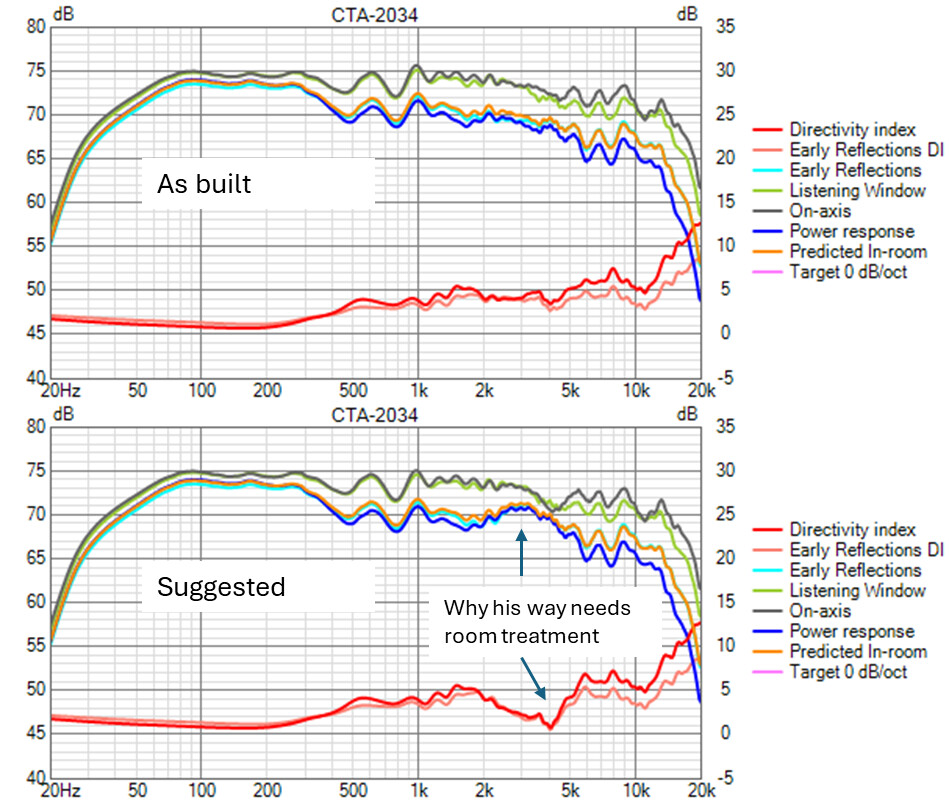
He should have used AI to investigate what happens to his measured samples after gating…
1 Like
I like the first set of graphs, nice even smooth taper from 1k to 10khz. the second looks wonky (just the on axis also looks better). If the second graph was all i had, i would change the driver or something, plenty of drivers that mate well, don’t have to stretch pull anything, unless it’s for INDY theme build!!!
1 Like
An update - Amir counter’s Danny’s opinions on impedance/amp interactions. It’s also an interesting mini-dive into prompting AI.