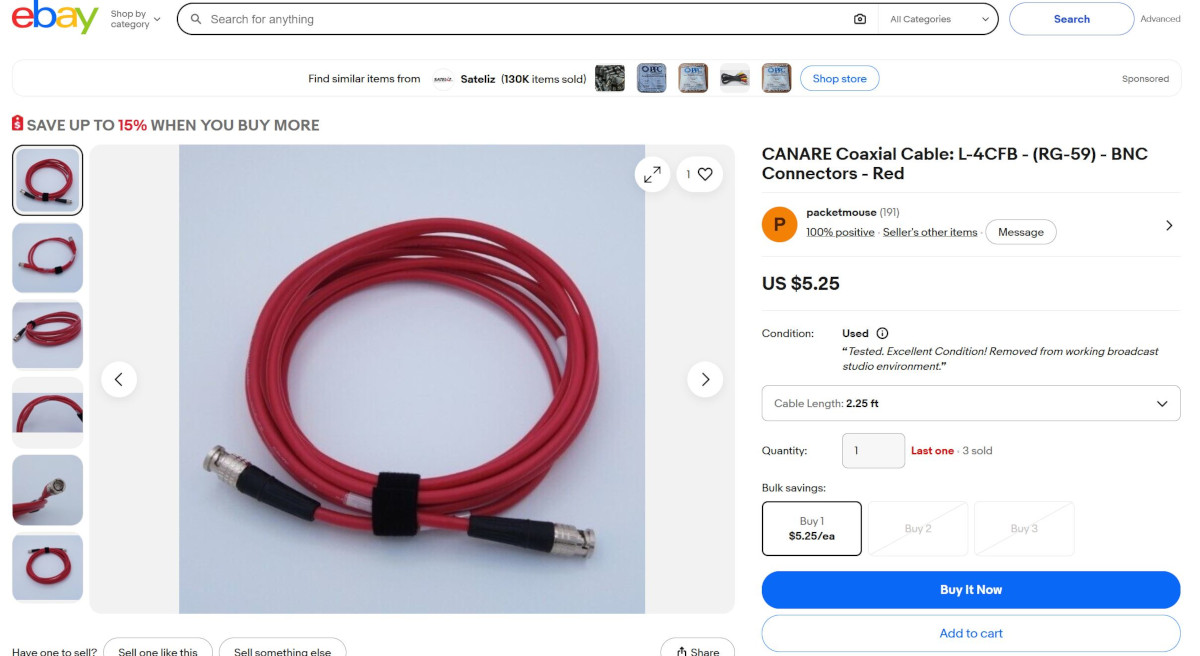
The idea here is to discuss best practices for connecting a high end digital preamp or CD/DVD player to a digital, DSP based loudspeaker system. What type of cables to use and why? What is the difference between a mono analog RCA unbalanced cable and a digital 75 ohm RCA S/PDIF cable (they look basically the same from the outside)? What is the difference between a digital AES/EBU XLR cable and a balanced analog XLR microphone cable (they look basically the same from the outside)?
Try to keep the discussion in this thread based on ohm’s law and avoid drifting over into snake oil type topics relating to things like cable risers, etc. Thanks.
There are many different ways to go about making these connections, so I will start things off with a list, together with reasons as to why you would want to choose one method over the other. Remember, I am fairly new at the digital game, so my analysis may be incomplete (or in error). It is based on my recent research into setting up a digital DSP based loudspeaker system using the new Hypex FA123 plate amps.
-
CD player/preamp unbalanced analog RCA outputs to Hypex DSP unbalanced analog inputs. For this you would need two fairly long (15 to 25ft or so) RCA cables for the right and left channels. This should work OK as long as the analog output impedance of the CD/DVD player (or preamp) is fairly low. For instance, a tube type preamp or CD/DVD player with high output impedance might create a high frequency roll off problem. Another disadvantage is that this adds an additional A/D and D/A conversion stage.
-
CD player/preamp balanced analog XLR outputs to Hypex DSP balanced XLR inputs. For this you would need two fairly long (15 to 25ft or so) analog XLR microphone cables for the right and left channels. This should work OK as long as the analog output impedance of the CD/DVD player (or preamp) is fairly low. An advantage of XLR over RCA, however, is that they are balanced and therefore have a much lower noise pickup for long runs. They also have lower capacitance per foot. So high frequency roll off, when using a tube preamp, is less of a issue. But analog XLR, just like analog RCA, adds an additional A/D and D/A conversion stage.
-
CD player/preamp digital 75 ohm S/PDIF outputs to Hypex FA-123 S/PDIF inputs. For this you would need a single, fairly long (15 to 25ft or so) digital 75 ohm S/PDIF cable. About $20 each on Amazon (order placed). My CD player has one S/PDIF digital RCA output, so I will report back my findings when I get my new cables. From what I have read, you should not use a standard unbalanced RCA audio cable for a digital S/PDIF connection. The 75 ohm characteristic impedance of the cable is needed to reduce RF reflective cancellation and insure maximum signal transfer. Another advantage of S/PDIF over analog RCA or analog balanced XLR is that a direct digital connection from source to DSP eliminates one D/A and A/D conversion stage.
-
AES/EDU digital in/out. Cable looks the same as balanced analog XLR, but the characteristic impedance is 110 ohms instead of 75 ohms. Signal transfer is digital, not analog. I will not be experimenting with this type of cable, because my CD player does not have AES digital outputs. JR’s Oppo BDP-95 also lacks AES digital outputs.
-
Optical toslink digital in/out. Still researching this method.
-
HDMI digital in/out. The Oppo has these outputs, but my CD player does not. I will not be researching this method.
Right now, I am leaning toward one S/PDIF RCA digital connection. I ordered three 15 ft. long S/PDIF RCA cables. One cable will run from my CD player’s S/PDIF output to one Hypex FA123’s S/PDIF input. Another 15 ft S/PDIF RCA digital cable will run from this Hypex FA123’s S/PDIF output to the other Hypex FA123’s S/PDIF input. This digital connection between the two Hypex amps is needed to not only transfer the digital audio signal, but also to transfer the remote control signal commands from one Hypex amp to the other. The 3rd 15 ft cable will only be used if I can’t get the digital S/PDIF connections to work properly and therefore need to fall back to a dual analog RCA type connection for the right and left channels.