If you want something done right, do it yourself . . . 
passive parts have gone up. but so have many drivers. what are the factors for this?
I believe audio is niche market and lower economies of scale due to smaller production runs.
audio is simply not what the companies are making these days. Philips stopped making CD players and CDM drive mechanisms ~2000s. Sony moved to CD drive based gaming in 1994 with the Playstation, and 20 years later it’s revenue overtook its entire home entertainment division. Gaming, in fact, overtook Hollywood AND the music industry about a decade ago.
1 Like
High end audio has always been a niche market here, but judging by the number of specialist stores it’s now even more niche compared to 20 or even 10 years ago.
The declining $A and increases in shipping - especially from the US and Europe - seem to be a major factor in increasing parts cost. Driver prices have more than doubled for some brands such as US sourced Dayton Audio, while others like SB Acoustics (Indonesia) and Peerless (China) have only increased slightly over the past five years or so.
The highest XO parts prices I’ve seen here were $800 for a 8.2 microfarad cap and $55 for a resistor, but the cost for good quality XO parts hasn’t gone up so much, maybe 20% in the seven or so years I’ve been in the hobby.
Very few people I know under 50 have a ‘hi-fi’ system, rather, they have low fi TV sound bar systems and Play Stations etc. When we bought a new car four years ago, I asked if it came with a CD player and the salesman looked at me like I was from Mars. Likewise when I tell people I make my own speakers!
Geoff
3 Likes
I was in app. 2007, and been away since 2011 or so. Thus the shock lol.
Cheers / Robert
Hi all, just a question about Jule Fidelity.
I messaged the company and inquired if they could fabricate a 0.55mh 18awg inductor for me and got no reply. Not a big deal. So I tried to order some components and PayPal says that JF doesn’t ship to Tennessee, even though the JF cart calculated a shipping cost for me. Has anyone else had this issue? I’m wondering if the company is still in the process of moving and if they just need more time to resume shipping. Thanks!
It is run by Brad @Hifiside, and not sure that he has other employees. I believe he also has a day job at the moment so he may not be able to answer immediately. But I’m sure he will do everything he can to get ya figured out.
1 Like
To me high end audio has always been about transducers upsold in fancy cabinets.
100 years ago this was state of the art:
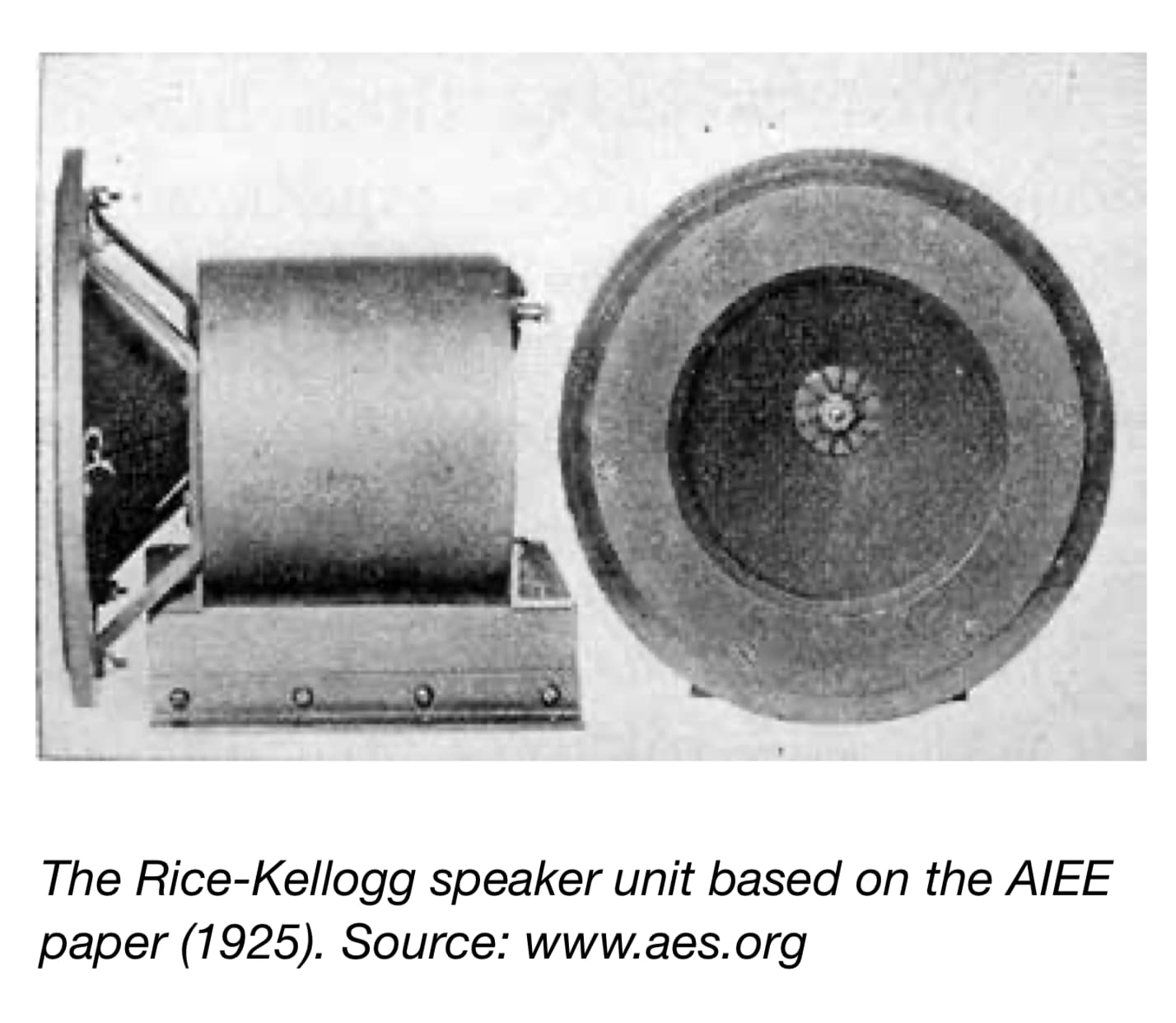
Rice and Kellogg were engineers at General Electric. And yes, Made in USA.
Over time, as General Electric, Telefunken, RCA, Philips moved onto other products, like television, video, computing, integrated circuits and other high-tech (for their time), record lovers stayed behind. Those to loved to listen, talk about and write about music and the favorite artists and bands got organized. Stereophile was founded in 1962, The Absolute Sound was founded in 1973 by Harry Pearson, who termed “high-end audio” , and the industry worked hand in hand with the cottage industry of smaller volume, boutique manufacturers sprouting up. When David Wilson left The Absolute Sound, he used KEF’s B139 woofers, satellites from Braun (the German electronics company) and equalizers from Crown International in his first product the WAMM. In 1981 this had an retail price of US$35,000. It was more expensive than anything else at the time (Arnie Nudell’s Infinity Reference System (IRS)- was $29K, and Mark Levinson’s HQD- was $24K.
It was a LOT of speaker, but also a LOT of MONEY for a speaker→ equivalent to US $130,000 in 2025. It was marketed well in New York, home of Stereophile and The Absolute Sound, and started the arms race for the most spectacular speaker to adorn the mansions, ballrooms and estates of the wealthiest people in America, the richest country in the world.
Today we have speakers at 10 times the price.
Who buys the million dollar speaker? Well, the billionaires, of course. Back then there were only a few. When Forbes started in 1987 it identified only 140 in the entire world. Today there are more than 3,000 billionaires, most of them from USA, China and India.
And time, diffusion of technology meant that transducer could be Made in England, Germany, France, Norway, Denmark etc.
In 2025 it’s a commodity item made in all countries of the world including India, Taiwan, China, Philippines, Indonesia, Vietnam etc. And people in mother Russia and countries in eastern Europe can all manufacture them now.
Where are all the high-end made today? Well, the majority of bespoke, low volume custom cabinets made for kitchen/bathroom/bedrooms today. Today AU $5,000 ( i.e. US $3,000) buys a single Australian-made bathroom vanity in real lumber. This excludes anything fancy with aluminum, stainless steel, carbon fiber or complex shelving (bracing).
From BMW to B&W Loudspeakers to Scan-Speak to SB Acoustics, the majority (85-90%) of production is sold to export markets, where they can fetch much higher prices. Is it any wonder that a high-end loudspeaker Made in USA, Canada, Australia, England, Denmark etc costs 5 figures by the time it’s exported internationally and sold into retail markets…
If you want to buy local- you need to spend about US$20K to buy a product with locally made cabinets:
Meanwhile, plebs like us in USA or AUS or CAN get it cheaper if we buy things from “Jhina”
The price for low volume production drivers, caps, inductors and power resistors have also gone up too.
It’s like buying an analogue wrist watch when the world has moved past digital wristwatches and already have computers in their pocket (smartphone)
1 Like