I’ve never owned the ScanSpeak 21w 8555-10s, but very temped (before they’re gone). Low fs and looks to extends nicely for a two-way. I really like the MarkAudio’s as a midrange, but not as a bass/mid - nothing to speak of for bass.
Thinking there is something to be said for non-plastic non-metal cones for midrange clarity.
I would look closely at Wavecor WF223BD01/02, the Wavecor balanced drive motors are really stellar through the bass range. There’s Satori WO24P as well if you want to go a bit bigger.
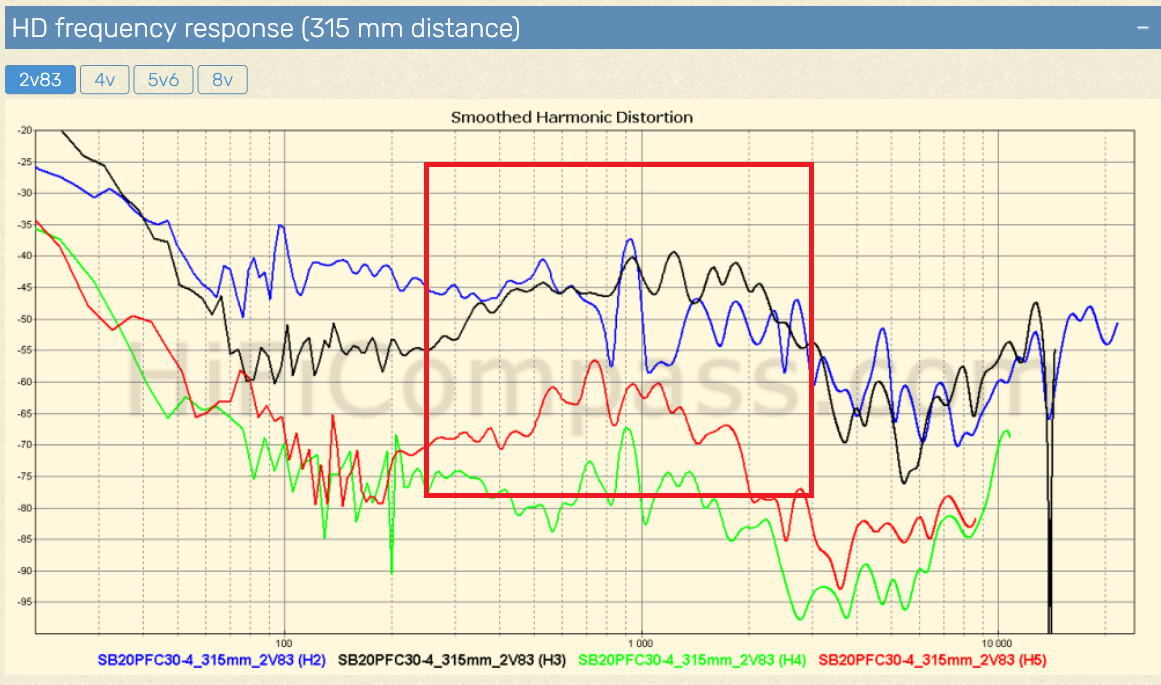
I don’t have a use for it at present, but the SB Acoustics SB20pfc series looks like great value: it’s cheaper here - A$60 - than from Madisound. It looks like the cheapest good quality 8” driver available. ‘Papyrus’ cone.
Only thing I’m not sure about is the distortion profile, although it’s been used by Troels Gravesen and SB Acoustics themselves in 3 way kits, which must say something.
I haven’t been particularly impressed with the bass from sb non metal woofers. Though my sample size may not be the greatest. Just has a wierd sound to it. Sort of a soft fatness, not sure how else to describe it.
Thx for posting this chart. I’m considering a few two-way designs and the distortion rise though-out a broad Xover / mid+ range would be problematic. For me it’s first about getting an extended midrange response clean.
The chart was from Hi Fi Compass so I’m assuming it’s accurate.
There are several 8” two way designs on this Forum - the latest of course being JR’s Cabrini - and ‘out there’, it must be hard to narrow down the options. Budget, room size, cabinet size/WAF, desired F3 etc etc.
One limiting factor is that some of the tweeters I’ve seen in various projects, such as the Dayton RS28 series and Peerless DA25s are NLA, although the designers have sometimes re-done them for a different tweeter, as Wolf did with his Zingers. Here’s a couple, fyi:
No idea how the first one would sound, the tweeters are very expensive (not exactly ‘humble’) and the XO looks very complex, but it might give you some ideas.
Have you thought about doing a WAW, for example, I recall Dan N winning the under $200 speaker design competition with a budget Vifa TC7/RS225 tower some time ago. DIY Audio Forum has an extended discussion on an RS225/Scan Speak or Vifa TC9 project, although you’d spend more on the XO than the drivers.
re WAW I’d probably go with a MarkAudio, but I’m currently hooked on the ESS Heils (good with a 3rd order HP 850~900ish range).
Currently have the Heils paired with a couple of 8in RSS210HOs (8ohms) in a 1.5 way sealed enclosure (the .5 w back mounted comes in ~62Hz, rolls down 3dB ~125Hz to be full on to match with ~where a single woofer in a sealed would be down 3dB, i.e. ~60Hz). Quite happy. Tons of headroom for a large room, but ‘wondering’ how a (KISS) simple single woofer (i.e. the Wavecor WF223BD01 really looks interesting) in a quasi aperiodic terminated / short TL line would sound???
My previous build was with a single RSS210HO (4ohm) heavily stuffed aperiodic and with gentle EQ which also easily fills the room, but not sure about a single Wavecor with its lower Xmax. Trade-off of possibly a cleaner upper midrange transition (paper based vs metal cone) with low-end headroom.
Now you’ve gone and done it…. I didn’t realize these were paper cones, and since I’d eq the woofer LP with a targeted 1st order curve (~600Hz) the slight (2dB) cut around 750ish and rise thereafter should be of little net issue. +/- 9 for the Xmax should fit the bill.
For an aperiodic loaded short transmission line enclosure using the Scan-Speak Revelator 22W/4851T00, a suitable estimated internal volume (Vb) is around 40 liters, based on comparable designs and alignments for this driver’s parameters (low Qts of 0.22 favoring vented or damped line configurations for balanced response). This volume allows for a compact folded line (approximately 1-1.5 meters effective length) with heavy stuffing or resistive venting at the terminus to achieve aperiodic damping, minimizing resonances while maintaining good extension.
The estimated -3dB frequency is approximately 29 Hz. This assumes moderate damping to smooth the impedance and provide a gentle rolloff similar to a tuned vented system but with the TL’s characteristic augmentation for cleaner transients and slightly deeper reach in practice.