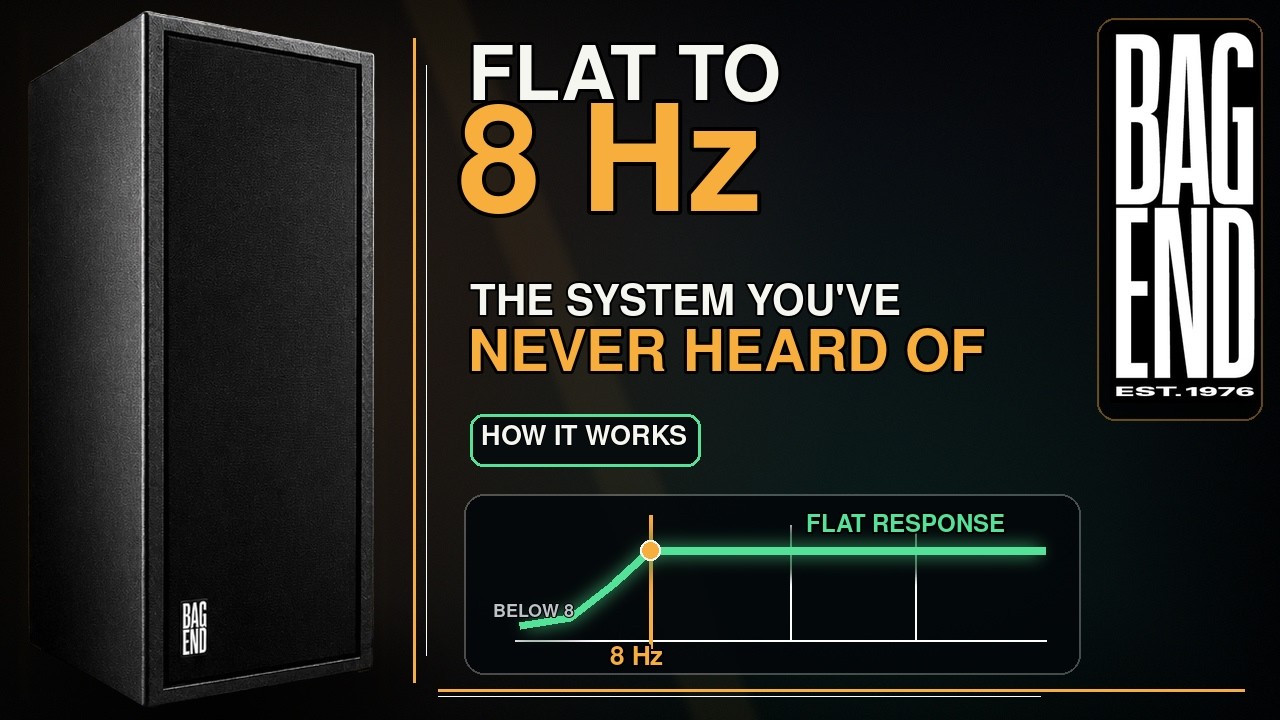
How Bag End InfraSub Reaches 8 Hz, and Why It Matters

This is somewhat old news, and it is a very specific way of equalizing a sealed box subwoofer, but it’s easy to do (and I am glad to see Bag End enjoying some renewed interest). The video is barely competent and uses lots of ridiculous AI imagery. Yes, this is a subwoofer design that relies upon equalization to produce deep bass output, but it is a tailored strategy of equalization that is specific to operating a sealed enclosure below its resonance frequency.

Instead of low Fs drivers, you want higher-FS drivers with lower mass, but still long excursion, which makes PA-style drivers ideal. Instead of the Fc being the lowest frequency the system will operate at, you choose Fc to be the highest frequency; in the case of the Bag End systems it’s around 75-80 Hz. Then you set a 2nd-order LPF to the frequency where you want the LF cutoff to occur, say around 20 Hz. (The ELF Dual Integrator is effectively this.) Then you apply gain, gain, gain until the system response comes up to the level you need. Last, you apply a sonically transparent limiter (which is admittedly easier said than done) to keep your amp from clipping, or the driver from being overdriven at the lowest operating frequency, because that is where maximal amp output occurs.

The reason it works is because a sealed enclosure rolls off at a predictable 12dB/octave below the sealed Fc regardless of the box size. So if you apply a LPF with inverse 12dB/octave slope with its corner set at a low frequency, then between the LPF’s Fc and the sealed box’s Fc you have effectively a flat acoustic response. Below the LPF Fc, the 12dB/octave roll-off takes over again, and above the sealed box Fc, the LPF’s 12dB/octave roll-off will control the response.

I bought a used 10" Bag End ELF sub to experiment with, and using a Behringer NU1000DSP (now NX1000D) amplifier with DSP I was able to apply a 20 Hz HPF, then use additional filtering to integrate the sub with the main speakers. I can say that it works, and it produces bass of good quality, although the demands on the amplifier are severe and a high-powered Class-D amp is probably best suited to it without becoming large, heavy, and expensive. Also while the excursion demands are not greater than any other sealed box system, the power handling required from the speaker can also be extreme, so I don’t think this technology is as viable for live sound where you’re already operating drivers near their thermal limits. The ideal place for it is the living room, the home theater, or the studio.

Bag End’s claim of 8 Hz has caveats. This might be true at very low output levels (maybe practical in a small closed listening room with multiple subs), but as the input increases beyond the system limiter’s threshold, the limiter holds the maximum power at those low frequencies steady while allowing power at upper frequencies to increase, so the effective F3 of the system rises for larger signal inputs. The motor is being driven very hard for small excursions being produced, so care needs to be taken in its design to reduce flux modulation, preferably through saturating the steel. PA drivers also commonly use large magnets so this shouldn’t be as much of an issue for them, but cheap drivers may exhibit more motor-related harmonic distortion and IMD.

2 Likes

… or you could just Cult Of The Infinitely Baffled

1 Like

Here is the patent for the Bag End INFRA sub. They do just as AcousticTheory mentioned. The driver is operated completely below resonance. It’s probably a very low Qts driver with high power handling. The “dual integrator” applies a 12 dB per octave boost below some frequency (e.g. below Fb) and a lamp-based limiter keeps this in check at low frequencies. This requires a lot of drive voltage, but the input power depends on the exact load that the driver presents. When the Q is very low the impedance peak is very broad and even far below Fb the impedance is higher than Re by several times, and this keeps the current demand low. Also for class-D amps, the driver is inductive below the impedance peak. This means that it pushes current back to the amplifier and its PS (Keele publishes a paper on this) and that can improve the efficiency of the system. But you still need high rail voltages in the amp to make it work.

BAG-END WIKERSHAM LABS US Patent 4481662.pdf (458.3 KB)

1 Like