Hypex FA123: Going down the FIR filter rabbit hole

I won two Hypex FA123 plate amps at the SDC this year, so I decided to take the plunge into DSP and FIR filtering. There is quite a bit of documentation on the web as to how to go about implementing FIR filters on a DSP type DIY speaker buildling project, but it is very sporadic and difficult to follow. So I decided to start my own thread on this topic, using the thread as a learning tool to carefully document my adventure. I’ll be asking many newbie type technical setup questions as I go along, so feel free to step in and correct me from time to time as I am sure that I will be
making many mistakes. This will be a 3 way digital DSP project using the new Hypex FA123.

Projected Workflow (based on my study so far):

  1. Take in box Spin SPL and IMP measurements using dual channel mic and DATS V2.
  2. Develop crossover in VituixCAD using digital Biquads instead of passive parts.
  3. Export the three crossover filter sections as TXT impulse files.
  4. Import the three TXT impulse file xover filters (T, mid, Woof) to Hypex HFD software.
  5. Connect Hypex HFD software to the plate amp via usb cable.
  6. Export the three filter sections to Hypex Preset 1.
  7. Import the same 3 TXT impulse file xover filters to the rePhase software package.
  8. Pound the phase squigglies flat in rePhase.
  9. Export the three phase corrected TXT impulse file xover filter sections.
  10. Import the three phase corrected TXT impulse files to Hypex HFD software.
  11. Connect Hypex HFD software to the plate amp via usb cable.
  12. Export the three filter sections to Hypex Preset 2.
  13. Hook Hypex plate amps to my preamp and play some music.
  14. As the music plays, flip back and forth between preset 1 and 2 using Hypex IR remote (don’t have the remote package yet, but will be picking it up soon).
  15. See if I can hear a difference between the IIR and FIR filter presets.

Please note that I will be using the latest Hypex Filter Design (HFD) program verion 5.24. My Hypex FA123 fusion amp came loaded with firmware bundle FA32 v5.7 and reports in the software as a DSP3-213 (fusion amp). It is important to note these numbers because some of the earlier versions of the Hypex amps can only handle IIR Biquad type filters, not FIR filters. Also, the latest versions cannot natively create FIR filters. So I will need to process the filter files with the RePhase software program to create the FIR files. Should be a fun project!
1 Like

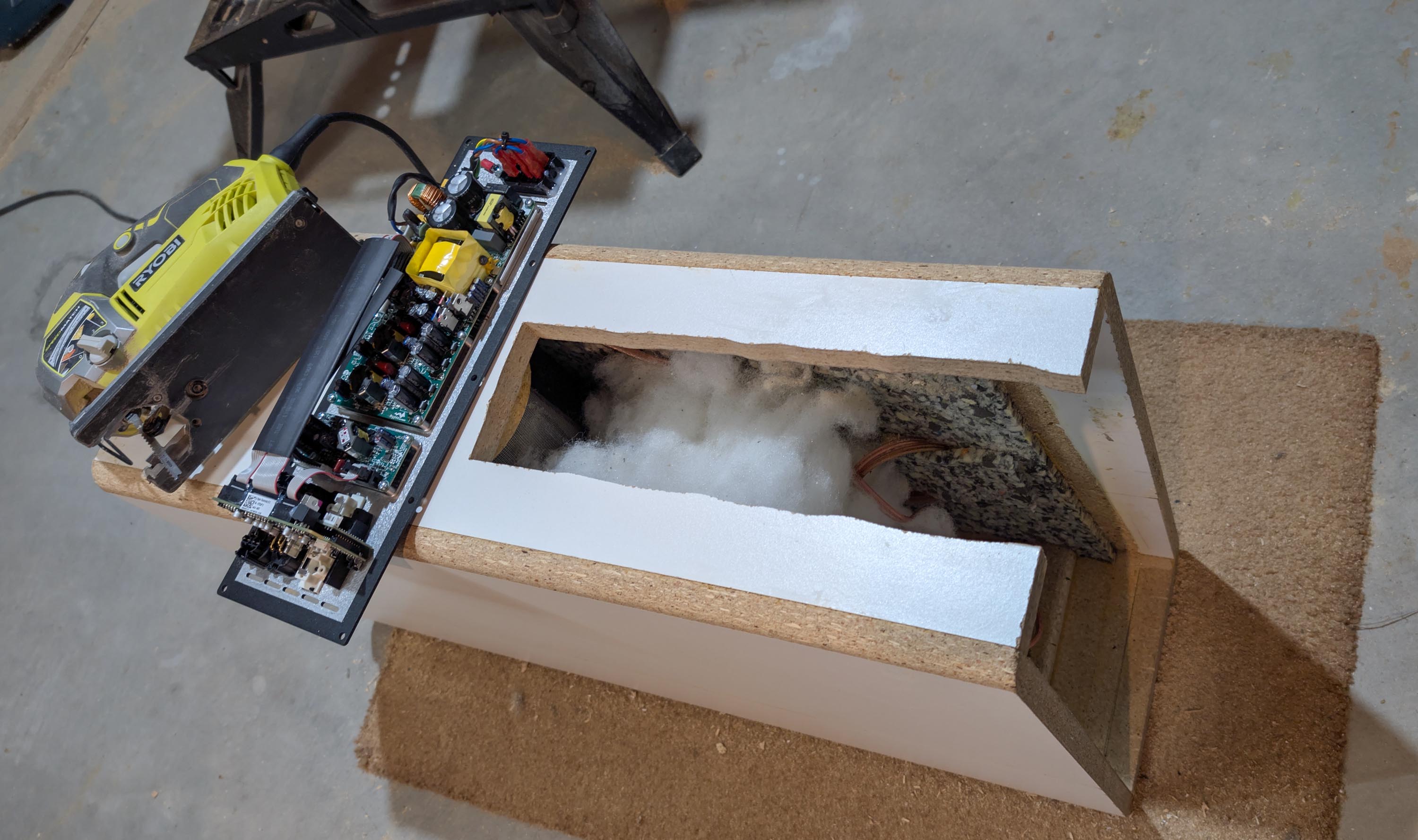
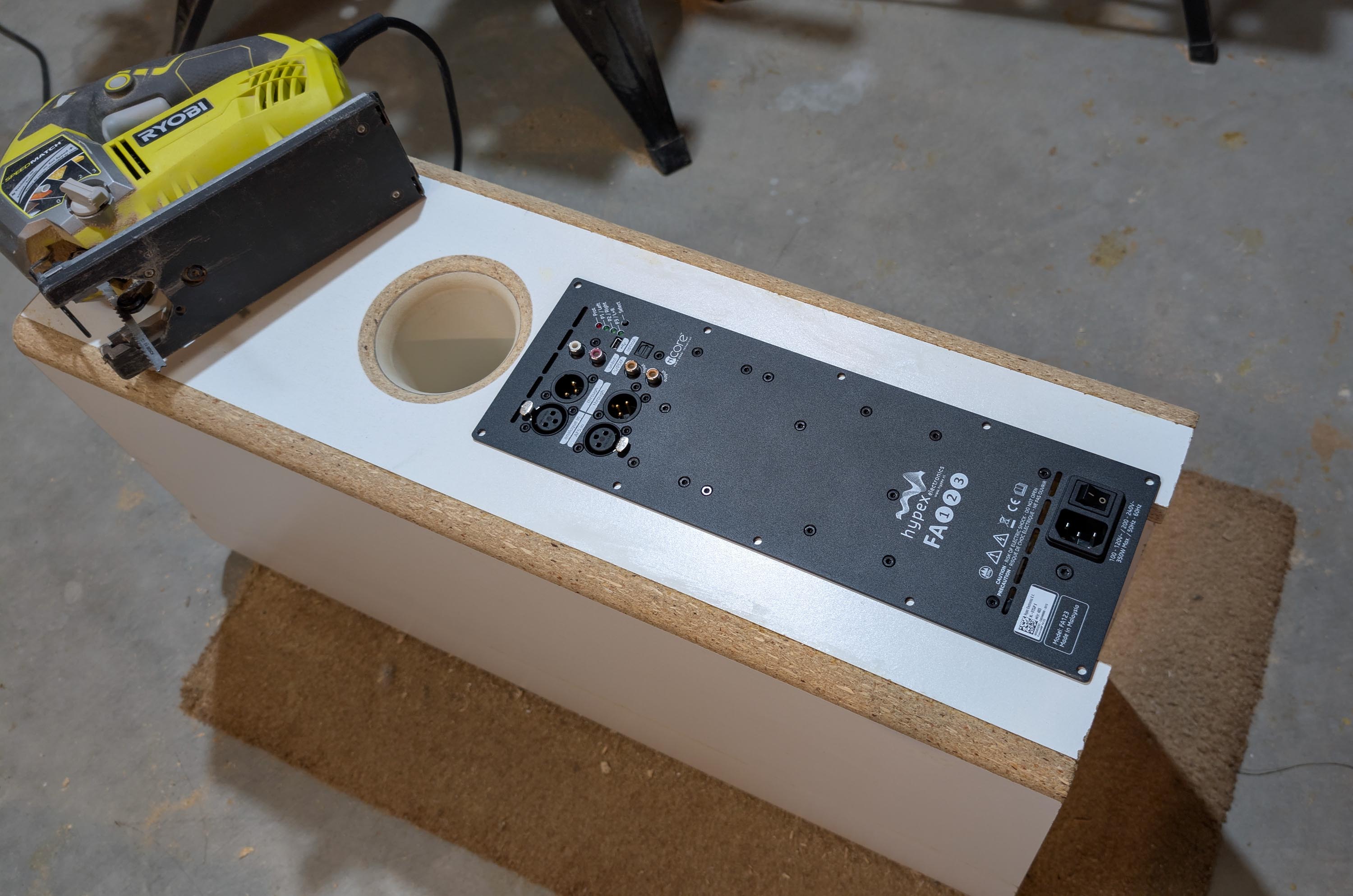
To mount the amps, I cut a long 14" slot on the rear with my jig saw. They just barely fit between the floor and bass reflex port.


5 Likes

You won a $1000 worth of plate amps… Wow! You better not screw this up LOL

1 Like

Yeah, so jelly!! Rock them​:sign_of_the_horns:t3:

I’m also starting an active project. Unfortunately I’m not sure if what I’m using will allow FIR.

Wow - those are some serious amps, Bill!!

I’ve been playing around with DSP a bit too. Unfortunately the plain version of SigmaStudio won’t import Biquads. I had to manually enter parametric filters that REW gave me. It sounded really good! SigmaStudio+ will import Biquads, but it’s quite different & I haven’t had time to figure out how get it to connect yet.

As much time, effort, attention to detail and documentation you put into your projects, it was bound to pay-off handsomely at some point - you earned those amps, Mr. 4thtry.

Hats’-off to you.

4 Likes

Select the “Filters” - “Second Order” - “Double Precision” - “No Slew” -“General EQ (2nd Order)” filter control. Then select the “IIR Coefficient” filter option in the control. I used a 6 dB shelf in VCAD which doesn’t exist in SigmaStudio. I used this control in SigmaStudio, copied the biquad coefficients from VCAD and loaded them into the SigmaStudio control. Voila!

PS - Before copying the biquad coefficients from VCAD select the “Generic” DSP System and set the SigmaStudio sampling rate in VCAD options page.

Thanks Ed! Since I’m using REW Auto EQ, it could be a simple formatting issue. I was selecting SigmaStudio to export. I may have to bite the bullet and start learning VCAD. I’ll mess with this a bit more later this week or over the weekend.

Thanks for the tips, reet! I changed my DSP system setting to “Hypex FA 192k”. So then, basically, my new, improved workflow would be to use the filter block space called “Phase EQ” to pound the phase and group delay squiggles flat, either manually or by using the optimizer. And I would use a parametric EQ filter block to pound the SPL squiggles flat, either manually or by using the optimizer. The “Lin phase” check boxes would only be used when optimizing the “Phase EQ” blocks. Would this be correct? Or am I way off course?

The Hypex FA123 has ventilation slots at the top and bottom of the plate, so you need to make a subenclosure to seal it off. I made mine out of some scrap 1/4" plywood and 1/4" chalkboard that I had laying around. I doubled it up with Titebond II for a 1/2" thickness all around. ID measurements of 14.25"H x 5.25"W x 2.4"D.

2 Likes

The Hypex vent slots are very small, so I added several new vent slots along the edges and bottom to keep things cool.


7 Likes

Nice! Great thinking on ventilation.

From an engineering standpoint, the plate amplifier appears designed for natural convective cooling, drawing cool air through the bottom vents and exhausting heat through the top. This thermal loop creates a chimney effect, where airflow velocity increases dynamically with heat generation. Introducing larger volume ports could disrupt this convective loop and cause internal heat stagnation. While the designer likely optimized this setup, any necessary ventilation would typically be specified in the installation instructions. Therefore, adding unprescribed vents may inadvertently compromise thermal performance.

Interesting. When I get the speaker finished, I"ll set up an A/B test to see which format runs cooler inside. Run the amp for 1 hour with my extra vents wide open and a temperature probe taped somewhere inside to monitor the temperature. Then plug the extra vents and run the test again.

2 Likes

And another lucky contestant won a prize in the drawing that was valued much higher than this!! Unbelievable!! Paid my cost for gas, hotel, meals, etc., and then some. You should consider attending next year, Craig. With only 60 or so contestants, the odds of walking away with a very nice prize is about 1 in 30!

Then again, you might end up with a subwoofer you nor anyone else wants.

Ya, I saw that. Bummer.

I like the DIYIowa vibe the most.

2 Likes

Usually a 100$ prize ends up costing me 500$, imagine getting a 1000$ prize…!

2 Likes