Multiple Entry Horn - thoughts?

Curious what others think of the Multiple Entry Horn (MEH) designs.

  1. What designs have you listened to and liked?
  2. Is there a good build thread that doesn’t use $1000 compression drivers and is known to sound good?

Recent Design Seeking:

I’d been contemplating building a cardioid Gradient 1.4 clone for awhile, working through how to CNC the top ball out of wood, but just had not committed to a coaxial driver. Yesterday I noticed Multiple Entry Horn designs, probably seen them before but during vacation I’d listened to some large Klipsch horns and was probably more susceptible to pay attention. Still need to read Scott Hinson and Bill Waslo papers but people seem to like MEH attributes.

Caveats and Considerations:

  • I don’t have a dedicated listening room. The office is 11 x 13, there is other stuff in it, and the speakers are on the long wall because of where doors and windows are.
  • I liked the Gradient design because it is supposed to be room friendly. Some like Chris A seem to think MEH designs are nearfield friendly.
  • I plan to use a Eminence Definimax 4012ULF 8 for low bass and speaker stand.
  • I know it is harder but I’d like to stay passive for the crossover. I could pull the DSPs out of the home theater setup when I finally redesign it to remove the tweeter noise floor hiss, but I don’t want any more hardware with windows requirements to configure.

I got to hear a pair of Scott Hinson’s MEH. I’ll caveat this by saying the owner used room correction DSP in his preamp, and had quad 18’s for bass so the MEH were highpassed at 80hz

They were very crisp, detailed, lively and dynamic. I was mostly off to the side so I can’t say much on imaging, but the system was certainly fun to listen to. The one criticism I’d have is that the vocals were rather recessed which sort of killed the one song I played which I was most familiar with. Though this very well could be the effect of the room correction EQ applied and not a fault of the speakers. But I can’t say for certain.

I’ve heard 3 pair now; the same Hinson pair as I was there as well, JohnH small 3way, and a huge pair Bill Waslo did several years back.

Honestly, I see the directivity reason, as it does that part very well. However, I do not feel the midrange/vocals have the clarity I listen for.

I’ve only heard Hollander’s, and only briefly, but I remember them having a holographic quality that I really liked. Scott’s white paper reveals some interesting reasons why they might be legitimately superior to other speaker types, so I’m very curious, but would need to hear more to make any real conclusions.

Curious of the 3 do you remember any being better than the others?

What have you found that does match the clarity you listen for?

Related notes

  • JohnH drivers are much cheaper than what Hinson used based on the write-ups I’ve found.
  • re-reading Newell Holland Loudspeakers from 2007 apparently there is significant variability in quality because compression drivers are harder to manufacture. “good compression drivers are not cheap to manufacture, because they require precision, low tolerance engineering. It is therefore futile judging compression drivers in general by listening to cheap examples.” … apparently some diaphragms are made by vapor deposition, the same process used to dope substrates for integrated circuits

The feedback on Scott Hinson’s MEH speaker’s midrange/vocals is a head scratcher because it’s the opposite of all the groups that have auditioned them in my home. It’s not my intent to defend Scott, but to add perspective. For context, I built his MEH speakers out of curiosity after having already built my cost-no-object all Accuton WMTMW all active system, with the active crossover programmed and voiced by Meniscus Audio. When Scott with his credentials said the MEH speakers were the best speakers he’d ever heard, by far, that sold me on giving them a go. I agree with Scott and quickly sold my former “end game” speakers.

I’ve thought about four things: First, for those of you who care about measurements (I do) I’ve attached a screen shot of the Trinnov processor’s graphs of the speakers as measured at the MLP with the Trinnov calibrated mic. It shows the response both before and after correction filtering, and both include the +4dB bass target curve boost. Super flat through the midrange so no issue there with room correction.

Second, the first time I play these speakers for anyone who hasn’t heard them before, the first two tracks I always play are female vocals. Suzanne Vega’s “Tom’s Diner” that is a solo voice, and “My Name Is Luka” that adds percussion and bass. The reason I start with midrange vocals is the human voice is familiar, we are sensitive to imperfections, and it demonstrates the clarity, detail and honesty of the midrange. These tracks have never sounded better to me on any speakers.

Third, the system was in full Auro 3D music surround mode, processing two channel material into Left, Center, Right, left surround, right surround, left rear and right rear, plus the three subwoofer locations. The center channel is the third MEH speaker, so the sound is consistent across the front speakers. It’s entirely possible that the signal processing altered the balance of sound differently than what it would have sounded like in straight two channel mode. I’ve noticed this negative effect with other surround sound processing modes, but I really enjoy the Auro 3D experience. The tracks that Wolf and impious were familiar with may have been so affected.

Fourth, it may just sound different than how they’ve been used to voicing their own speakers and their preferences. Plus, these speakers, including their complementary subwoofers, can move a LOT of air effortlessly, and on that foundation, the midrange and highs come through crystal clear. That balance may be unfamiliar.

I’ve had the chance to listen to familiar music recently on the $400k+ Wilson Chronosonic XVX with their matching subwoofers, the $850k Sonos Faber Suprema system, and these MEH speakers can do things none of them can in terms of clarity, impact, and the way they image and load the room with their controlled directivity. The B&C 464DCX coaxial compression driver in a constant directivity horn is kick-ass good.
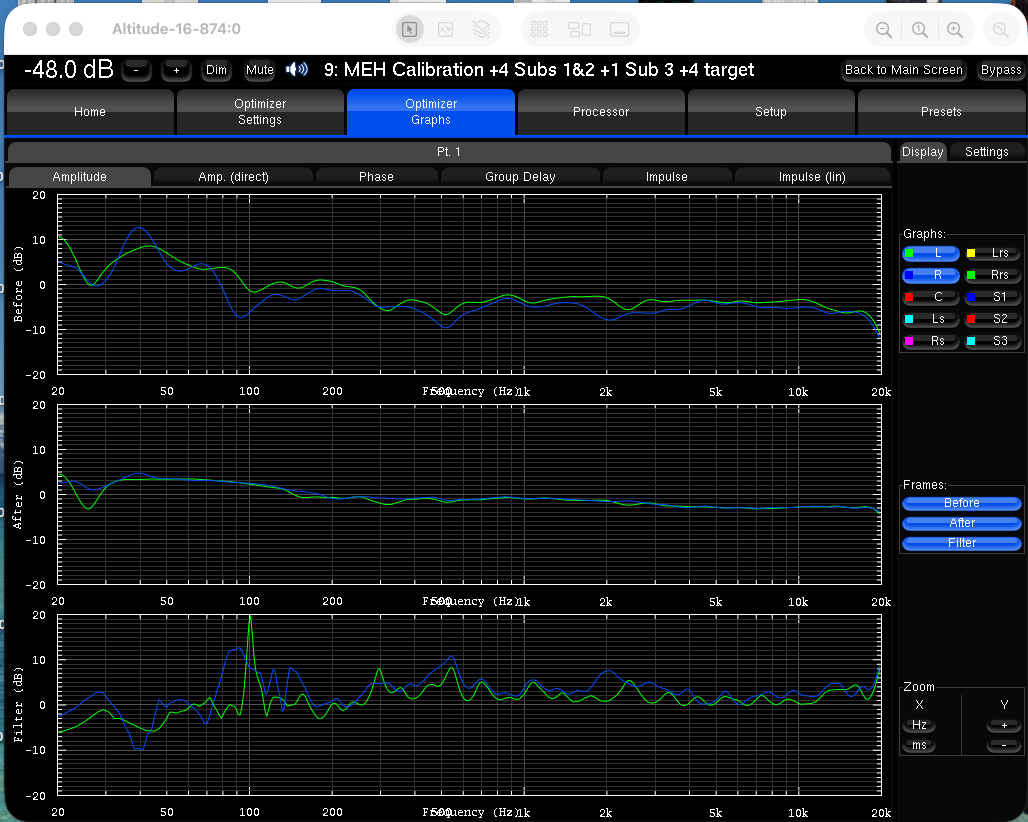
It’s a little hard to read, so to clarify, the top curve is raw measurements before filtering, middle curve is after filtering, bottom curve is the filter applied.

And these are the MEH only, no subwoofers.

I’m very familiar with those Suzanne Vega cuts. I’ve heard it clearly on my stuff and my passed friend Matt’s system, and he had JBL or Radian compression drivers depending on the day.

What i heard could be a result of the surround setting, being they had less focus than I’m used to. I do not prefer to listen to music in non stereo processed modes because of this issue. I would almost bet money that this is the culprit.

@Swimerz thank you for the thorough reply. Curious how big is your room, front MEH placement to walls and listening distance.

I respect/appreciate the answer you gave but rooms drive response. Curious how similar it is given I’m trying to use a small room.

My room is 18’ wide, 10’ high ceiling, the left wall is 15’ long before it opens into the rest of the house. The right wall is 42’ to the back wall. The listening position is 12’ from the midpoint between the speakers, and the speakers are 5’ from the side walls and 33” from the front wall. The volume the speakers play into is quite large because of the open floor plan house. Yes, the room makes a difference, especially in the bass. The really fantastic thing about Hinson’s MEH speakers is their uniform directivity. A big deal-breaker for me are speakers that have poor or very limited smooth off axis response. These speakers allow you to walk right up to the front of them and move your head all around and the sound doesn’t change. That means they will work great in a very small room, or in my situation, fill a large space.

2 Likes

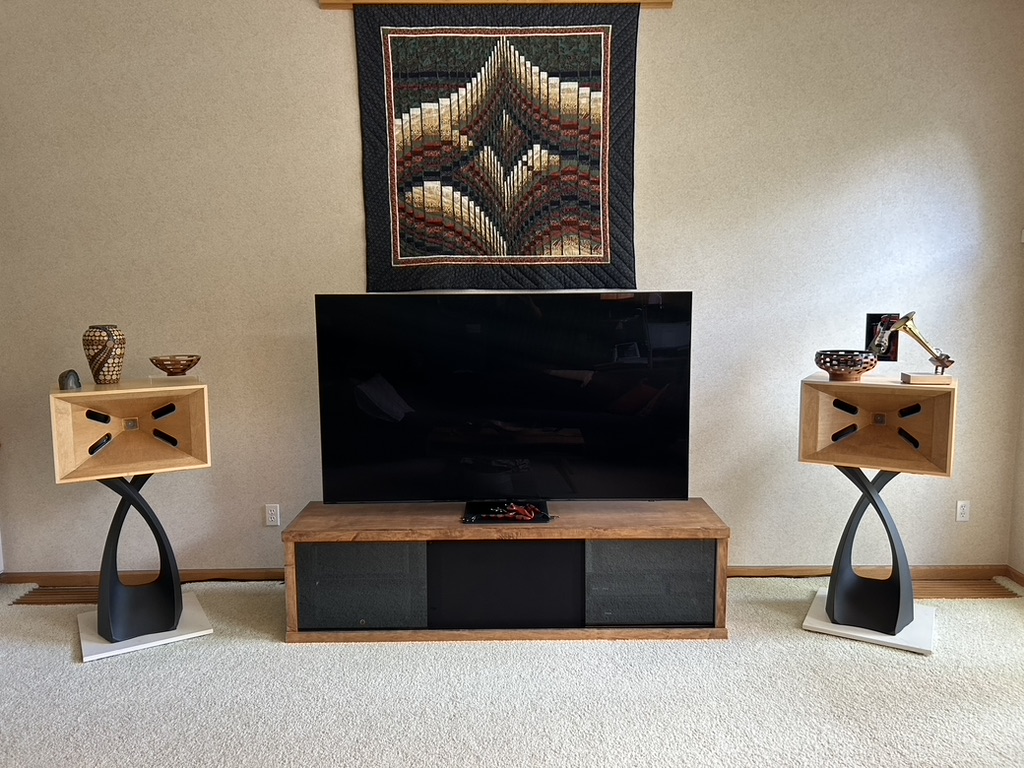
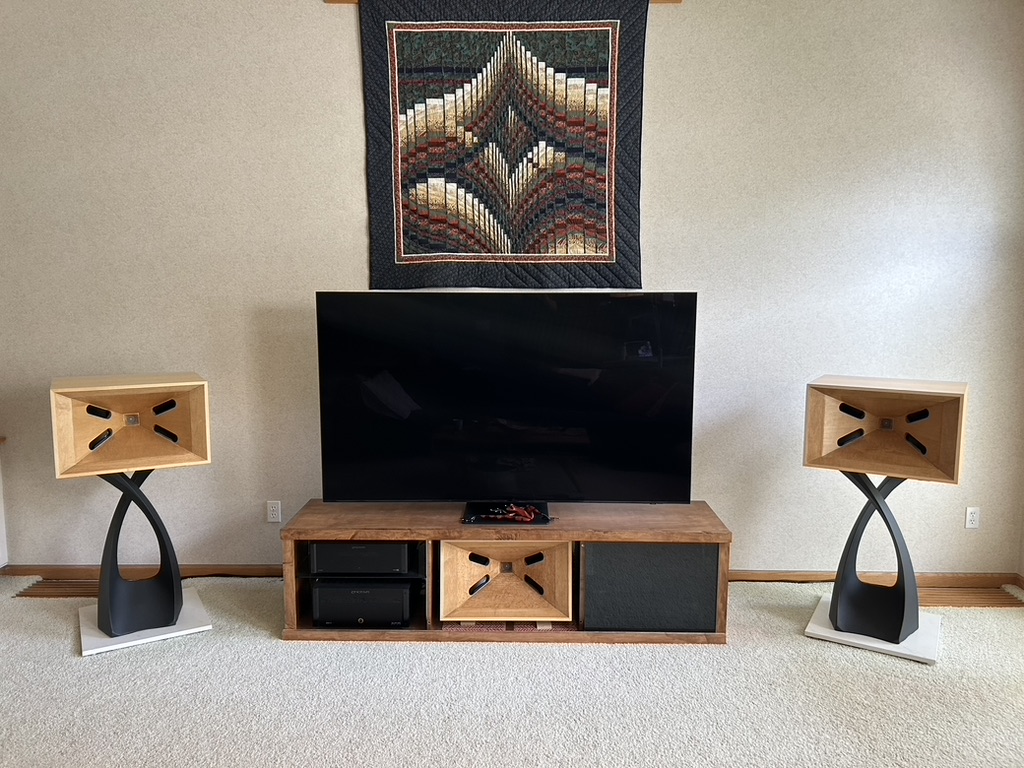
Very nice. Do you happen to have pictures of your system…?

Two of the infinite baffle subwoofer locations are visible behind the speakers. They look like floor heating grates. Each has a pair of 18” drivers mounted to a plenum in the basement. The third subwoofer is a HSU 15” sealed model, located on the right side wall, midway between the speakers and listening position.

5 Likes

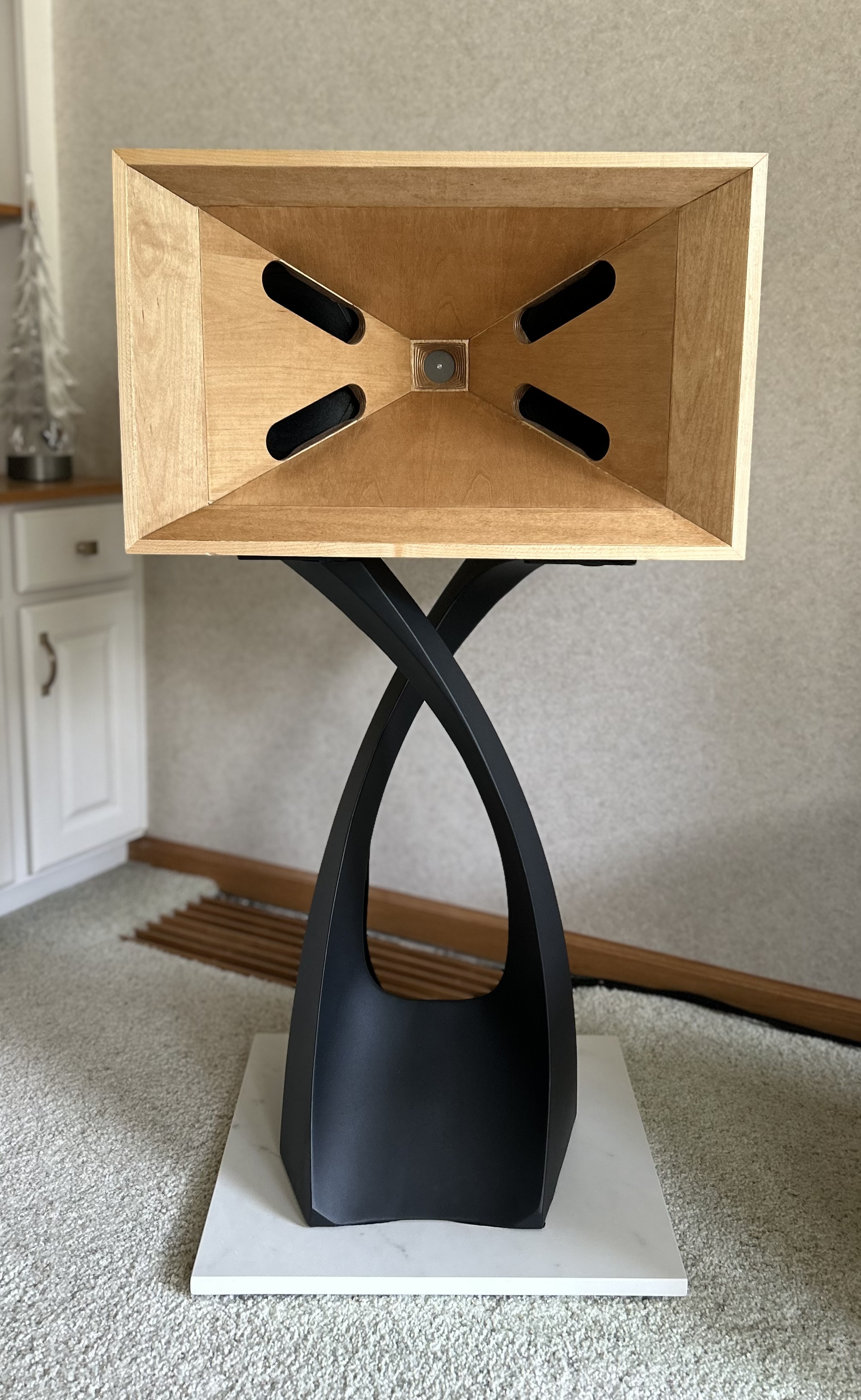
Nice looking / interesting stands !

Very nice. Agreed the stands look great. Any detail on how you made them?

You also mentioned a center channel. Is that hidden somewhere?

I’ve seen the picture up close of those before in another thread. There are really cool. Really like the idea of smooth off-axis response.

Apparently I’m not the only one who has wood turned vases on top, though my mains are narrow so we only used the wide center as an art shelf.

The speaker bases are one of the really cool designs from Etsy.com’s Flowyline. These are the Flowyline Tulipe 28H table base, model 316-14S. They are 28” high and 14” wide at the base and top, so you would look for the 14”x14” size. They are welded steel and powdercoated black. They weigh about 40 lbs but I filled them with 25 pounds of silica sand. Then bolted 30 pounds of granite to the bottom for a total stand weight of 95 pounds. Four 2” diameter x 1” high aluminum pucks are under the granite on the carpeted floor. The center speaker is nestled into the entertainment base, angled up at the listening position. The center speaker has curly maple interior horn veneer whereas the left and right speakers are straight grain maple veneer.

2 Likes

Here’s a link to a video of my speaker project if you’re looking for something to put you to sleep. This was with the original solid maple speaker stands.

Ok, so that didn’t work. Just search YouTube for Randy Parker Builds Multiple Entry Horn Speaker with B&C DCX464 Coaxial Compression Driver