Thought this might be useful to my fellow forum members.
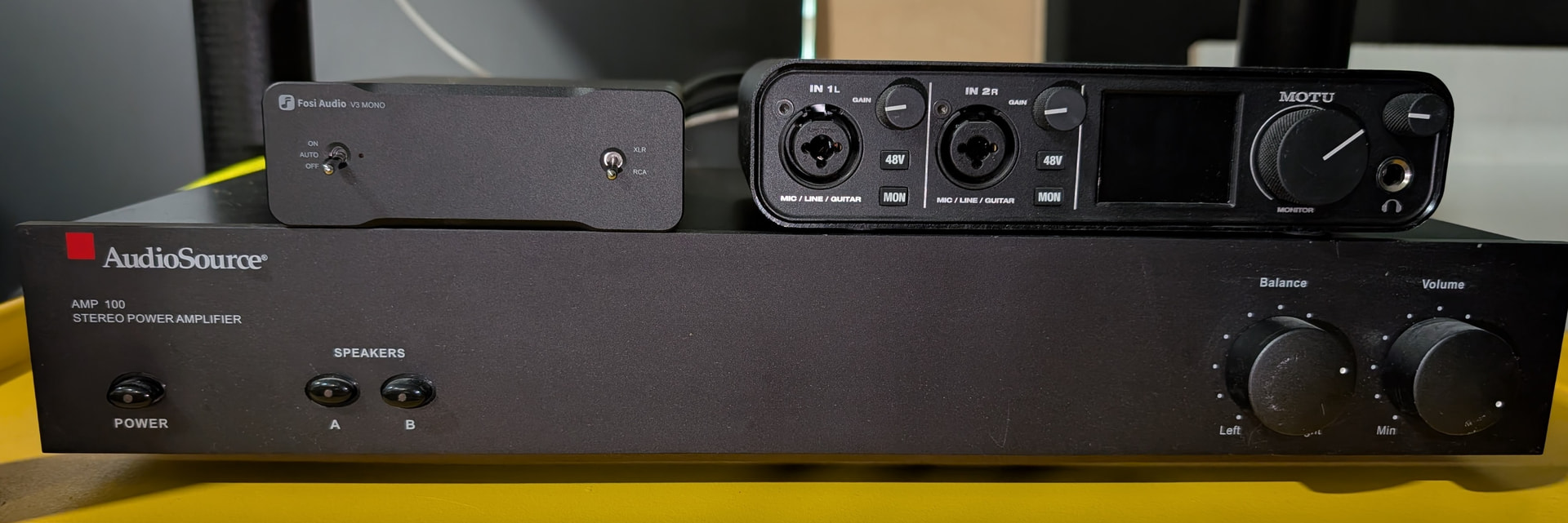
So, I want to replace my AMP100 with a Fosi V3 Mono amplifier as my measurement amplifier. Why? Because the Fosi is much, MUCH smaller and therefore more convenient.
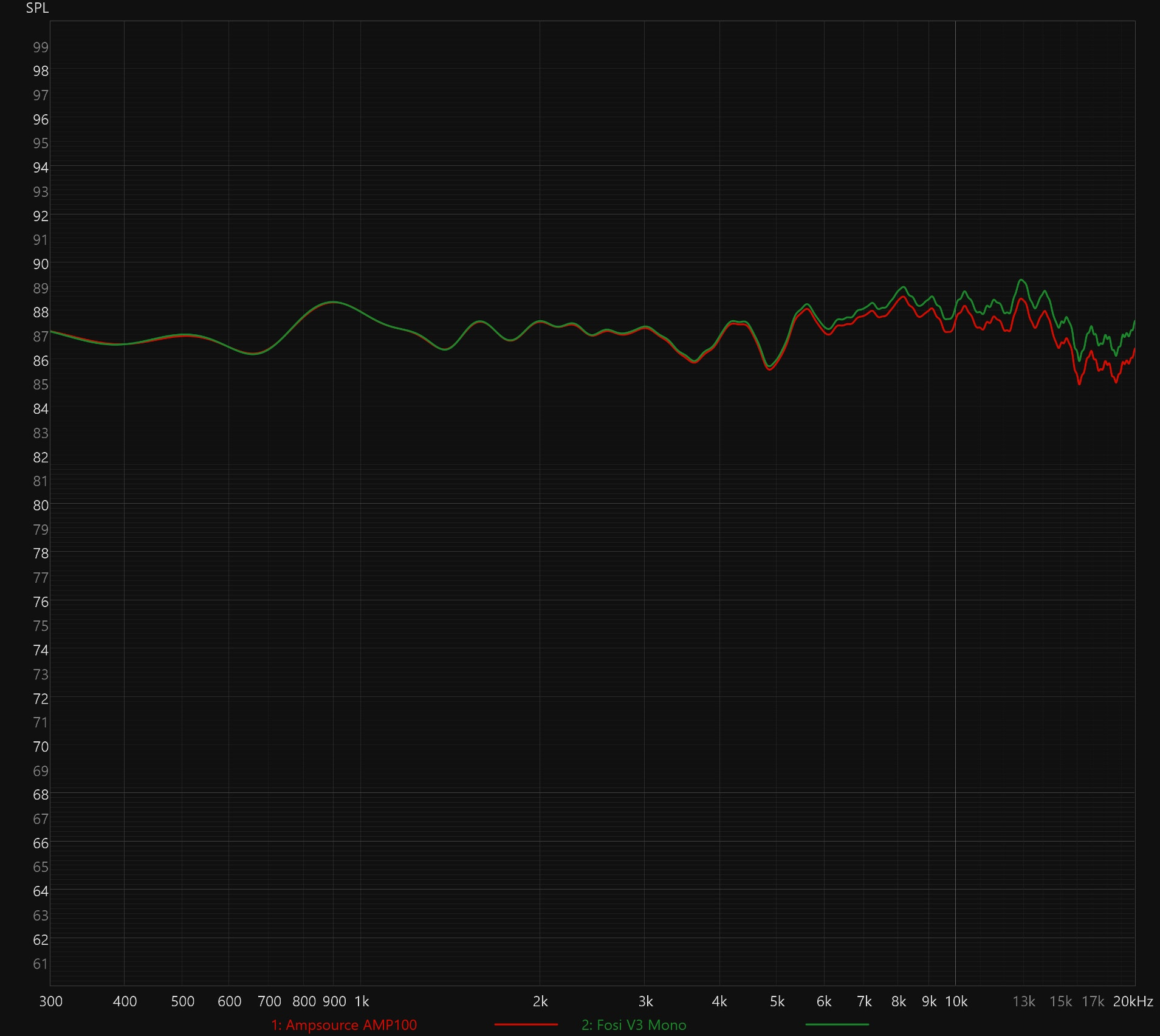
Before doing so, I wanted to make sure that the Fosi was up to the task. I picked it because it has PFFB, so should not be load-dependent, but I also don’t necessarily trust these cheaper Class-D amps. I measured a speaker with both amps and go the results below - RED is AMP100 and Green is Fosi.
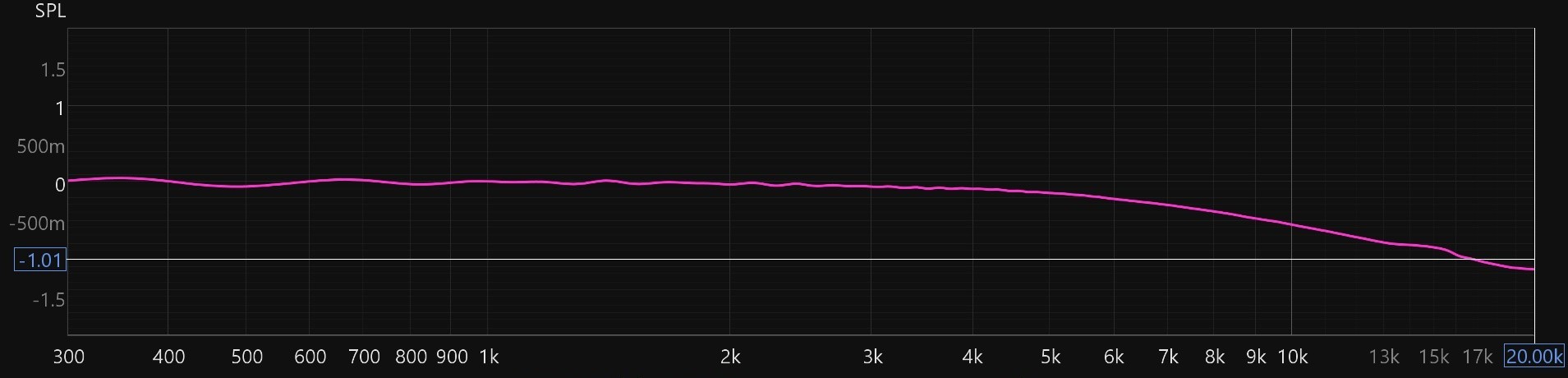
Note, the difference is not very much, but I want as accurate measurements as I can get. The image below shows that the difference is about 0.5dB at 10kHz and 1.0dB at 18kHz. I was a little skeptical because I was expecting, if anything, that the Class-D would possibly be falling after 10kHz, not the AMP100.
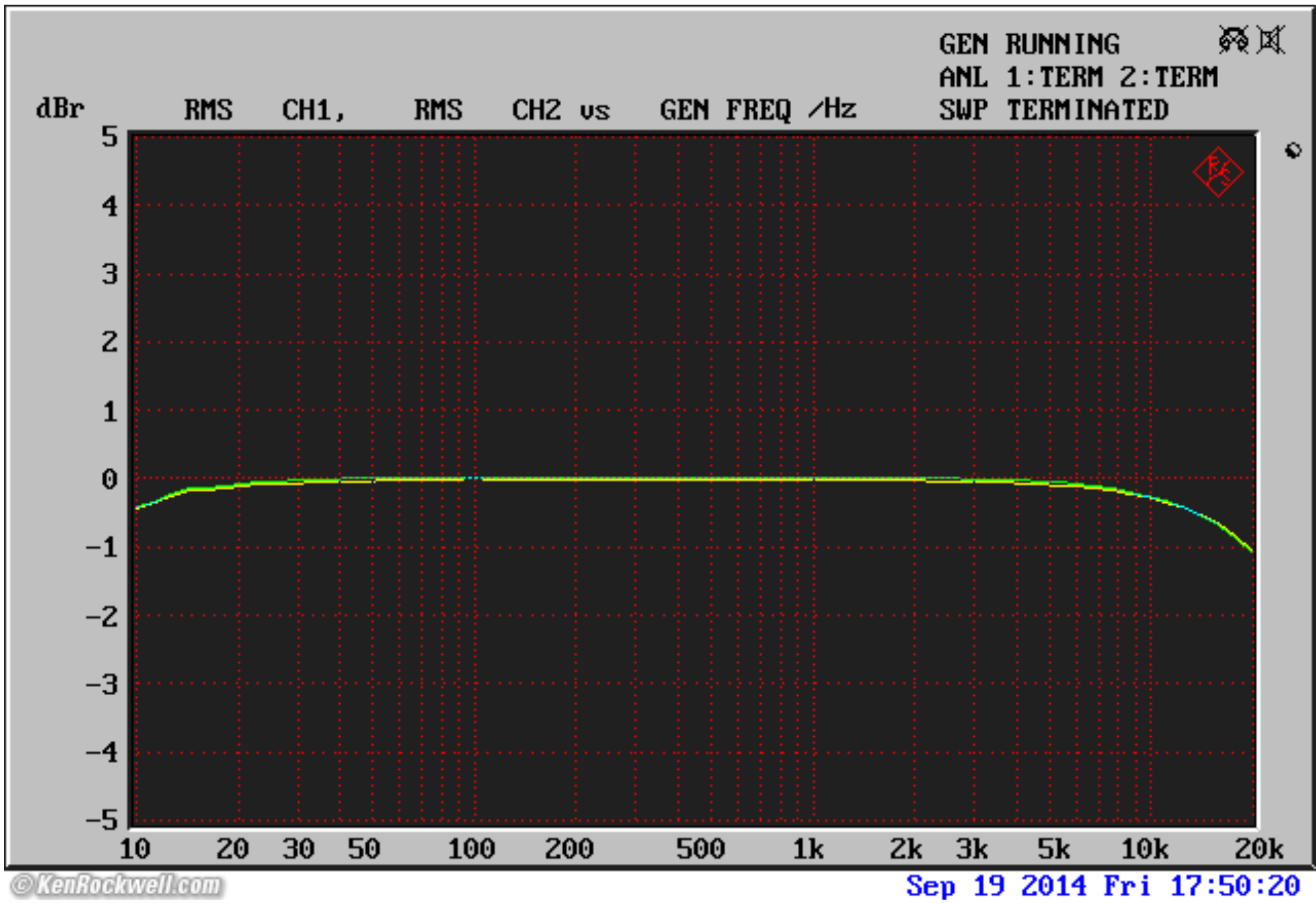
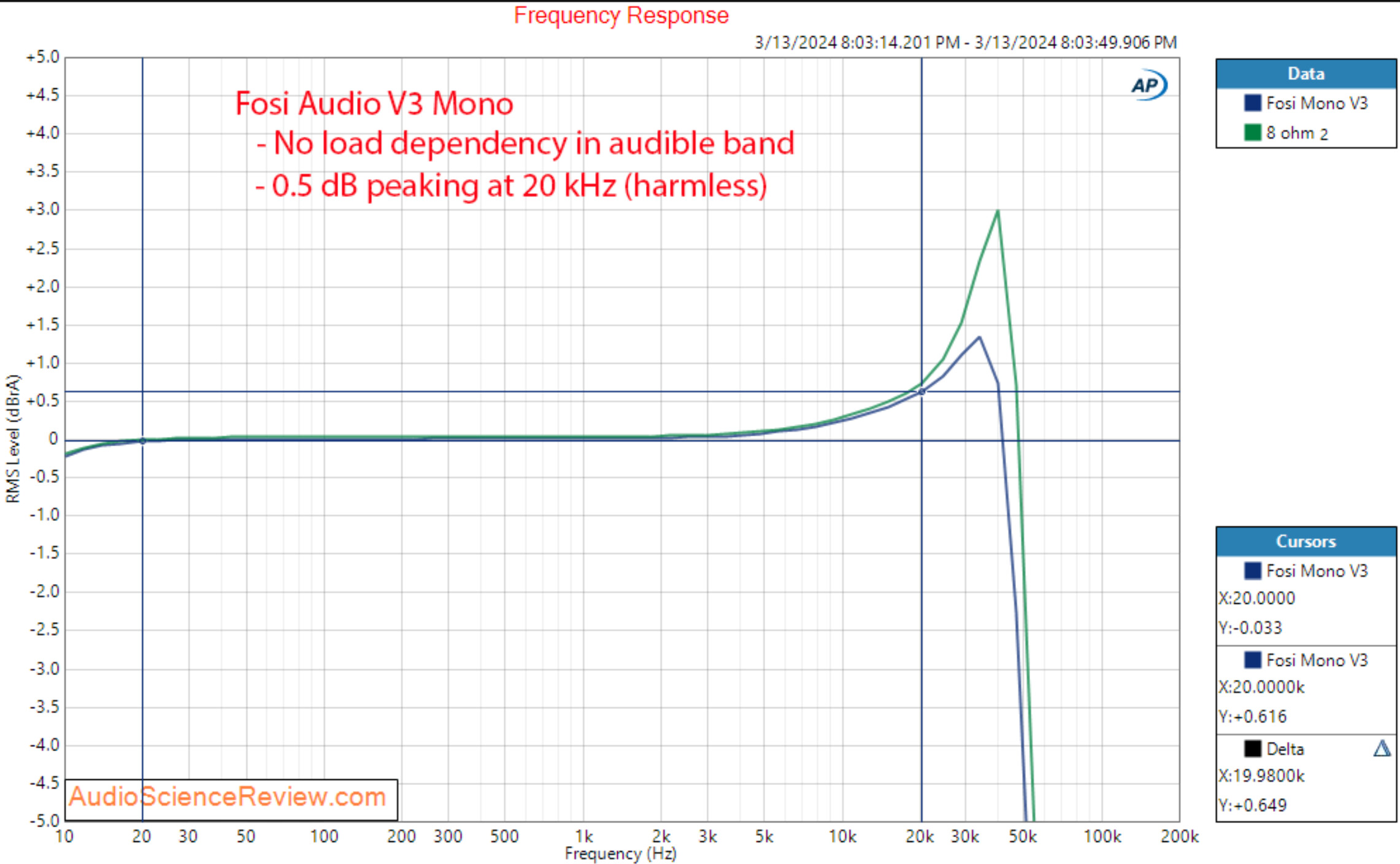
I picked up the AMP100 a year or two ago based on some posts many years ago on PETT. I assumed, being Class AB, it would be flatter than the Fosi. To see if this actually made sense, I scoured the internet for hours (i.e., asked AI and got the answer in about 10 seconds). It turns out the AMP100 was measured a long time ago by Ken Rockwell and he found that it rolls off a small amount over 10Khz, about one dB. ASR measured the Fosi and it measures quite flat up to 20kHz, with a slight rise of about 0.25dB at 10kHz and 0.50dB at 20kHz. So I now have confidence in my measurements and will be switching to the Fosi.
I made a similar move just recently. The amp certainly gets warm after a while so I’m a bit curious if that impacts anything (i.e. cold vs warm performance), but otherwise I am very happy with it. I certainly understand why some folks run a pair for music.
Edit:
Actually I’m setting up a brand new system with the Fosi, Motu M4, and REW…is that all what you’re using? I’m trying to find some guides on the full setup prior to taking measurements.
I quickly Googled and it mentions NOT to attach a standard multimeter across either terminal or it will likely destroy the amp. I DID connect a multimeter to set the voltage to 2.83v and nothing happened, but maybe I go lucky. But were you suggesting we should NOT use the BTL amps for measurements because of that? (Because if that was your point, I will use a 3e Audio A7 mono which is PBTL.)
PBTL is still BTL… You don’t want to connect that with a basic voltage divider to an audio input (ie dual channel measurement jig), you will end up grounding one side of the amp, TPA3255 has good protection circuit, so just expect no output, it won’t go boom. SE input needs to be connected to SE output, simple as that, common will be connected together so the black terminal on the amp actually needs to be a common. BTL doesn’t have a common terminal, so more complex circuit is required for feedback to audio interface.
You will find this warning in red text in VituixCAD measurement guide on the first page, and on my dual channel circuit page at HTGuide. Easiest solution is to use a different amp. FYI most low cost class-D “chip” amps will be a BTL circuit.
For any amp, any frequency response non-linearity be completely compensated for with loopback calibration, or dual channel measurement. Loopback calibration only works for amps without load dependency. Dual channel measurement completes a loopback calibration with every measurement, that’s essentially what the reference channel input does.
I thought that just compensated for the pre-amp. For example, with my Motu M2 and AMP100, I thought the loopback compensated for the M2 (the loopback reference is going out the back of the M2 and right back into the front) but how does it compensate for the AMP100?
It compensates for whatever you measure. If you measure the amp output instead of the interface output, that’s what’s being calibrated with the measurement.
Use your dual channel jig, measure the reference channel to create your calibration file, it’s that simple.
So I guess the question then becomes, what’s an economical amp for replacement of the Fosi that is currently available and in a similar form factor that is not BTL? Generally speaking, I’m talking about a brand new Class D monoblock or stereo amp that would be suitable for testing purposes.
Define economic. Hypex ucd based amps are not BTL but their distortion performance is mediocre, which may not be a problem depending on what you’re looking for. Hypex nCore is about as good as anyone could ever need, but a bit more spendy. IMO Class-AB amps are a dime a dozen, just use them. LM3886, TDA7293 that have been around for 20 years are fine too.
Regarding economical, that is a fair statement and I should have defined that, but it really comes down to this: I had hoped the Fosi would allow me to have a measurement setup permanently in place on my desk, something that is compact enough it would not interfere with other needs (like work and other hobbies). The fact it was not only space economical, but price economical was a boon! I still have a Dayton (or Franklin?) APA150 sitting somewhere, but even this was larger than I was willing to leave there. I have an Ncore-based NAD amp that sees little use in my ‘main’ listening area - I have considered dismantling that setup recently. However, despite its relative svelte-ness it is far too large for this. Perhaps an LM3886-based amplifier would work, so I will look into this further.
I use an old Adcom GFA5002 power amp. No smaller than what you are using now, but I have made several crossover mistakes that just caused the amp to cut out into protect without letting out the magic smoke.
Also has adjustable gain per channel, so I find it easy to dial in 2.83v output from a test 60hz signal.
These are noob questions, because I am, indeed, a measurements noob. I just want to be sure I have at least some level of understanding before purchasing both another Fosi V3 (so I have a pair for use with music) AND another amplifier for testing purposes.
Why set a 2.83v output? Unless I am comparing efficiency of speakers I don’t see how this is terribly useful, provided I am getting enough output for measurements to be valid (i.e. high enough volume for frequency response and distortion measurements to be valid). Comparing sensitivity/efficiency just doesn’t seem necessary unless you are committed to using low power amplifiers. Since I’m firmly in the camp of “Class D has big numbers so let’s use them”, does this apply to me at all?
When using a Motu M4 (or similar) is a DIY voltage divider still necessary? Several other guides I have seen suggest you can get valid measurements from REW without going through that hassle (at least, to me it seems like a hassle but I get why others would just see it as another DIY opportunity).
In preparation for the answers above to continue to rule out the Fosi, I’ve done a little research on available compact amplifiers. However, my lack of understanding of all the varying topologies out there is limiting me. I see a Topping B200 might work for me? It’s on sale right now for a little over $500, which is not insubstantial, but I am committed to this hobby for the next 30+ years so I am indeed considering that investment. An nCore Nilai or Purifi amp may be in the cards as well, despite even more substantial cost, but they generally seem physically larger than I’m interested in…though it would be nice to not have yet another power brick. It seems anything under $500 would probably be BTL. Even the used market is not particularly friendly when it comes to compact amplifiers.
2.83v is not needed for your own work unless you are wanting to present standardized measurements. I set it to 2.83v and have a mic calibrator because I want (not need) to present at an accurate 2.83v/1m SPL.
Reet can comment better than me, but the jig (1) allows you to switch between impedance and SPL measurements without switching cables around each time (2) allows you to include a capacitor in series to protect a tweeter within the feedback loop (3) allows you to include the amplifier (as well as pre-amp) in the feedback loop.
If you are interested in assembling something, Neurochome has nice LM3886 based amplifier kits. (Too much work for me.)
Also, as far as amplifiers, my specific need is something quite small that I can put into a 3D printed enclosure along with the dual channel jig. If I didn’t want to do that, my AMP100, a Dayton APA150, Adcom xxx, any old used class AB amp, etc., would work.
Thank you this is very helpful. I do see value in presenting standardized measurements I’m just not certain that for personal use it’s super necessary. That said, I suppose if I ever want to share those measurements and get input on them so I can maybe graduate from noob status someday…maybe I should rethink that philosophy.