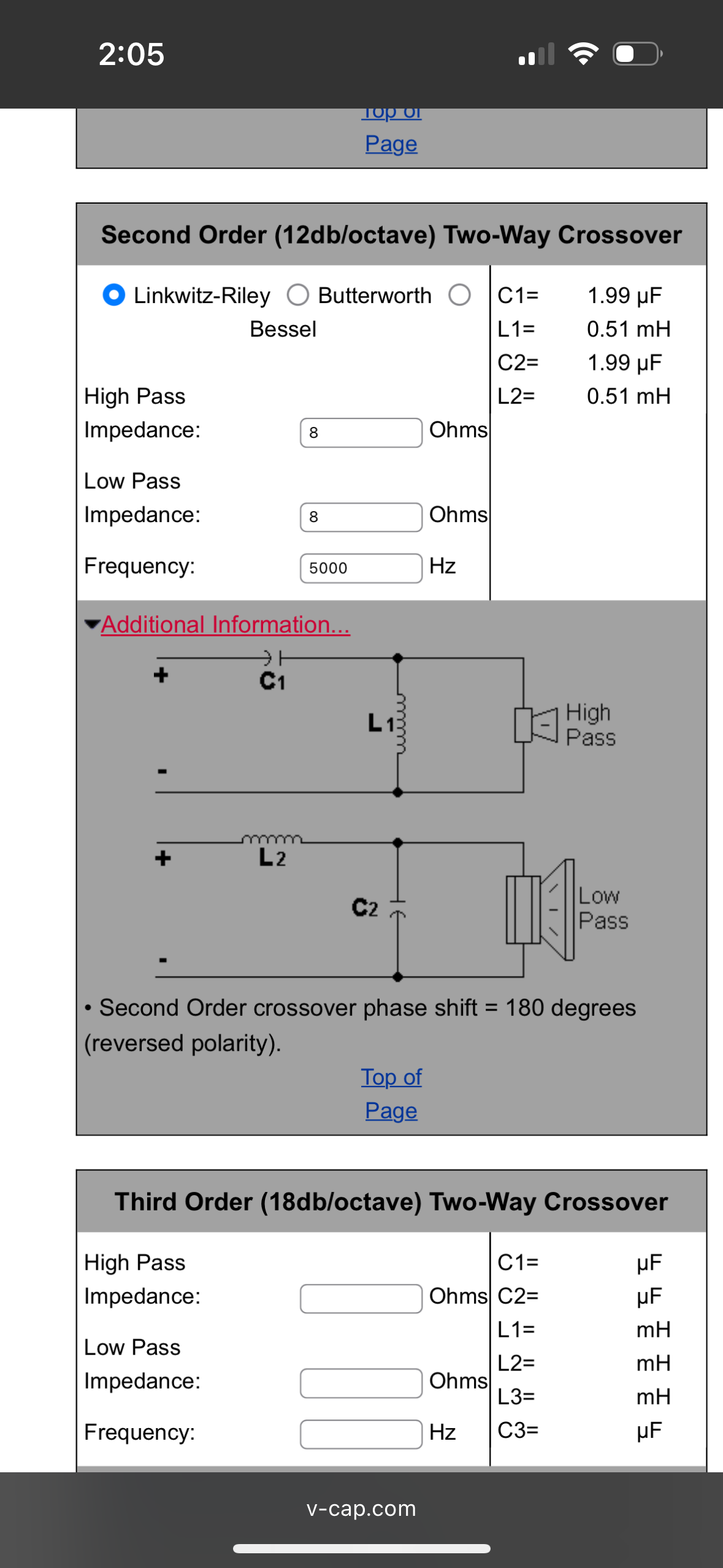
Hey gang, I doubt many if any of you have, but any experience with simple online crossover calculators? I make a lot of Bluetooth radios and sometimes have drivers I can’t find proven designs, so just need to set up simple 2-way crossovers. For instance, want to make this PA radio for my daughter’s softball team and was given a Selenium ST350. Purchased a SB Audience Bianco 10MW150 to pair with it. I got this simple crossover for it. Seem in the ballpark(other than needing some attenuation on the tweeter)? Thanks!
1 Like
When your drivers have a purely resistive load of the exact value used in these calculations (the value you entered for “impedance”), then the crossover will be picture perfect! The problem is that most drivers have a load that is reactive and its impedance varies with frequency. So the online calculators will spit out some values, but the results when you build it up with the components shown, which also come with a tolerance on their values, may let you down and sound poor.
For better results, use crossover designer software to which you can upload the measured driver impedance, or at least simulate it from the MFG values.
Thanks Charlie. I get what you are saying. Looks like I will have to suck up the time and do what I figured would be the answer.
onward and upward…..
Do you have any measurement gear?
I have a mic (never used, no idea, have had it a few years…) and I have fiddled with some kind of trace program and calculator once in the past….
I think I have a DATS I’m not using, let me check.
1 Like
I have a Dayton WT3, mic cable, mixer and/or blue icicle for output and phantom power.Also an ecm8000 measurement mic if interested.
1 Like
Acquiring proper goods in the works…..
It’s pretty basic stuff but will get you there.
This is what I love about our MAC community! Everyone here is great.
5 Likes
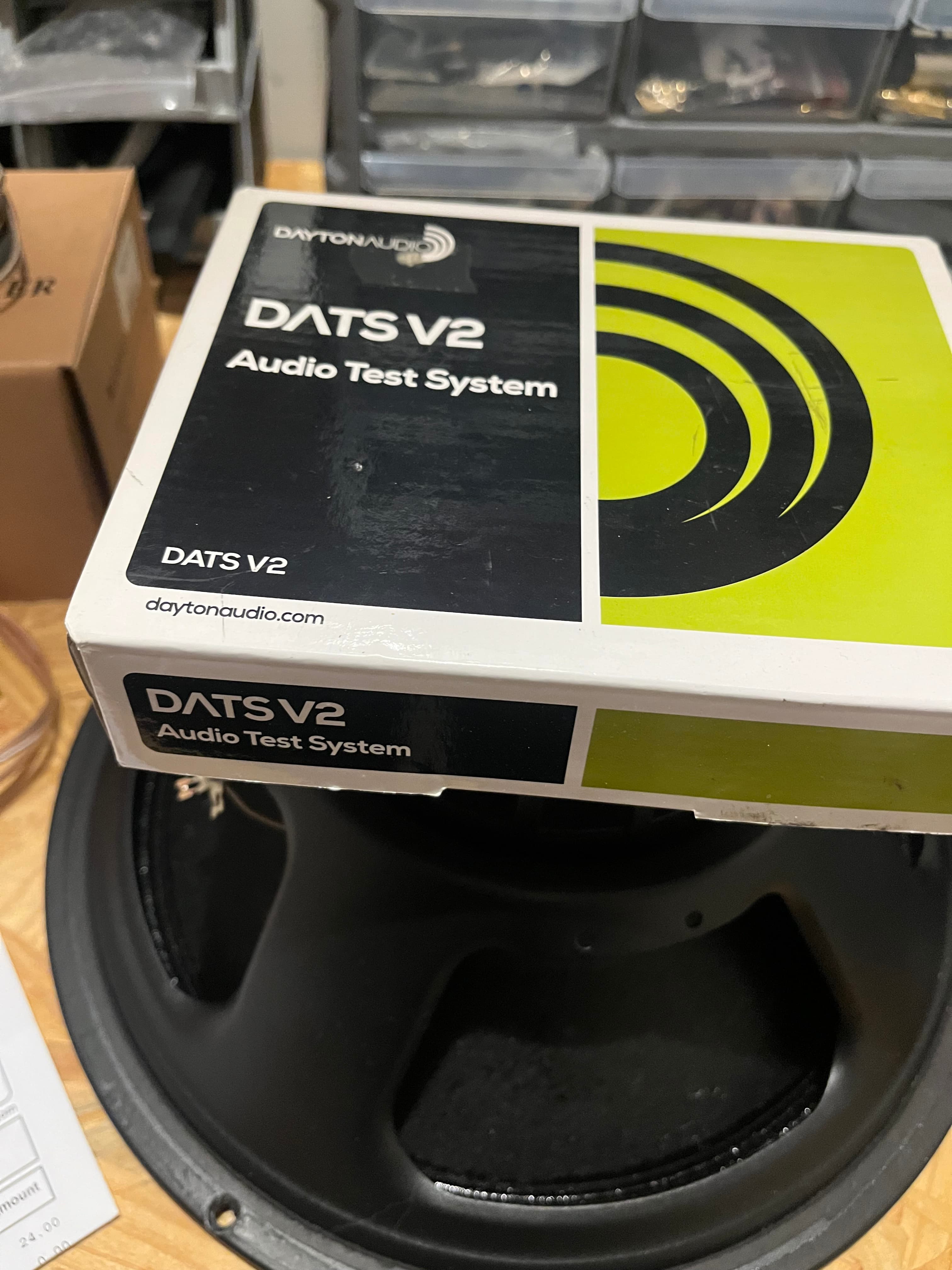
What would be better, wt3 or dats v2? They do the same thing, correct? I am completely ignorant to the units….
I’ll let the experts weigh in. If the DATS is better go for it.
Tom, let’s just roll with it.
Thanks 6th but gonna pass at this point!
1 Like
I think you’ll be ok. From what I could glean there isn’t a big difference.
1 Like
If I may suggest an alternate method especially if you are gifting. The dayton 4 CH kabd DSP will set you back by about a 100$, but saves on XO parts and amp and has Bluetooth as most will use that rather than futz around with line in and DAC and whatnot. You do need to add in a Power Supply so account a few bucks for that.
The wt3 days and mic will get you to a proper box design and measured active XO, though it’s sigma studio and has a bit of a learning curve. Kabd is decent enough, though more exotic options are there for top shelf drivers or designs.
It was a consideration and still could be, but would be nice to learn for the future. Part of me still likes the building and passive nature.
Thanks Ani!
2 Likes
Learning is always good. Once your are setup on the measurement side, post the TS specs and we can help with box designs. We can use the manufacturer specs too, but sometimes they are off and sometimes way off, so measured specs is always better and if can break in the woofers by playing music through them for a few hours then even better. Tweeters need not be broken in.
The next step will be to build the box as per the TS. Keep an eye on the CTC between woofer and tweeter. Rule of thumb is to XO tweeter at 2x it’s DS. If course you can cross a little lower and higher, but this is a starting point. If you can find distortion measurement, you can use it to also see what will be a good XO point. Cross before the distortion starts rising. For woofer, you can look at the frequency response to see where it breaks up and cross below that ( well below if you can). This will help your choice of tweeter and woofer.
Also we typically do not like to pad drivers which play lower frequency, so tweeter should be more efficient than the mid, mid should be more efficient than the woofer. Woofer also needs about 6db for full bsc, but in typical room, closer to the wall 4 DB is also sufficient. So you can get away with pairing a T and W with same efficiency or a M with a slight lower efficiency say 2 DB with a W if you cross the M to the W above Baffle Step Frequency. And compare efficiency at 2.83v and not 1 watt.
Put your drivers in box and then measure the FR of each drivers on tweeter axis at 1m individually and then all together. Take nearfield of woofer and blend with far field. Now you are ready for to work.
Post all specs and measurements and we can help you get started and refine the XO.
Hope this helps. Guys, please chime in to add any other nuances that help you make great designs.
1 Like
Or correct, as necessary…
Massive Ani! Thanks!