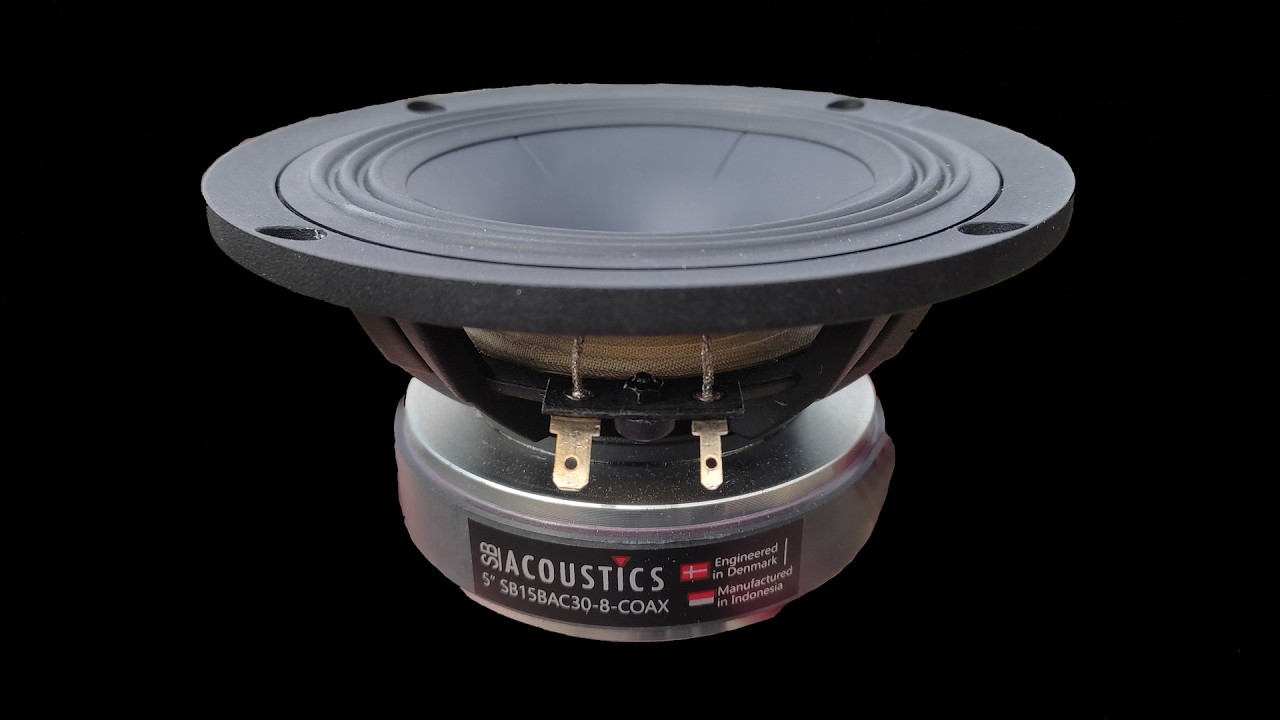
Really looking forward to this. I love coax drivers!
1 Like
As a mid and high driver only, it has decent HD. It’s when used as a midbass that the HD increases to about 2% in the lower mid/upper bass range.
2 Likes
What Ben said.
To be honnest I can’t think of a HiFi application when a coax is best as a 2 way and not a 3 way. Move the woofer for bass frequency and you move the “waveguide” for the tweeter… You HAVE to limit the cone movement for best results.
4 Likes
Coaxial with it’s own horn - ie beyma (no moving waveguides).
You have still cut the effective cone area considerably. This also limits the CD to horn interface, you cant make the ideal hifi union.
Like most of life compromises are made.
1 Like
Sorry, I’m not sure if I understand the full extent of your statement. In any event, thinking still a better option than a simple moving waveguide in a coaxial arrangement. Always offsets/ compromises as pulling a tweeter away from concentric position adds its own issues.
Is there a specific sonic reason to not hand off to a LF driver?
Its just a different set of compromises.
A dome tweeter in a woofer is so that the cone/waveguide is part of the source of music and hopefully our vrains dont notice the change. Center to center is 0. Ofset is close to zero.
A compresion driver that has to go through the pole of a woofer, puts the tweeter at a greater offset. That also limits how smooth of a transition. You can make from your CD to the back of the WG. This also causes the throat to be longer than ideal. The horn can also become problematic for the woofers responce.
I’m not saying ANY of the combinations listed can’ sound good you just have to pick your set of compromises for your application.
Drew, I dont then they is ever really a sonic compromise to a TMW over a TM as long as you implement it well. The compromise is cost size and complexity.
1 Like
Thx for the reply.
Roseanne Roseannadanna, its always something!
Active can assist with timing relative to the offset, as well as passive to some extent-takes a bit more finesse - hence the compromise trying to balance the filter selections.
Andrew Jones has gone with rather large mids in his coaxials I was thinking possibly less movement of the mid (at least it its lower range) being the waveguide for the coaxial mounted tweeter? It would be interesting to see a visualization of the impact of midrange on the tweeter’s propagation.
1 Like
I’m still enamored with concentric coaxs since my first set of Auras I had in my car back in the late 90’s. Although I haven’t heard a proper set of KEFs, I can’t help but see they are still top of the game in that regard. I still dream of a build using the R series coax, probably never happen, but I can dream.
I am not great at measuring speakers, so could someone tell me if the below is possible?
We measure speakers in isolation, so just the tweeter and just the mid, never combined. Would it be possible to measure a coax mid at a given tone - something lowish to get the cone moving, perhaps even near xmax, depending on the level that would take - then continue that tone while running a sweep on the coax tweeter, and subtract the mid measurement from it? Then one could compare a tweeter output with the mid on and off to see what impact it would have?
1 Like
The measurement sweeps across the frequency range over time, and the cone would be in an unknown position and direction at the time of measurement. I don’t see that giving much useful information. Probably most practical would be to hold the cone in various positions through the excursion range and take multiple measurements.
4 Likes
You can apply dc voltage to the woofer while measuring the tweeter.
3 Likes
https://www.digikey.com/en/resources/conversion-calculators/conversion-calculator-ohms
JR is not wrong, but be advised 9V is equal to 20 watts on a 4 ohm load. Remember speakers are rated for AC sine wave not constant DC, so make sure you don’t cook a coil.
I would assume that you could get a decent idea of what is happening by feeding the speaker white noise rather than a sweep.
1 Like
I always like the idea of shorting the woofer leads to help control cone movement