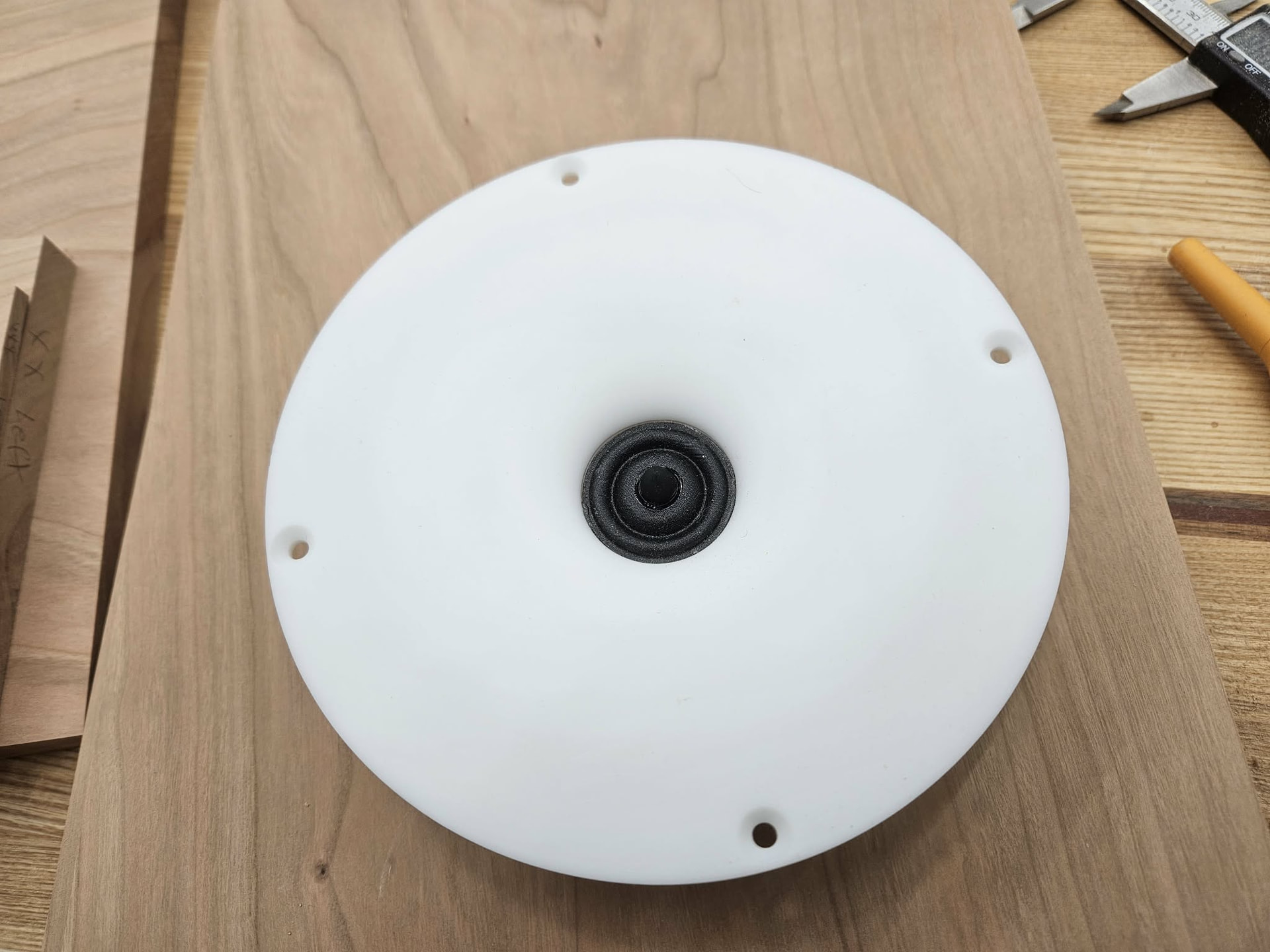
I tooled around in WinISD a bit. I checked down to 1.5" dia port, would still be dealing with port resonance in the pass band due to lengths required.
A single SB racetrack PR (SB15SFCR-00) would tune perfectly IMO in 15l with no added mass.
[EDIT] Since this is intended for desktop (15l seems kinda big): 11l (40g added to PR). 45hz F3 , but still get 32hz F10.
This is pretty much essentially the Revolution Mistakes’ tuning and volume that JeffB built by accident. I really liked them, but the SB standard range Be model is NLA.
That said, I don’t know that I’d pair a 19mm ring tweeter with a metal coned 5” midbass, even in a waveguide. I think there might be better options out there that will reach each other.
I think that pairing will work well. I’ve used the OT19 crossed at 2.5 kHz in the Hafnium and it can handle that comfortably. The CAC15 can easily get there, as Craig’s projects have proven. The ceramic layer seems to help extend the usable range. Even the non ceramic NAC and NBAC benefit from some resonance damping from the indentions around the outside of the cone.
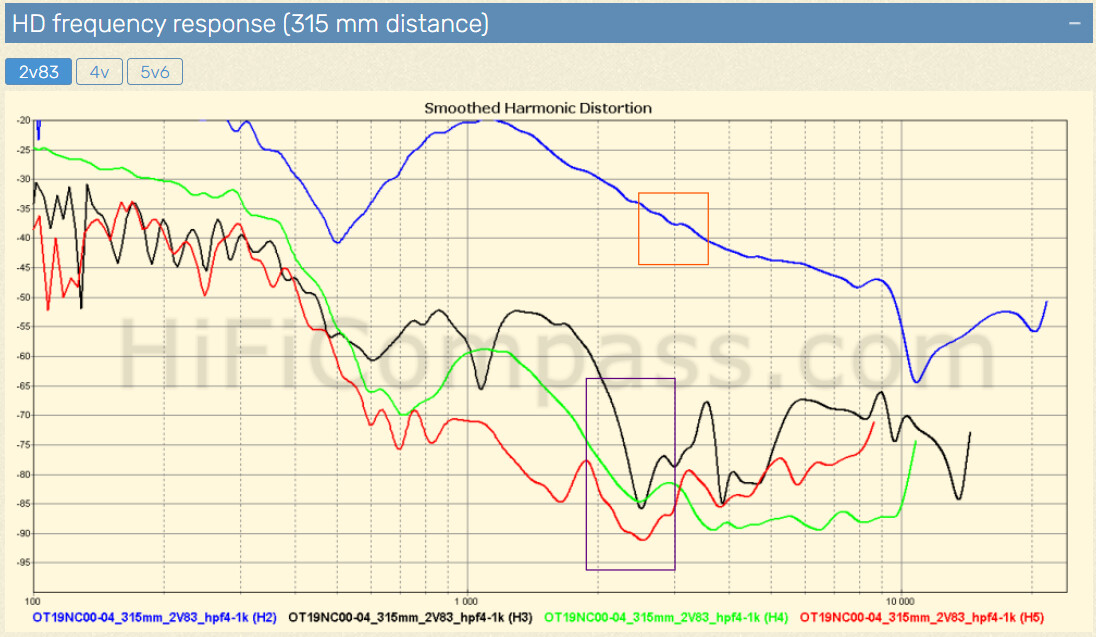
Just by the distortion graphs I’d say ~3.5khz, or maybe a bit under that with higer order highpass. Though that is mounted to a flat flange. Sufficient waveguide might stretch that down to ~3khz possibly?
I’m curious what in particular you are concerned about in the 2.5 kHz to 3.5 kHz range that would lead you to conclude that 3.5 kHz is the bottom of the usable range. I look at the same data and see 2.5 kHz as usable and have used both the OT19 and OX20 there in designs that have been extensively auditioned and shared over the years. This is not intended as a debate about who is right, but I’m curious what you are looking at that says “don’t use this below 3.5 kHz”.
Mostly just looking at the rising distortion as an indicator of stress on the tweeter, and comparing to how the other larger ring radiators in that peerless line seem to work. If that is not the case in this instance, then cool. I’m still learning stuff too. This might help me on my current project with small dimple dome.
Starting with the orange box. The second order distortion is around -40 dB (1%) at 3.5 kHz. At 2.5 kHz, we are at about -35 dB (2%). With a 2.5 kHz crossover in place, the response is likely reduced by 6 dB at that point - and a waveguide will likely further provide some reinforcement. Higher order distortion (purple box) is less than -60 dB (0.1%) down to 2 kHz. -65 dB is about 0.05%. Distortion levels (3rd, 4th and 5th order) are starting to rise below 2.5 kHz, which seems like signs of stress. Elevated odd order distortion will sound harsh. The 2.83 drive level will produce 88.8 dB according to the data provided in the HiFiCompass report. The higher drive levels (4V and 5.6V) represent 3 dB increments, so 91.8 dB and 94.8 dB. You also gain 3 dB or output by running a stereo pair, so even 2.83V is a pretty high drive level.
For higher drive voltages, 2nd order distortion has a similar curve, but shifted up a few dB’s. Higher orders stay below -60 dB above 2.5 kHz.
I really think you won’t have any trouble running these at a crossover point of 2.5 kHz and I think Craig crossed the SB15CAC at something closer to 3 kHz to the planar HiVi RT1.3 in the Keramiska’s.
Yes, I did cross the SB15CAC-08 right at 3kHz LR4 in the Keramiskas that used the HiVi RT1.3WE planars. They only required a small “tank” cap in parallel with the main LP inductor. I found them really easy peasy crossing there. I made a second project using the Viawave ribbon tweeters crossed lower at 2.2 kHz IIRC. Those SB15CAC’s sounded just as good at either xo point. The polars were a bit better crossing lower to the ribbons but at the expense of twice as many xo parts.