Particular interest in its FR and directivity:
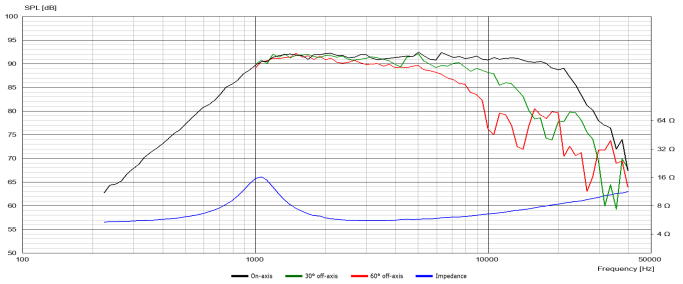
$48 ea @ Madi but then there is also the on-sale-Wavecor for $28 ea . . .
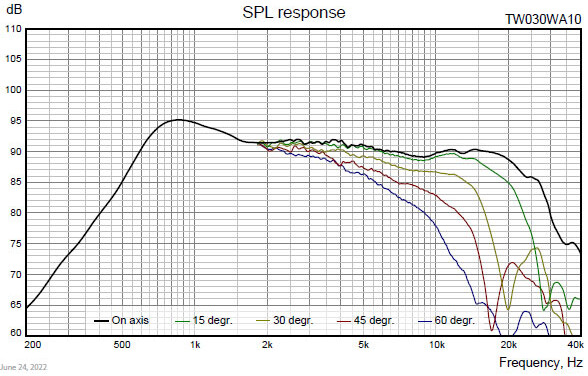
Which is better for reducing off-axis sound pollution [above 3kHz] in a midfield application?
Particular interest in its FR and directivity:
$48 ea @ Madi but then there is also the on-sale-Wavecor for $28 ea . . .
Which is better for reducing off-axis sound pollution [above 3kHz] in a midfield application?
The tw030 has better controlled directivity.
I would not say that everything off axis is noise pollution. Wide and narrow dispersion can sound very good depending in your room snd personal preference.
I would also equate pollution with distortion. If that is what you are looking for these graphs don’ show distortion. There are some tweeters that do have very low distortion and a wide directivity.
According to an old post on DIY Audio Forum, this tweeter is a re-badge of an old Vifa:don’t know if that’s good or bad and I haven’t heard it.
“the Scanspeak D2606/9200 is actually an old vifa tweeter that’s been re-badged, and when it was a vifa tweeter it was exactly the same as yet another tweeter used in many very good 2-way and 3-way speakers, including studio monitors, so it has decent enough potential. My main concern would be mid-to-mid distance and all the associated issues, and it’s not a tweeter I’d cross low… personally about 2.5 LR2 for a start point, I wouldn’t want to push it much lower”.
Thanks Ken for your feedback.
My needs are obviously different than those of others where as general discussion goes, as I have discovered that wide dispersion in my room produces bad sound due to diffraction and reflections.
Minimizing these effects for creating recordings/mixes that translate to a large number of different playback systems requires a more defined listening window which is why I bailed from studio monitors and into a recording reference system [SSA VSX] to begin with.
Now that I have a reference in which to guage/compare my monitors too, I have found the need for increased directivity at the listening position.
This is all about the application which is recording/mixing - NOT for home theatre/living room listening.
I would encourage you to have some more details worked out before you pull the trigger on a tweeter.
If you are crossing over at 5k the d2606 might give you better overall directivity depending on what the mid is doing.
Also, If you room is problematic for wide dispersion speakers to sound good, then the room will still be problematic for controlled dispersion, especially if mastering is the goal.
Sounds like you will be back far enough from the speakers that they will sum well even if the CTC isn’t ideal.
Ken, Hobi & Reet - thanks for your thoughts.
Definitely some good food for consideration - this is a concept design stage work in progress.
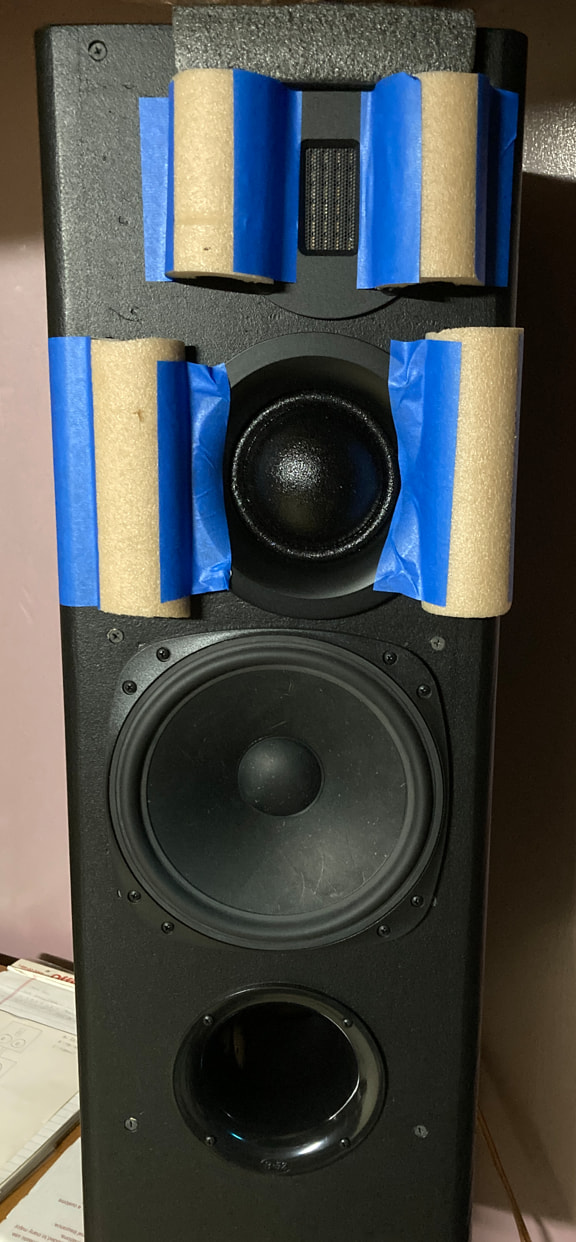
The current mini-tower 3-ways sound great but there is still some improvement to be had like getting the pipe insulation “waveguides” replaced with something better looking/more consistent.
I use them between 6 and 10 feet away and the drivers merge well within this envelop.
They give me a sanity check for bass EQ/Levels in-room against the SSA-VSX headphones and a way to listen to my mixes while moving around/stretching [getting old] between takes/mixing.
Ken mentioned distance ^ and CTC and that crept back into the fore of my synaptic meanderings this evening and the combination of physical observations/experiments yielded this result which has further improved the sound of the speakers - The tweeters and mids are far more directivity matched as I move from 10 feet away and towards 3 feet away, on the listening axis.
No more change in the balance/levels of the MT nor woofers - I used to think this change was cool because getting closer sounded like near field monitors for detailed work and moving away gave me more fully propagated lower/longer frequencies of the bass and kick drum, emulating mid-field monitoring.
They are much more balanced sounding and nothing about the room response is annoying me. 
The snare cuts through the air just like the SSA-VSX flat headphone mix does - wonderful!!
The listening window is still pretty wide at around 5 feet. Nothing like it was before.
Less amp power is required now [for comfortable listening levels] and the definition in the midbass has noticeably improved.
I can highly recommend obtaining some pipe insulation and painters tape for experimentation on all speakers that you currently have in your inventory . . . . and use your ears at reasonable levels.
Ok, do you have any way of verifying what you are hearing? Foam (open cell) on the face is usually used as a way to control/change diffraction not horn load or controll directivity.
I worry you could be doing more harm than good without verifying the results.
As a general rule, the larger the diaphragm the less energy will be present off-axis as you increase frequency. If I am reading your post correctly you are targeting a certain level of beaming to minimize interaction with the room? If that is the case, go with the Wavecor. The 30mm diaphragm will beam at a lower frequency than the 25mm dome on the SS. If this is not what you are targeting, my apologies.
You have captured my objective concisely, JR - Thanx.
Ken,
Pipe insulation is Closed cell foam, and tape are reflective to sound.
I have created a megaphone effect in the horizontal axis and left the vertical axis alone.
I understand what you are trying to do.
Have you measured to verify that you have achieved your goal?
Here is a write-up with measurements showing a similar format to the d2606. This shows how big a difference surface mounting makes:
This shows how a poorly implemented waveguide causes a wonky response:
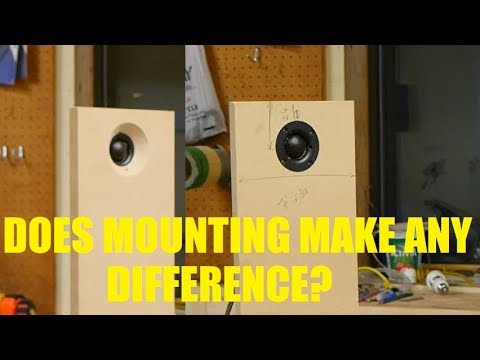
Here is an example of edge diffraction reduction:
Hope this helps.
Ok, I have used OmniMic to flatten/PEQ each driver after each time I added a flare but haven’t done it for the dome mid yet - I will try that this evening.
My efforts here have been an attempt to narrow the directivity of the speakers to remove as much of the room’s effects as possible [reflections & edge diffraction from nearby shelves, etc].
I use my ears a lot now because of the amount of time I have put-in to training them over the past couple of years while recording and mixing. The measurement mic is for refinement of my ear’s information and testing.
Thanks for the links.
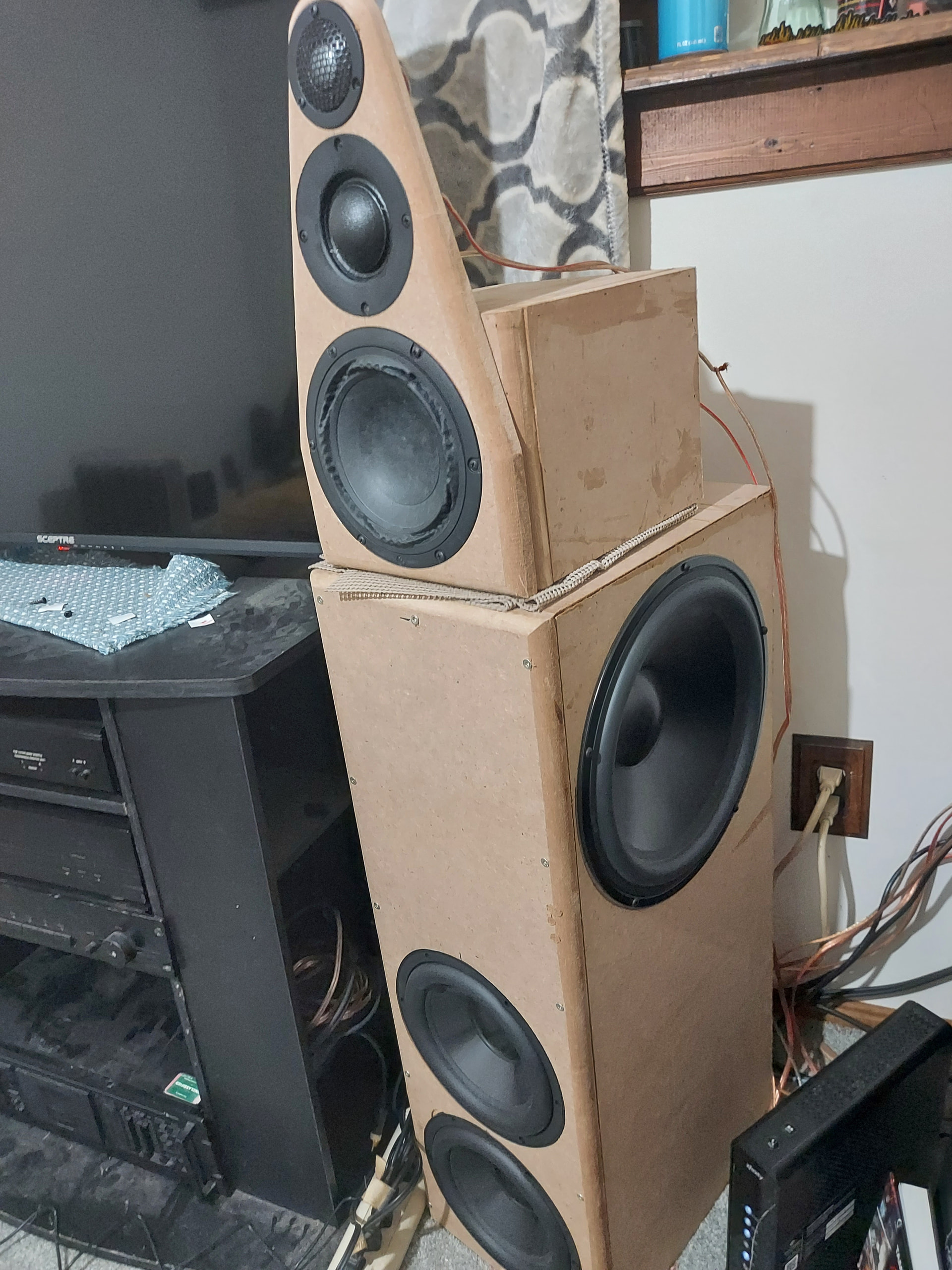
I finally realize that I am not going to make these speakers better in my drumming room by purchasing more drivers and placing them on the existing baffles.
Since I am acquiring excellent responses from experimenting with closed cell foam pipe insulation and EQ’ing - why should I continue to add expense and effort to something that is already working splendidly for my production needs???
Mastering requires a dedicated mixing room, well treated such that it sounds like a set of expensive ribbon headphones and I don’t have that sort of space to dedicate to it and this is a hobby finally being realized after a lifetime of wishing I had the time/clarity of mind to focus upon it all.
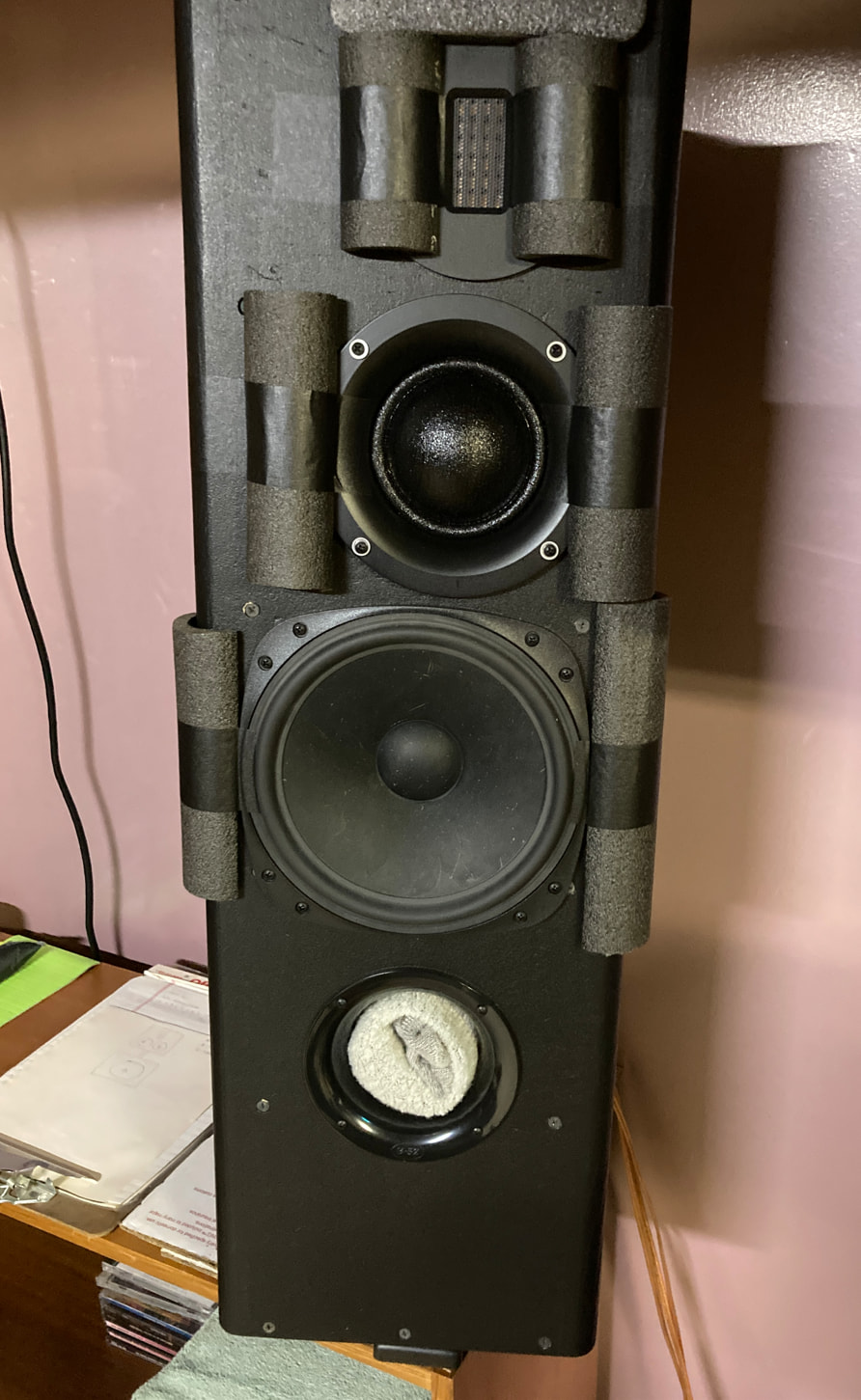
I guess aesthetics could be one reason but having been a “function over form” kind of guy the best I can come up with is finding black pipe insulation and black painter’s tape to make what works currently look better.
Oooh –>
https://www.amazon.com/gp/product/B0BG52MG35/ref=ox_sc_saved_image_1?smid=A368H7N44L7J50
Once again, speakers like to be ugly.
Hey Steve, my mixing AND mastering system is in a small room that is pretty heavily treated. I also measure speakers in there. It has my Reference system which consist of four RSS210HO subs, 6.5” Purifi midrange drivers, Tang Band 2” soft dome mids and Bliesma T25B tweeters. They are still unfinished after 7 years.
Oh, and they were quad amped but now they are tri-amped. Added a passive crossover to the tweeter and high mid.
Here - Loop (repeat-play) this as background music before you continue reading [to get into the mood/set the tone . . .] → https://www.dropbox.com/scl/fi/1zktldbcqjcx01pzbxxlp/Dance-Under-the-Sun-Offthewally-SJL-Drums-6-3-2025.T15.MASTER-MIX-TEST-2.flac?rlkey=66a609xlxn71jgojkqd3bvjdv&dl=0
. . . . . . . . waiting for you press play . . . . . . . . . .
The timing on the rhythm guitar upstrokes gets my blood shivering in time with that groove - so subtle yet present in the moment . . . .
Ahem!
OK . . . Oh, yeah - Aesthetics of directivity . . . . . . here we go again . . . . . Humour-me while I wander-off the path of convention.
Finally got around to the aesthetics and taped these Franken-Speakers up with some matching bandages/diflectors/round-overs . . . (See upthread for previous look):
I [on a whim] added the round-overs in addition to the woofers and immediately noticed something about the snare drum sounded more natural to me . . . Still need to Re-PEQ each driver [one channel at a time at the LP] but I expect I am on the right path with my room . . . really want to mix while moving around without headphones one day . . . . keep experimenting and don’t give up when you get tired . . . each of us create either our individual form of art, in -all-its possible manifestations of our efforts or a hell of the scattered mind torn between all-points of a contrived multiverse of thoughts.
Bring order to the chaos and most importantly;
Be what you came here for . . .
OK, you can turn the tunes-off now if you want too.