Scott's amp testing thread - resurrected

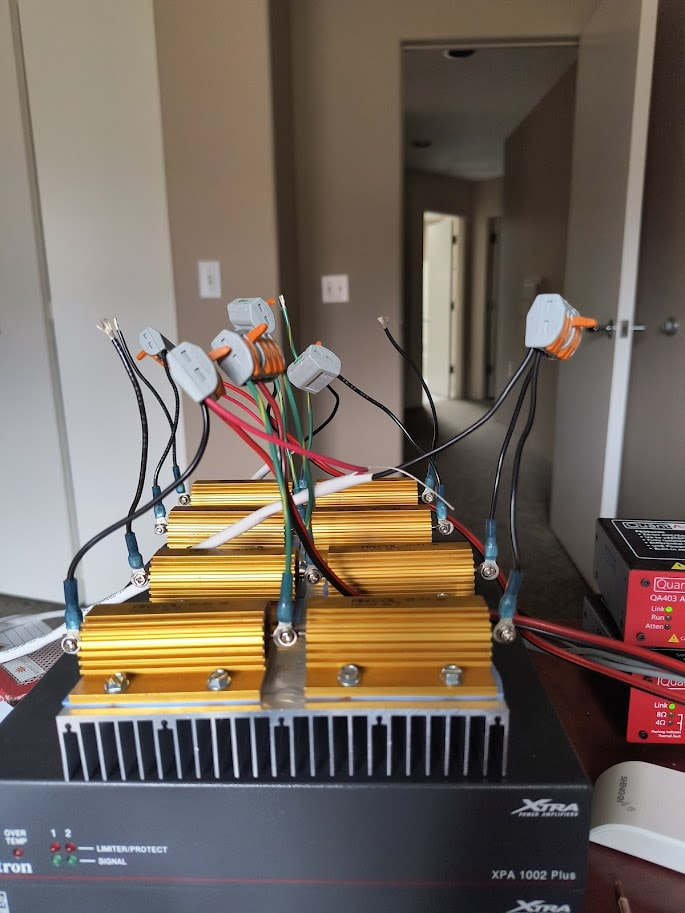
I’m staking out a spot in the current forum for amplifier testing. As some of you will recall, I have had the Quantasylum QA403 audio analyzer and QA451 programmable load for a few years. The power limitations with the QA451 (and QA403) have meant that I was limited to about 100W into 8 ohms and 200W into 4 ohms. I have at least 5 amps currently in house that exceed that - so a couple of years ago I purchased a lot of 100W 4 ohm Arcol power resistors. I have gradually accumulated the other stuff and knowledge I need to build a robust external load for amp testing. I finally got this project completed shortly before Christmas. I used a similar approach to what is described in the article on linked from the QA451 product page QA451 with external loads

The resistors I found are 4 ohm Arcol HS100’s with a 1% tolerance. There were 10 in the lot and I needed 8 for my planned setup. When I want an 8 ohm load, I use 2 per channel wired in series. For a 4 ohm load, I add another two series resistor array in parallel.
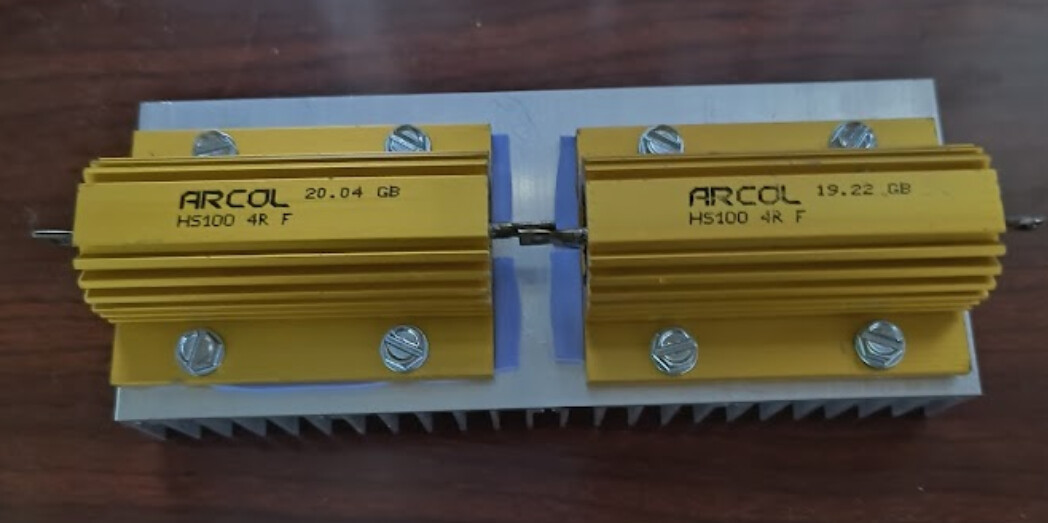
So, I have 4 of these assemblies. One per channel for an 8 ohm load. Two in parallel per channel for a 4 ohm load. I send voltage back to the analyzer from one end of the assembly and the center tap between the two resistors. This attenuates the voltage by half (6 dB) to help overcome the analyzer’s voltage limitations.

The resistors I found weren’t the non-inductive variety, but I read the data sheet and found that the inductance should only be few microhenries for the low resistance we are looking at here. After assembling these, I decided to test this.
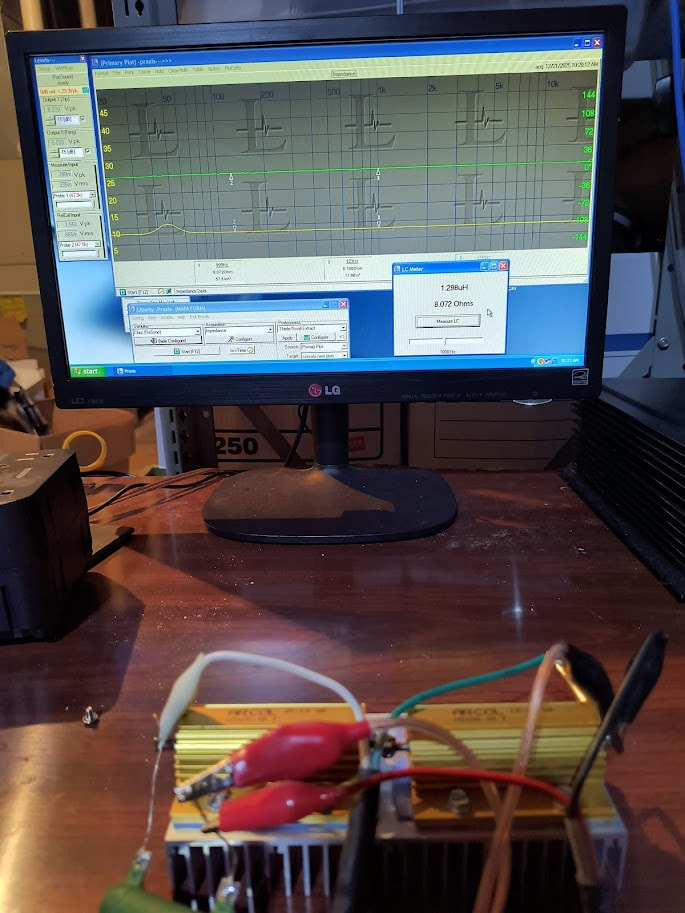
Resistance for all 4 was between 8.07 and 8.08 ohms and inductance was around 1.2 to 1.3 microhenries. So, I should be good to go.

As far as thermal/power considerations go, the resistors can dissipate their full rated power (100W each) continuously if properly heat sinked with thermal compound at the interface. I think I am at least close to having those boxes checked and that would give my 200W into 8 ohms and 400W into 4 ohms per channel. The data sheet gives overload ratings for the resistors. They can handle double their power rating for up to 3 minutes, 5 times their rating for 5 seconds, and 10 times their rating for 1 second. I’m confident these can handle my 500W into 8 ohm pro amps for at least a minute continuously, which would be an eternity from a standard testing perspective.
5 Likes

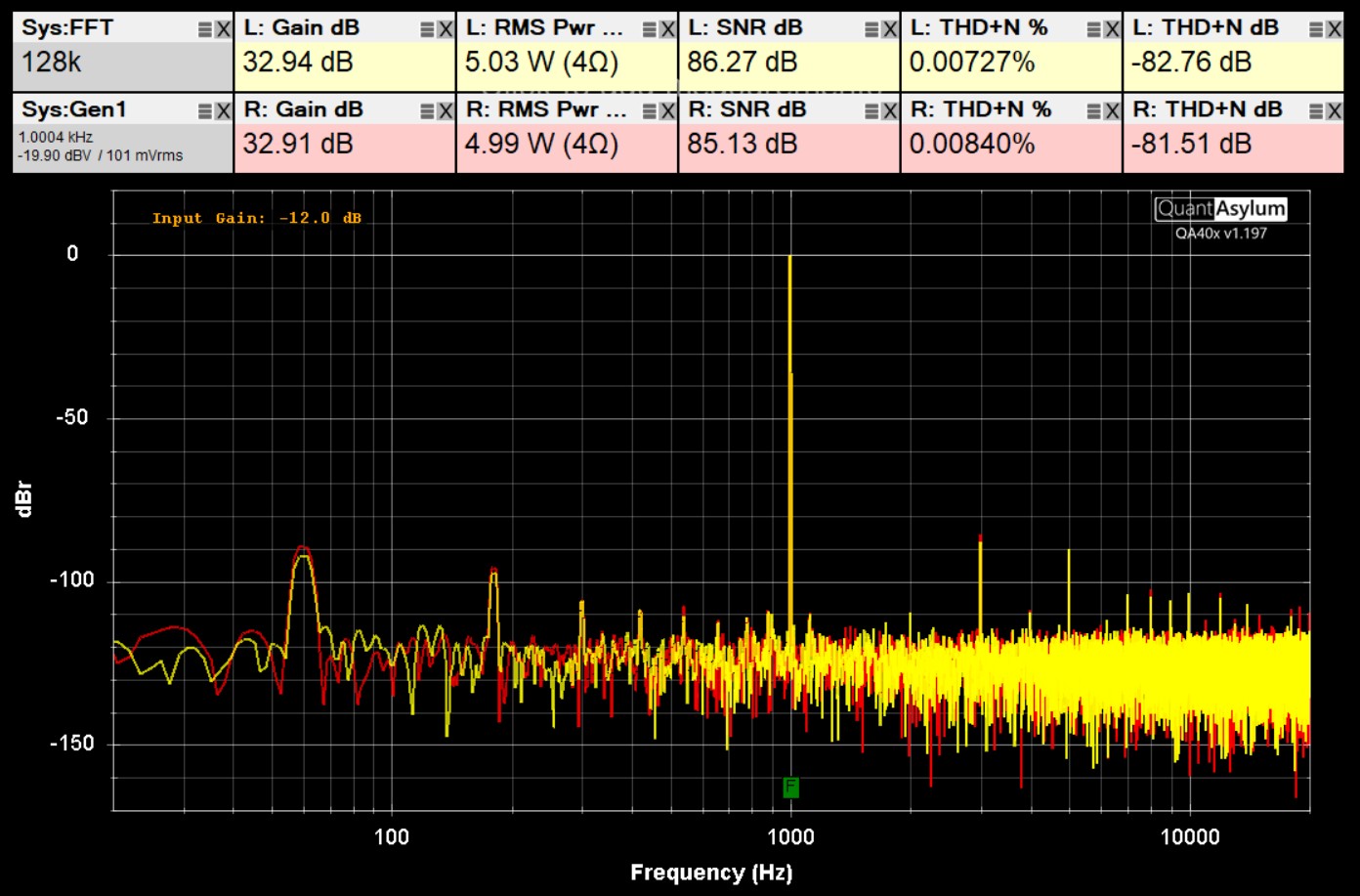
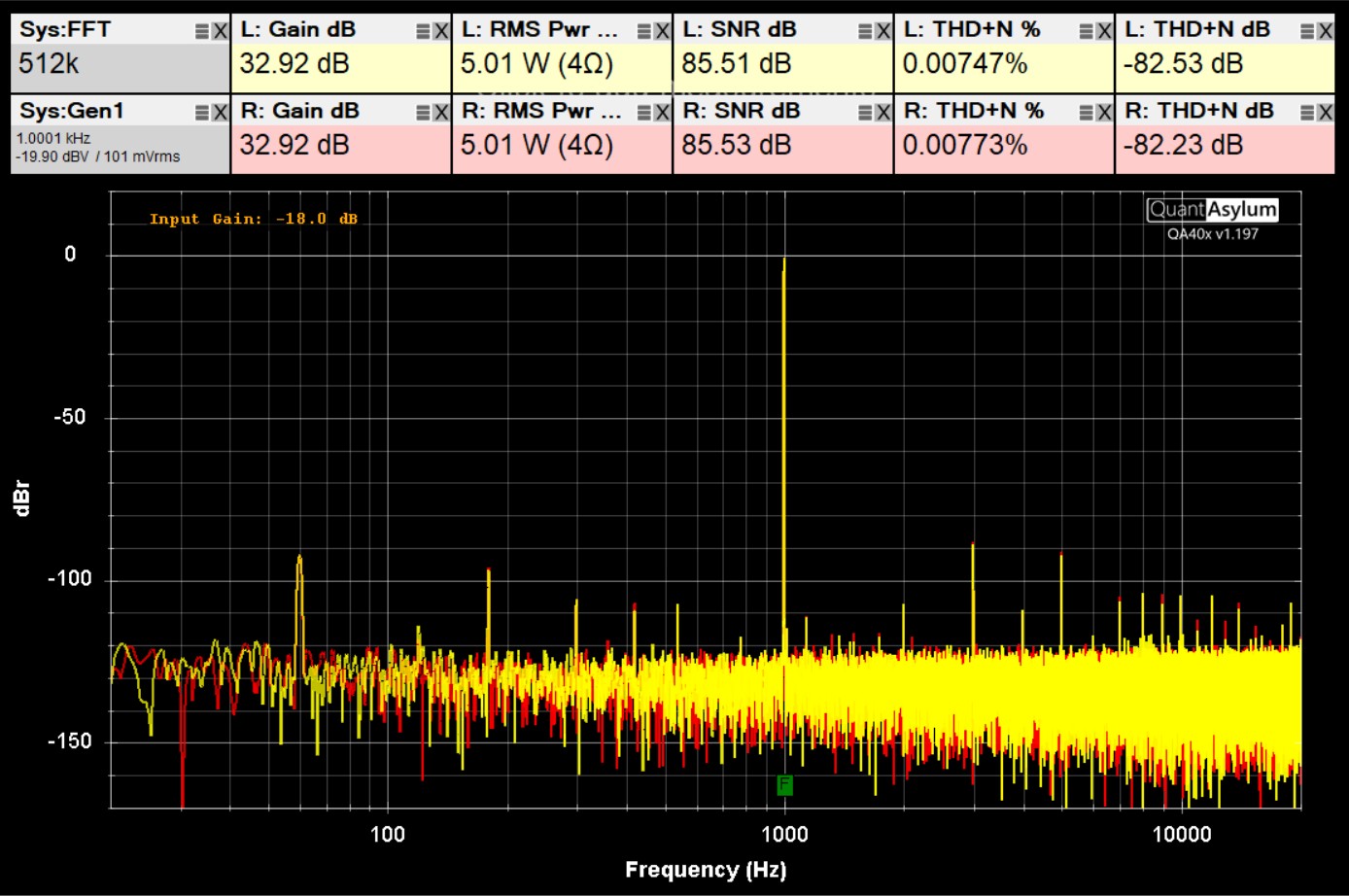
Before proceeding with publishing any test results using the external load, I decided to run a comparison an Extron XPA 1002 Plus. I had measured one using the QA-451 as the load and Amir from ASR has also measured one - so we will have a good idea if results are reasonable. Let’s start with the standard 1 kHz, 5 watts per channel into a 4 ohm load. Using the external load, I came up with this

One thing that is immediately noteworthy is how well the two channels agree. In setting up the external load, I paid a lot of attention to the electrical connections and ultimately decided on an approach including

  • Using screw connections to the lugs on the load resistors
  • Crimp on ring terminals to connect to the lugs and screws.
  • Short runs of 16 ga. stranded copper wire.
  • Wago lever nuts at junctions.

After seeing Tom’s posted measurement using a system FFT size of 512k, I decided to use it as well. The measurement takes a little longer, but there are more low frequency data points and better defined peaks/dips as a result.

Here’s what that looked like in practice (some wires are disconnected in this image, which means I was set up for an 8 ohm measurement).

My previous measurement using the QA-451 as the load…

SINAD, SNR, and gain are all very close. Amir measured SINAD around 85 dB and SNR of 87.5, which is in the same ballpark. I bought my amps used, so that might explain at least some of the difference.

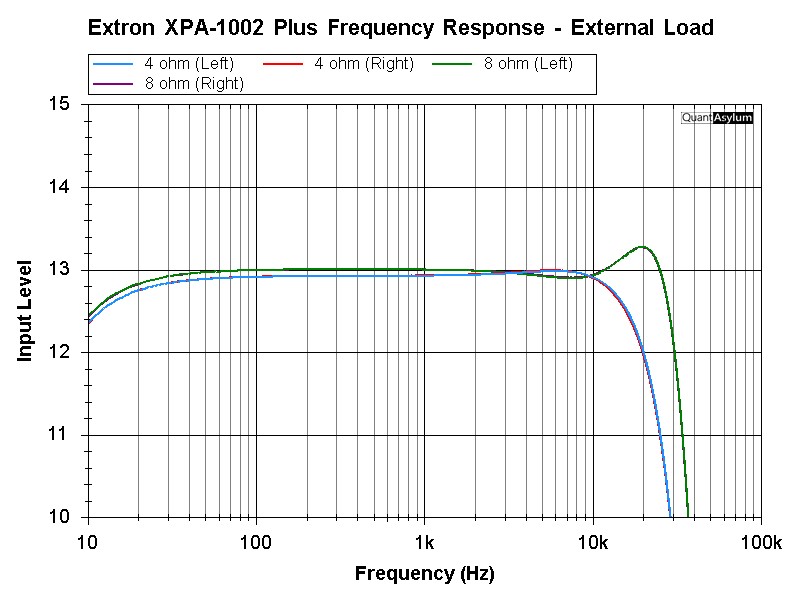
Next, we will look at frequency response. Here are the measurements with the external load in place.

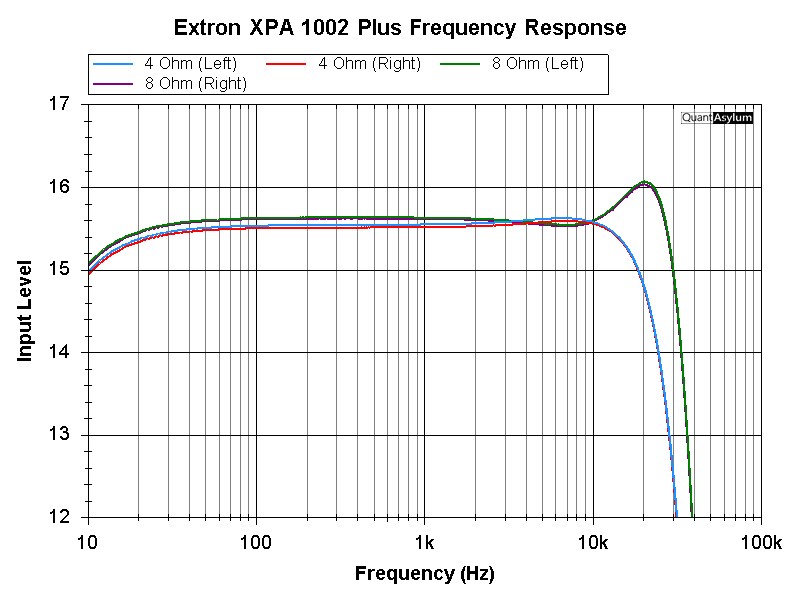
There is some difference in HF response between 4 and 8 ohm loads - about 1.3 dB at 20 kHz. There is also a little crossover between the 4 and 8 ohm curves in the 5-10 kHz range. Both of these features are also seen in the ASR measurements and my earlier measurements with the QS-451 load (below).

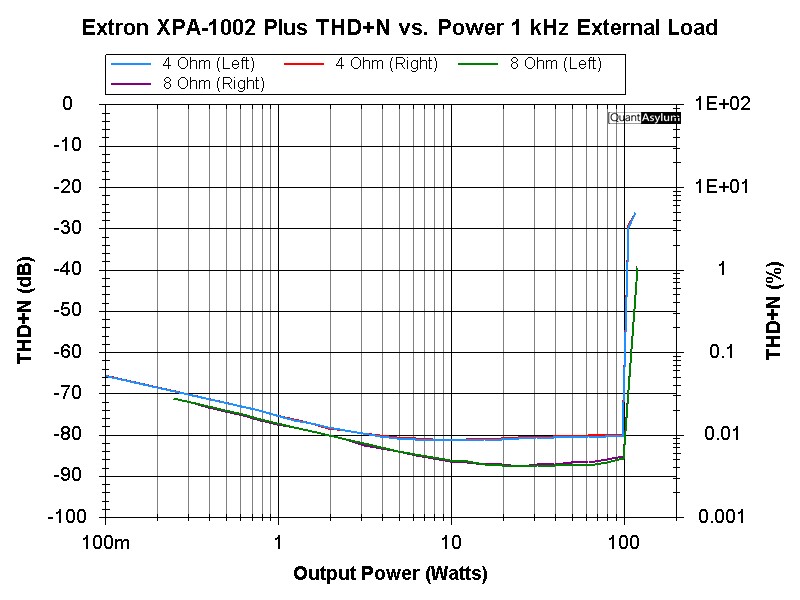
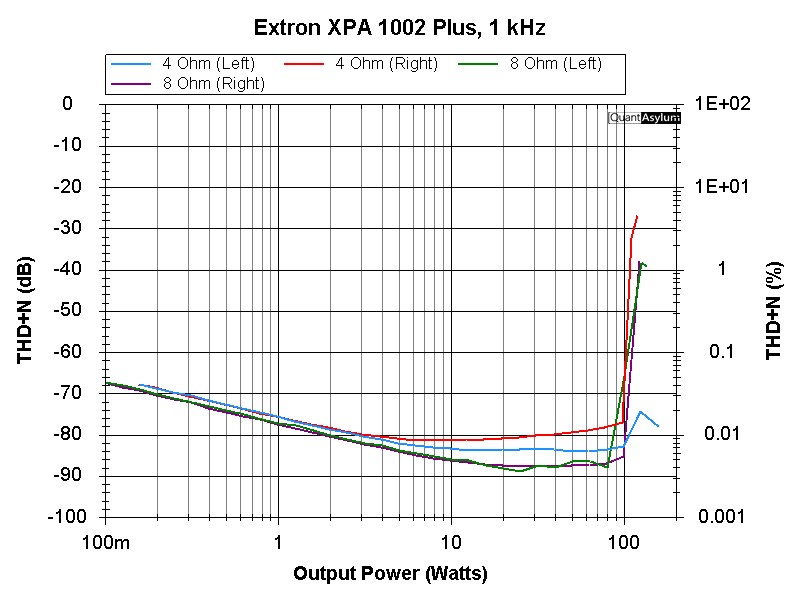
Next, I compared the distortion vs. power output curves. Here’s what we have using the external load.

This agrees quite well with what Amir found. Power cuts off sharply right at 100 watts per channel into 4 ohms. 8 ohms allows slightly more power output as well as lower distortion. Amir measured a few dB lower distortion, but the curve shapes are approximately the same. My earlier measurements with the QA-451 also agree pretty well.

Everything is in the same ballpark, but the external load measurements look a little smoother and more consistent.

Since I am not worried about damaging my external load resistors during these power sweeps, I decided to increase the FFT size from 32k to 64k (which doubles the time for each individual distortion measurement). The results didn’t really change, but the right channel of the amp decided to shut down after the 133W, 8 ohm data point. It came back up after a quick power cycle - but that convinced me that 32k FFT size is probably still a good practice for power sweeps (the individual measurements take place at a speed that looks similar to a music signal).

Overall, I think the external load performed as expected - so I am ready to try testing some larger amps. I will definitely post results here for the Samson SX2400, which has been the show amp for most of the DIY Iowa events over the last decade.

7 Likes