Solid Core Inductors

Thought I would share this. It is interesting and measurable.

This is from the “Transformer and Inductor Design Handbook” by Col. William T. McLyman. He designed transformers for Mariner and other spacecraft. Good news: he did all of the calculus for you. Bad news: it still requires “very” careful reading and formula figuring. The text is available on the web as a free PDF but is a basic scan. The book is much more useful than the scan and highly recommended if you are interested in electromagnetics. I got into this while building high voltage power supplies and Tesla Coils.

Here are some BH Loops for Solid core materials. First, an air-core inductor has a permeability of 1. In other words, they have a 1:1 ratio of B/H. This is why they’re desirable - they are linear. Limits are power handling and DC resistance.

Here is an Air Core BH loop.
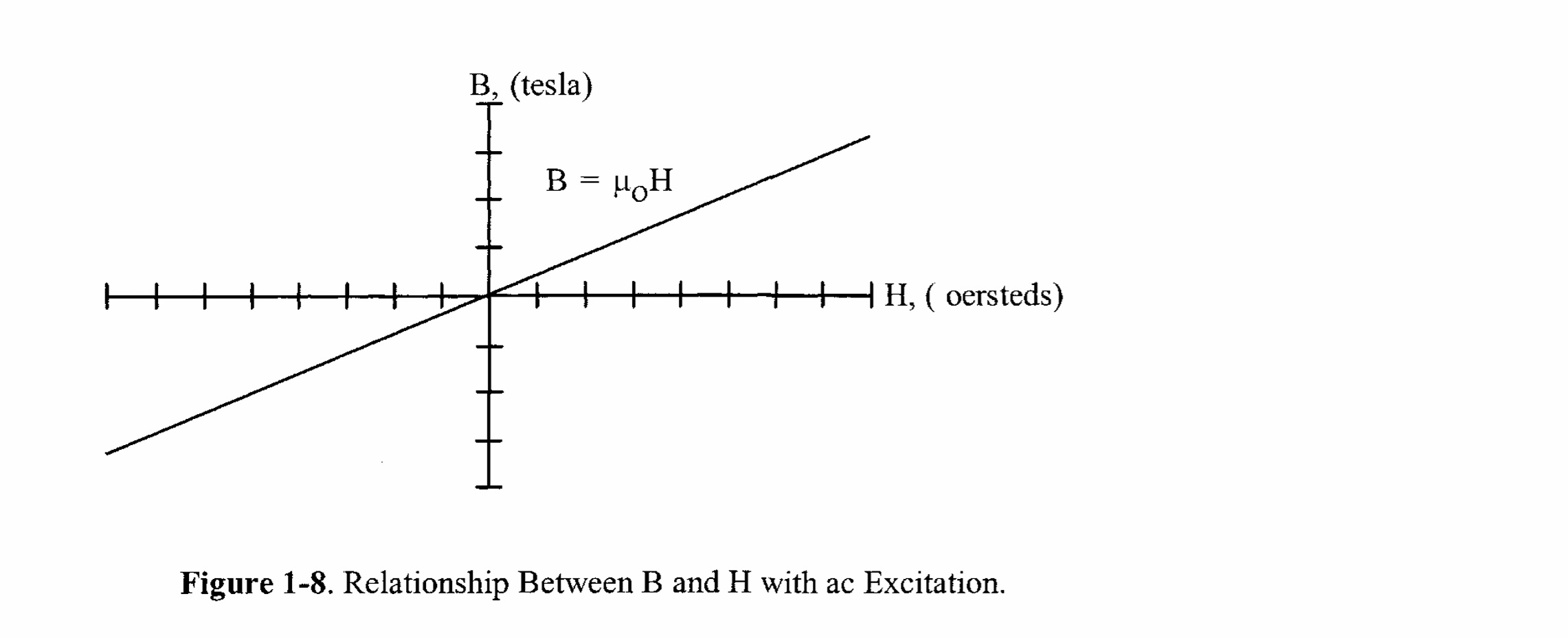
There is no such thing as a perfectly linear solid core inductor, but some are more linear than others. Both non-linearity and Remanent Flux (tendency to “want” to stay magnetized after current is applied) affect all solid core inductors.

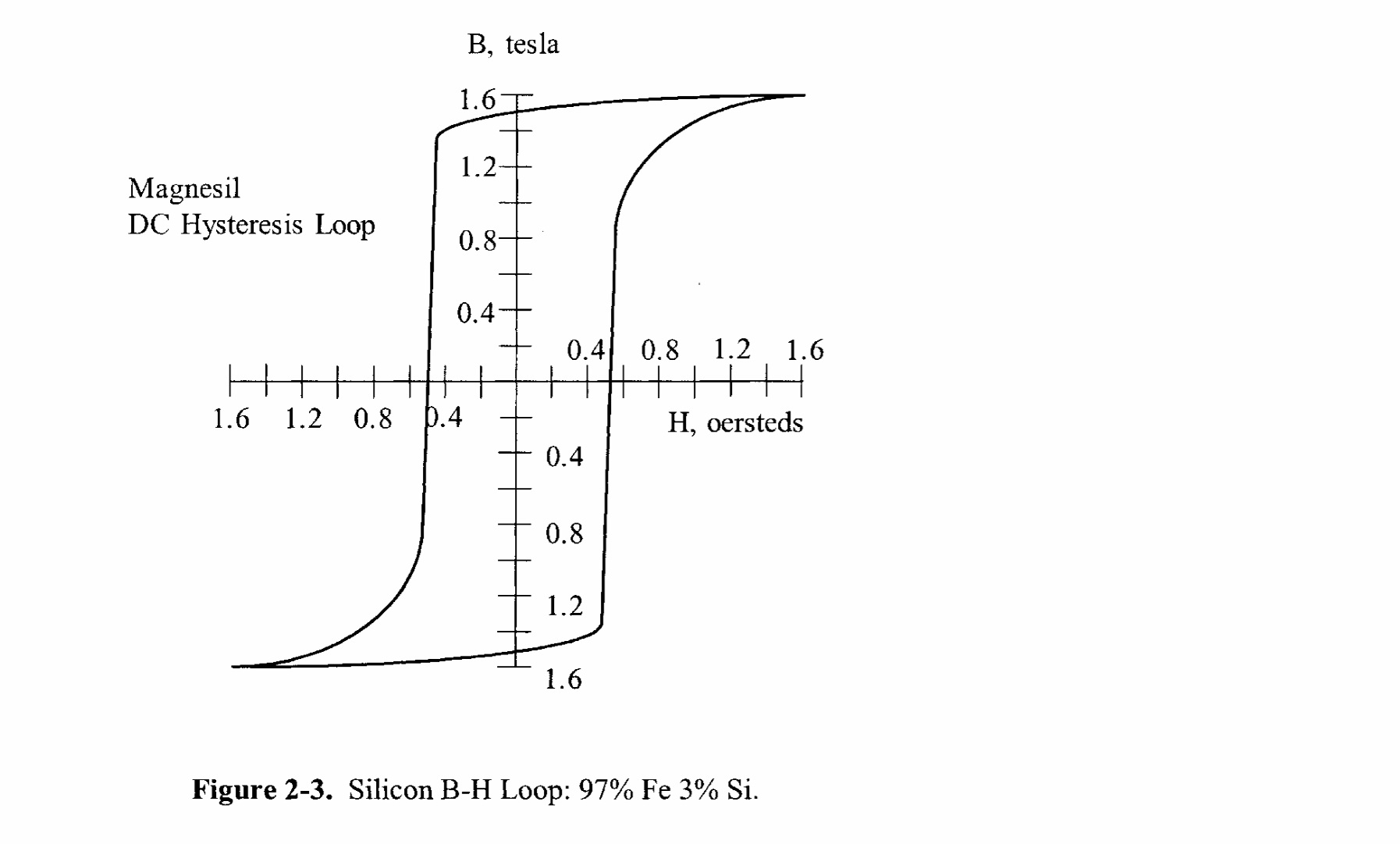
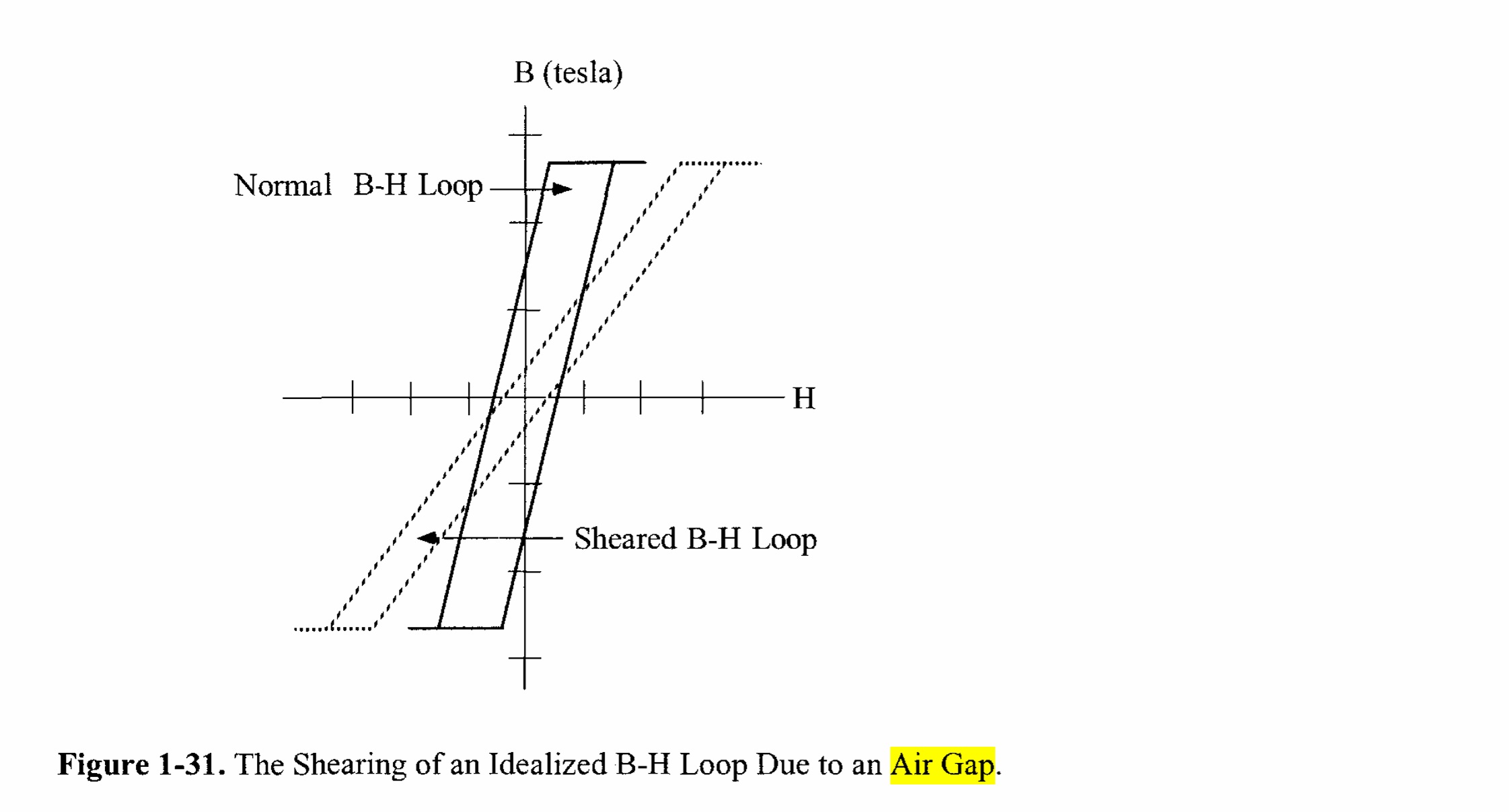
Below is a bar-core (Silicon-Steel) inductor. The pic below doesn’t account for the much-reduced permeability of a bar core. The Air Gap is essentially equal to the length of the core. This shears the curve way to the right and makes the straight portions of the curve more diagonal. It gives more of a linear area at the expense of a little efficiency.

If you push enough current through it, you increase H to the point that it starts to work in the non-linear area of the curve. Distortion. Silicon steel also has a tendency to hold “Remanent” Flux. This is what separates the 2 portions of the loop. It takes time for the core to switch from positive-going to negative-going.
Effect of an Air Gap on a BH Loop
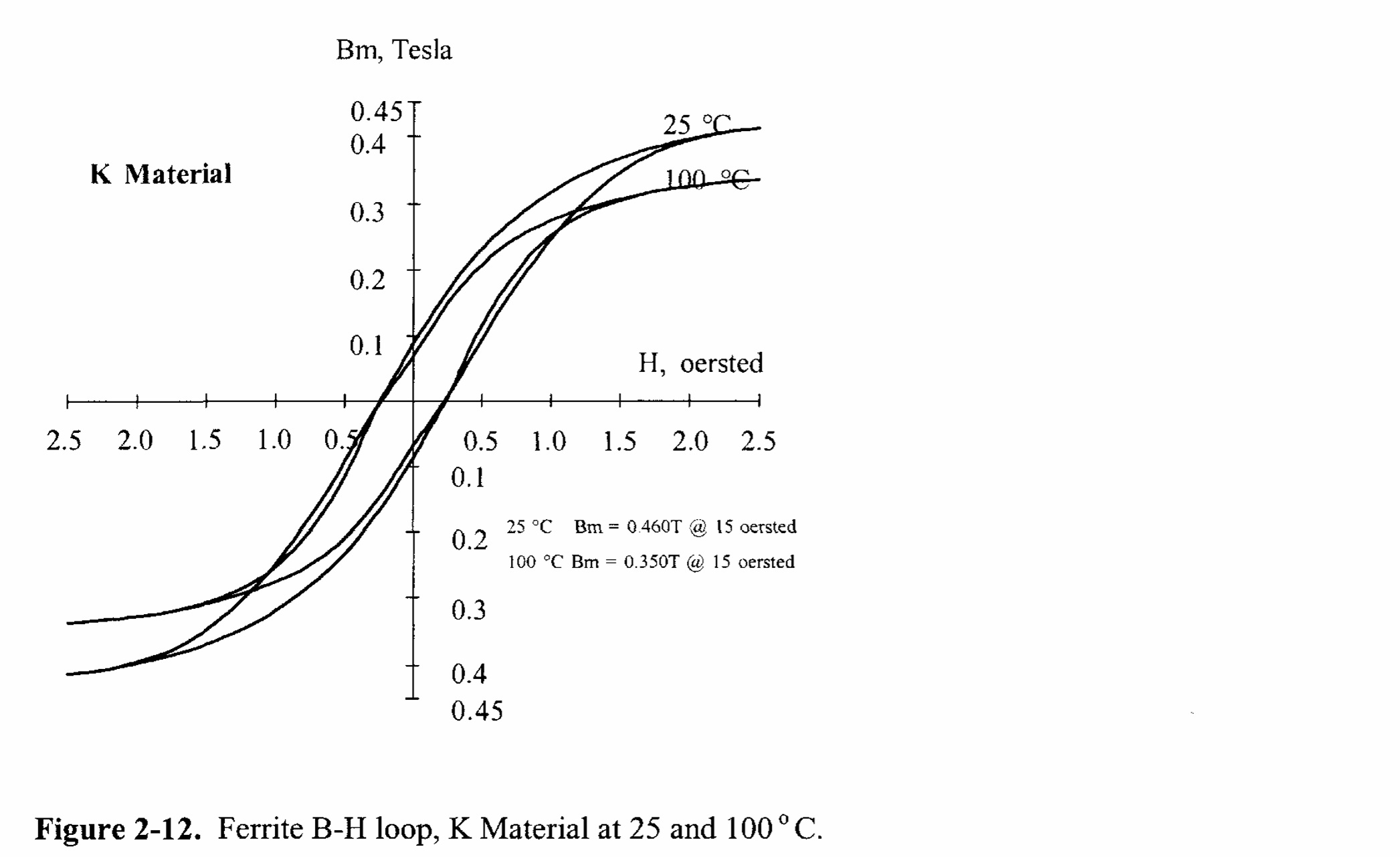
Next is a Ferrite Inductor. These have a very high frequency response at an expense. They can run in the hundreds of Khz but aren’t very linear. They can also be inefficient at low frequencies. Not audio grade IMHO. Good for high voltage / high frequency stuff!
Next is an Iron Powder Core, or P-Core. Again, the BH loop will be shifted to the right and will increase the Linear region. Note the gentle “knee” of the curve into saturation.
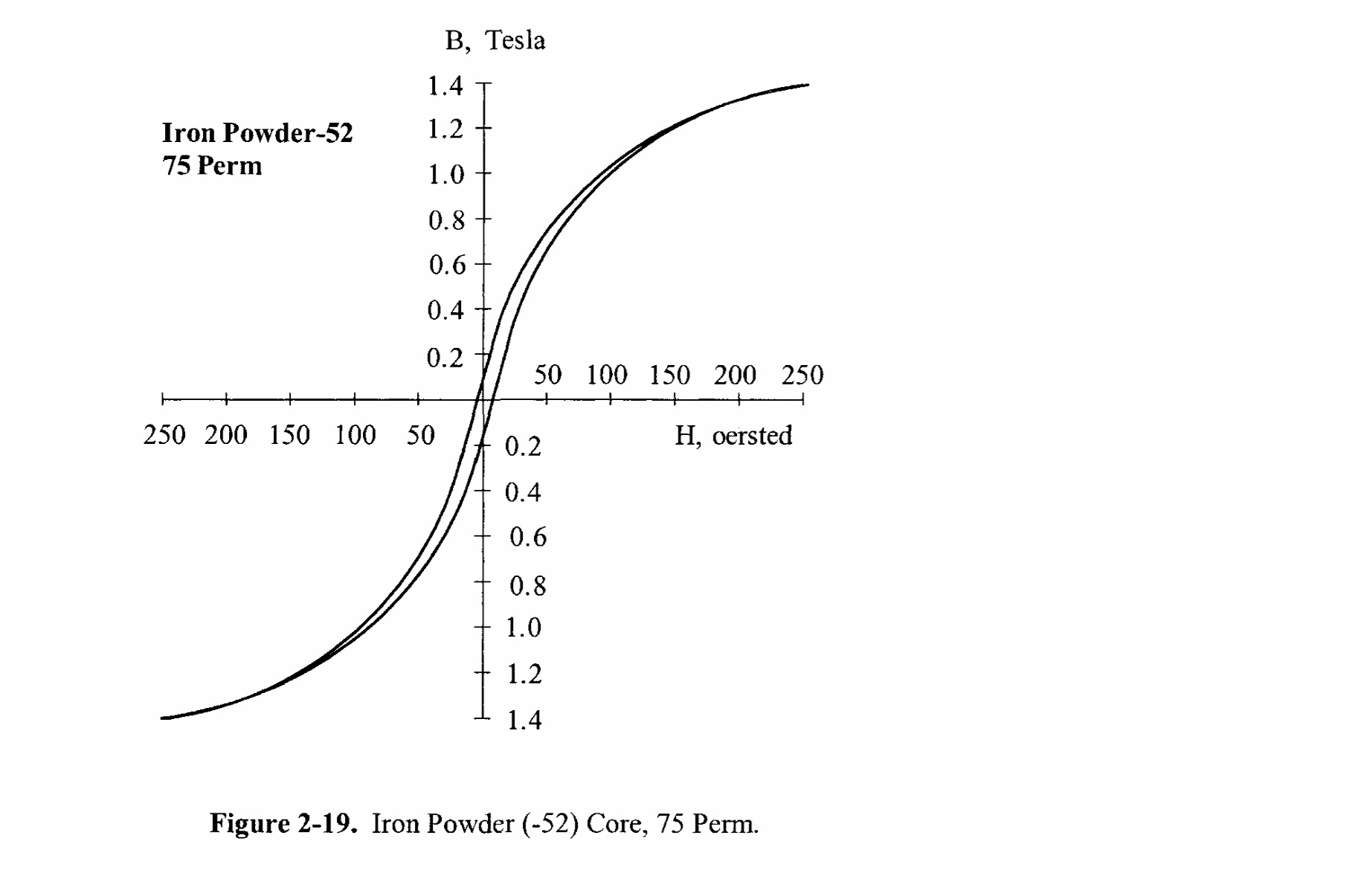
Here’s the most interesting one to me. This is a Kool-Mu, or “Sendust” core. It has the least Remanent Flux (almost none) and is quite linear. It also has the same gentle saturation characteristic of the powder core. Again, the curve will be rotated to the right by the large Air Gap.

Based on all of the above, I would choose either a Bar-Core or P-Core. A Kool-Mu Powder core, properly designed, would be a nice option too.

Cheers / Robert
3 Likes

Those charts are fine and all, but they don’t tell me anything about real audible effects on a given speaker in a low pass crossover application.

I would complete a direct comparison with audio that you can listen to for comparison and analysis, but unfortunately I don’t have any cored inductors of the same value as air core inductors on hand.

Of course! That is absolutely required.

A waaayyy back, Wolf did a cap comparison at one of the DIY’s and there were audible differences.

That’s why I let the cheaper caps go and went to poly.

Cheers / Robert

My comment was in response to your last statement “based on the above, I would choose…” where my comment is “based on the above, I know nothing about which type of component to choose” since it provides no context of what effect it has on the audio. How skewed does the oersteds and tesla relations have to be before it deteriorates the audio, and what will it sound like?

I won’t take any advice from sighted non double blind comparisons. When your ears don’t tell you anything, your eyes and pre-conceived biases will fill in the gaps.

Now, you could create some comparison listening to audio in the traditional sense and ABX test. You could even use a good low noise large condenser recording mic and compare that way, or take the comparison a step further and utilize FSAF to better isolate the differences in audio. FSAF allows one to separate the original audio from the recorded signal, so you can listen to just the remaining noise and distortion, rather than trying to pick it out of <1% or <0.1% of the audio.

I used FSAF in conjunction with a “current sense” measurement, in the same way that Hificompass completes “voice coil current harmonic distortion” measurements. This method allows a measurement to capture all distortion “on the wire” at the driver whether it’s generated by the driver itself via back EMF, or by any other components. For an example I had previously compared capacitors by measuring a “good hifi driver” with a simple series capacitor of the same value, I compared cheap yellow MET cap to a fancier and much larger and more expensive ClarityCap. 10uF was used, which created a high pass in the 1500Hz range. Measurements were completed at a reasonable/typical listening volume.

The result is a “residual audio” file that can be heard and analyzed through a spectrogram. An ideal residual would be silent, so in this audio anything heard is added noise, harmonics, intermodulation, barkhausen noise, resonances, etc. You can compare for yourself and draw any conclusion on whether the ClarityCap improved the audio.

The residual here has been amplified by 50dB to be easily heard.

I did the same using the capacitors in a typical 2nd order low pass scenario as well, resulting comparison was equally as boring, no difference between the two of any interest.

I would happily complete the same comparison with inductors, as I imagine there would be some real audible differences there which would be “interesting and measurable” in the topic of this thread, all I need is several different inductor types of the same value which unfortunately I don’t have on hand.

5 Likes

I thought that I had seen a detailed test of air core versus solid core inductors in Audioxpress, but I can’t find it now.
mtg designs inductor tests - has some basic tests. Some of the findings are that the HD % varies with mH value and power level and is mostly odd order.

1 Like

HiFi compass did some testing on solid core inductors here:

https://hificompass.com/en/projects/experiment/test-couple-iron-core-inductors

1 Like

Craig and Nick tested some coils not too long ago as well.

The above was for information purposes - sometimes you need a low-DCR coil. It’s not a must-do. Low-crossing 3-ways can run into the above woofer DCR issue. The F8 3-way did.

Nice Hi-Fi Compass article - it covers measurements well, but to reet’s point, there should be listening tests, too. AE Lambda’s are high power and low distortion, so it was a good test. I couldn’t find the Craig/Nick study but would like to read it.

The cap test didn’t get me buying Clarity’s or other super-high price caps, just the standard Film and Foil polys like Jule and Dayton sell. The difference between these and the cheaper caps with different compositions was audible at the DIY.

The rather entertaining reason I got into the design book is in the link below.

The circuit uses a switching power supply approach without semiconductor switches to charge the primary LC circuit. I did all the calcs and the circuit I made required a 4-Henry high voltage coil!!! I never made one but did successfully design the coil. Lol - a bar wouldn’t work for this, it required a C or E coil and a large winding window.

Cheers / Robert