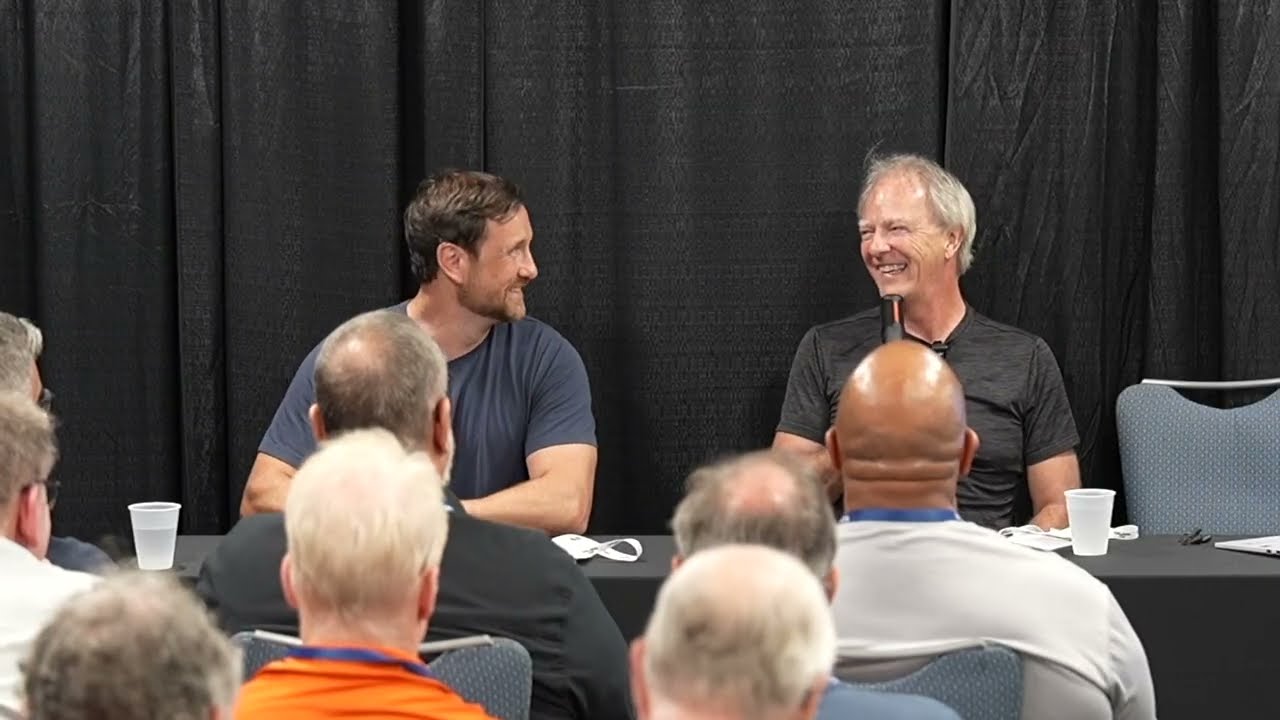
Toward the end of the discussion, Andrew touches on his recent experience as one of the judges at this year’s Ohio Speaker Design Competition (OSDC). Camera focus goes in and out a few times during the talk, but the audio track was very good. I found the video very entertaining with lots of good info on accurate measurement techniques and the difficulties of relating measurements to what we actually hear. Big thumbs up.
Thanks, really enjoyed the talk. Great, humble master
Fascinating, thank you
I don’t think that any of us really design “to the tracks selected” for the OSDC. It’s always just been a method for testing the entrees capabilities. Without music, there is no method to test, save for objectivity, sine sweeps, or pink noise spectrum measurements. The judges selecting tracks just makes their job easier to do with familiarity involved.
Sure, I listen to the tracks when released, so I know what to expect. But I use more what is familiar to me to voice and design a project.
I’m with Andrew, that vocals are very important, and thusly the mids. If it’s wrong, it’s very wrong. Low bass extension (but not peaky boomy) is nice when you can get it, and treble has to have detail without tearing off your ears.
The KEF study mimicking the room with 32 channels was interesting. We all could learn a lot from Andrew.
3 Likes
Yeah, there are two scenarios for me. (1) I get done around 5:00am and load the car and head to SDC, so never hear the test tracks before they play at the competition. (2) Bring something that was completed months before SDC, in which case I may or may not bother to play the test tracks to see how they sound.
2 Likes
This one I have yet to watch as well. Seems we have the same stuff popping up in our feed.
There are two dominant schools of thought in modern speaker design. There is the view of Toole, that speakers should have controlled and uniform directivity, and speaker designers should target neutrality through the elimination of resonances. This is evident in the Revel speakers by Harman that employ this set of values. There is the view of Jones that off-axis response depends on the midrange and tweeter being coaxially located and coincident, sharing the same acoustic center. A risk here comes from intermodulation distortion due to the high frequency horn’s surface being in motion. Genelec has taken an approach like Jones, but they use a lossy insert covering the midrange so that the tweeter radiation takes the lower acoustic impedance path across the surface of that covering instead of spilling into the midrange cone.
There is the third, more traditional and slowly being deprecated view that directivity doesn’t matter, and off-axis response doesn’t matter very much, but the data is now out there (and is getting its time in the sun) that supports the views of Toole and Jones, and most new speakers are being designed with some sort of directivity control, along with some spending the extra money to design a coincident MF/HF driver.
I like to have fun and hear a variety of speaker designs, and I honestly don’t care much whether a tweeter has a waveguide or not, or whether the midrange/tweeter are concentric or not, as long as the net result in the room is pretty good over the intended range of listening positions. But if I want to sit down and think about what the ideal speaker includes, it should have directivity control in the midrange and treble, but due to the tendency of a coincident driver to introduce intermodulation distortion which is the more objectionable form of distortion, I would target a speaker with non-coaxial and non-coincident drivers, only a compact midrange and tweeter with closely spaced waveguides that take care so the tweeter output does not spill into the midrange waveguide. I would use a hard diaphragm midrange and tweeter for pistonic behavior in the intended passband, because soft dome and cone diaphragms have changing radiation patterns due to diaphragm breakup. Right now that would force me to use the deep-anodized aluminum ‘ceramic’ drivers from SB Acoustics, though some are saying the TPCD drivers from SB are also good in this way. My low frequency alignment would be something vented to avoid overdamping, because modern Class-D amps tend to overdamp speakers, even though they have exemplary performance in other ways. For woofers, nowadays I would use the Purifi aluminum cone woofers in a three-way, or the paper cone in a two-way, together with the aforementioned waveguide-loaded hard dome tweeter or midrange as applicable. I don’t think a cardioid bass system is absolutely necessary, because I think eventually the room is going to influence bass resonances more than a cardioid system in a room can control, but my mind could be changed there if the results are a lot better.
A formula is emerging thanks to the gradual triumph of the Spinorama, and this is where I see things headed. Like it or not, while a speaker’s designer will evaluate a speaker through listening, and many listeners are as well, the audio-skeptical public is beginning to buy the data-driven skeptical narrative and evaluate a speaker by its spin data and preference score. (I mutter about this because this is without a doubt easier, and does not require listening or trusting one’s ears.)
4 Likes
Check out Beyma’s. They have units with fixed center mounted horns. The tweeter does not rely on the mid as a (moving) waveguide. The tweeter is horn loaded with its fixed coaxial horn. My fav.
Celestion’s are interesting in that, while their horn loaded coaxial tweeter does project onto the mid’s cone, it uses a single magnet motor (vs a coaxial horn tweeter that physically sits behind the midrange motor). Just happens that a pair of 6.5 inch high pwr Celestions are up for a no-reserve auction (proceeds all going to MAC) at Iowa - just sayin’.
I’d like to hear the horn loaded type coaxs. It just seems like that horn is introducing issues with the cone driver, more so than the normal tweeter using the cone as it’s horn/waveguide.
I personally think the modulation distortion that coaxs always get labeled with is very overemphasized. When used as a midbass/tweeter the cone really doesn’t move much under even spirited listening levels when crossing to a woofer. Normal listening levels, hardly any movement. Then of course your brain does it’s thing. I’m by no means a golden ear type (as we know ) but a coax does do something special.
Anyway, I’ve watched half of the video…then I couldn’t wait anymore to go fuck around with my speakers.
3 Likes
I haven’t noticed any issues with tw horn relative to mid. Could be as related to wavelengths, or maybe I am missing something- but the beyma’ sound and measure nicely. My preference (coaxial) vs offset mid / tw centers which are more susceptible to lobbing and off center / crossover design limitation issues. And yes, agree with your stmt regarding limited mid cone movement.
2 Likes
So these ‘horned coax’ drivers are a coaxial driver, yes, but they are not technically a coincident driver (in the tradition of Jones, Thiel, SEAS, KEF) where the acoustic centers of MF and HF drivers are aligned. DSP could achieve the necessary delay to produce actual time alignment despite the physical offset of acoustic centers. But there are still two issues that have to be solved some other way: 1) The horn provides acoustic shadowing of the midrange speaker, causing a narrowing of dispersion at the range of frequencies where the horn is an obstruction (horn width greater than 1/4 wavelength of the radiated frequency from the midrange), and 2) there is also diffraction of HF energy from the edge of the HF horn into the midrange cone which will produce a notch at a frequency proportional to the width of the horn and additional ripple at higher frequencies in the HF output. How much of a problem either of these things are in practice is a matter for more exploration elsewhere, and I have an idea about how to reduce issue #2 above but it would require 3D printing a custom horn. Another more extreme solution would look like a multiple-entry horn like Danley Unity/Synergy where midrange devices enter through acoustically small apertures so the horn provides the dominant radiation boundary condition for the high frequency wave.
The use of non-coaxial, waveguide-loaded drivers sidesteps the modulation issue and horn integration issues, but at vertical off-axis positions you’re dealing with a changing frequency response due to path length differences. So I’ll have to do some thinking about what the best compromise would be.
You’ve done your AI homework. As Rosan Rosanna Danna used to say, it’s always something.
Uniquely the Celestions do in fact have a common motor design (vs stacked) and when used in a 3 way, limited mid cone movement attenuates modulation.
You correctly noted a couple of design points with the beymas. And, as you pointed out you can manage the offset with dsp timing, and importantly can go a very long way with passive filter selection managing the filter’s crossover as well as timing/ delay targets (each order has its own offset / timing). Regarding tw horn interference to the mid; I haven’t heard, nor measured any issues, as they have measured smoothly through the broad crossover range I employ- especially when compared to many other non-horn coaxial designs.
Thinking those in this hobby over the years of building different designs have gradually developed our own preferences. Right or wrong (and probably a combo of both). For me, I became an early fan of panels - magnapans, and probably have become forever biased. I’ve also become a fan of coaxials as I’ve heard more issues with offset mid / tw designs- maybe just my less than ideal builds??? I just have less issues with coaxials (at least for extended mid / highs), and have come to manage what shortfalls they have.
As with individual stock selection and valuation, ‘that’s what makes a market’, and what makes this hobby sooo much fun !
1 Like
I’ve noticed the same trends that AcousticTheory pointed out. I’ll add long-term movement to ported often high Q bass over lower Q sealed designs with better transient response. Though more passive radiators designs are starting to show up.
With regard to the trend i think the other part of measurement is the power response downward tilt design target. Though sub genre of super tweeter adds still support those with high F hearing loss. The horn crowd seems to support at least part of this market.
The active crowd (and movement) in speaker design adds another lever in bass design over passive only. Depending on one’s low-end objectives rethinking how to design to hit low vs smooth low extension. Sealed vs delayed resonator supported bass systems.
I’ll stop now.
1 Like
I was surprised at how little delay I had to add to the tweeter after BW24 on the woofer and BW12 on the tweeter, 0.254ms
3 Likes
I had to ask AI to calculate the offset distance when I was messing with delay settings in SS. I knew 1ms equates a hair over 13" from my live sound days. 0.254ms = 3.5 inches.
1 Like
The more I screw around with the active set-up, the more I realize how much you screw around with delays.
Everytime you try a different xover topology, you have to retime align everything. But at least it’s just take a few measurements, change a few numbers.
1 Like
‘Cuz you can 
Phase rotation (and therefore group delay) relative to filter orders. I hadn’t given it much thought in my passive crossovers until I started playing with it via miniDSP (and AI).
2 Likes
I remember some major contributers on ProSoundWeb.com saying one of the big advancements was when when they could measure the time domain. I think Smaart FFT software development happened in the late 90s, but I couldn’t afford it back then.
1 Like