When did you realize it’s all about the crossover?
Like most, I just bought the premade xovers and it was what it was. I guess I got lucky enough, but then a few times I was like…??? Why does this sound so bad?
I built some PA cabs with a 15" Eminence coax and used a PE two way xover. OMG did they sound horrid!! Even after trying an L pad, it was awful. Later in life, building a set of speakers with my buddy Adam, it all started to make sense.
I didn’t!!! Luckily i skipped over the entire pre-made xo phase of speaker building
My story like everyone’s is a bit different. I got a very late start - and it started out by stumbling on PE’s techtalk. Taking the most prevelant advice ever to build a kit, i did - the Overnight Sendation - with it’s precut cabs. Then stepped into the single driver builds - with the aurasound 3” full range - A ported one and a sealed one with a huge cap (Wolf’s design I believe) - this was my first foray into woodworking. Then pestering people to help with crossovers and collaborating and more forums, and DIY meets.
Without the forums and the DIY gatehrings, i would have bought some powered monitors and a HTIB and be happy (i did both!)
I do not have an engineering or electrical background, so find the passive xo concepts a bit diffcult to grasp, and most of my design is by trial and error, keep throwing parts and iterating till it looks good and then minor / incremental changes till it sounds good. But i do have a computer science background, so find the active xo a bit easier, but they are not very practical as a turn key system and of course nobody else in the house knows how to turn them on!
Only when I did proper research into speaker building, reading websites like Paul Carmody’s, Curt Campbell’s and Parts Express Tech Talk about 12 years ago - I hadn’t discovered MAC/DIY at the time.
I was all set to buy the RS180, DC28 and a pre-made 2k Dayton XO, which would have sounded s***house.
Was into car audio in early 90’s, active crossover’s n such. Early 2000’s addict-like gear swapping via audiogon n such. Tried to get started with diy speakers via LspCad, the jig n stuff but online resources less back then (Zaph, Roman, htguide.com) and patience never my strong suit. But did fall into diy electronics, mainly amps, for number of years. Do have EE background, but it was computer engineering focused (firmware, vhdl, embedded systems etc.) and was sucked into software development career wise given I came out of school in dot com ramp up.
Had built some diy usher 2.5ways in 2008 or so.
2019 or so bug to try diy speaker stuff bit again. The using datasheet traces fallacy and some over simplified youtube vid’s. Built a couple kits; SB Bromo, CSS Criton 1tdx and the Zingers. Though was difficult to upend my long time reference speaker, old Acoustic Energy AE3’s (75lb stand mount 3 way). Eventually I had to switch from trying to create a replacement to just the entertainment from the learning by trial and many many errors heh. Knowing that the audio hobby in general is $lippery slope in that always have to try, err change, one more thing. Those eureka moments are great, but then it’s like days later find something else to nitpick.
Started in car audio back in the late 90s/early 00s. While it took until I found the internet and the old car audio forums to learn about it, information there was pretty readily available as to the importance and benefits of going active for the crossovers, phase and time alignment. Downside back then is active crossovers were few and far between so a lot of people were modding Behringer DCX/DEQ and other PA gear to run 12V.
DIY passives never really caught on in car audio because we live and die by time alignment. That’s why I stick to passives in my home designs. I’ve done the active thing. Passives are more fun to build as every one is a learning experience for me. Whole different game than active.
About 1988 or 1989, but I had zero means to measure FR, only impedance. I had one of the earliest versions of Vance’s LSD cookbooks. So I applied a Zobel network across every woofer and an L-Pad across every tweeter, then just used textbook 3rd order BW xo’s. Those xo’s won several car audio competions back then.
My story is a little like this. We were about to move back from China toward the end of 2015 and I was setting my mind on a real home theater room. Researching SVS subwoofers I discovered you could get a lot more for your money with DIY. Then I found the PE Tech Talk forum and my mind was blown! Not only were there DIY subwoofers, but even two- and three-way speakers!!!
I was an unregistered lurker and probably read every thread on PETT posted from 2005 to 2015 over the next two years. I finally joined in 2017 to ask a question. I realized quickly that the xo was the “brains” of the speaker and I would never be able to design one. But I started accumulating drivers and crossover parts for Jeff. B.’s Continuums and Denhams and all 5 channels of Statements II. I was content with the idea of building kits. I’d browse Meniscus and dream of being able to afford to build the Kairos.
Then, Wolf blew it all up! The InDIYana them for 2019 was the “Bare Minimum” challenge, with a limit of 5 crossover components. What would it hurt to try to design my own speaker with only 5 crossover components? If it was horrible, so what! I couldn’t get my measurement gear at the time work correctly and missed the competition. I got a lot of help from forum advice and John H. took my measurements and merged them, created min phase files, and came up with the a great starting point for the crossover. I got the speakers done for MWAF that year and took them to Meniscus/CSS and received positive feedback. It is possible that they are my best sounding speakers. And I was hooked!! I still have everything to build those Continuums, Statements II, etc. sitting in my basement with the more than 100 drivers I have in my storage room. Don’t worry Wolf, my wife doesn’t read the forums and doesn’t know it is all your fault!
In recent years, I learned that it’s also about the drivers, driver spacing, driver sizes, crossover frequency, cabinet shape, waveguides, room treatment, and blind comparisons.
I had plenty of exposure to Hifi from my late teens onward. The GAS aspect of Hifi bit me whenever I had a few extra bucks, which wasn’t often. The need for replacement drivers for a pair of Mini Mesas got me to Radio Shack in my late 20’s. Eventually I realized that process could be scaled up and DIY’ed at a price range at my comfort level. Then I found PE around 2000. Luckily I stumbled into Tech Talk before purchasing any XOs.
Further to my comment above, when I read the PE customer reviews about the Dayton off-the-shelf crossovers I was somewhat re-assured that many reviews said ‘these sound great’ or similar. I’m just so glad I didn’t go down that path.
Of course, once you decide that you need to build your own custom circuits, one problem is that you have to choose the quality and $ damage of the components. That opened another can of worms, with some people saying there’s a big difference between $5 and $80 caps, etc and others saying the price didn’t matter as long as the parts value was correct.
Curt C, who designed the speaker I finally chose, gave me straight advice about what mattered and where to spend my money.
I think I’ve always knew it was about the crossover. I stuck with woofers for most of my life and paid $ for mains when it counted, knowing I didn’t have the tools to really nail a flat response. I used off the shelf crossovers exactly once, picking a woofer and tweeter with similar published sensitivities and running with it. They were super cheap and sounded alright to me at the time. Biggest gap was a complete lack of baffle step so they were crazy weak without a sub, but no matter because I love subs. When I needed accuracy I dropped good money on a pair of Dynaudio monitors I still have.
It wasn’t until I stumbled into PETT in 2015 that I learned one could actually get good measurement data and DIY a good crossover. Now I like my builds better than my old Dynaudios.
The only premade, off the shelf, xover that I can remember using was a 3kHz Radio Shack unit that I used for an auto-sound system (1970’s?). It had a single small inductor and NPE cap inside a sealed, metal container. (When I junked out the car, I tore the metal container apart just to see what was inside.) My auto-sound system used a McGee Radio CTS phonelic ring tweeter and a Phillips AD7066/W8 7" woofer in the doors. These tweeters were $2.95 each from McGee Radio back in the day. How times have changed: https://www.parts-express.com/GRS-PRT-8-Phenolic-Ring-Tweeter-8-Ohm-270-252?quantity=1
After that, I did some textbook (not premade) xovers using the equations published by Robert Bullock III in Speaker Builder Magazine (1980’s). Robert Bullock III also wrote a DOS based computer program for xover calculations that you could use if you did not want to do the calculations manually. The program could do 1st, 2nd, 3rd, or 4th order All Pass, Butterworth, or Compromise filters. It had inputs for xover frequency and driver impedance load. But it did not have inputs for driver SPL or baffle step. So the crossover sounded very bright. But I did not realize this at the time. Bright sounded right and baffle step compensation was simply ignored.
Later on, in the 1988 to 1990 time frame, I submitted two articles to Speaker Builder Magazine, with crossovers designed using a technique that was a cross between a standard textbook crossover and a crossover based on actual measurements.
A little background: In 1987, Ralph Gonzalez published a multi-part series of articles in Speaker Builder Magazine for a DOS based computer program that he called LMP (Loudspeaker Modelling Program). I used this program to design the xovers for my Speaker Builder articles. The program would require the end user to answer a series of questions regarding the cut off frequencies and slopes of the tweeter and woofer being used. The program would also ask for driver impedance, driver SPL data , the baffle stepping loss frequency, and the amount of baffle step in dB that you wanted to apply. You could generate a simple crossover (no notches) and the program would produce a nice looking on-axis frequency response graph based on the simplified model. It gave you better feedback than a simple textbook calculator because it included baffle step, driver rolloffs, and relative driver SPL levels. But it did not use actual, measured FR data or impedance curves. Impedance was assumed to be a flat line. Driver roll offs were assumed to be perfect 2nd or 4th order filters using whatever corner frequency you entered.
Into the 1990’s I built a Joe D’Appolito Mity Mike and computer interface jig and began to attempt speaker measurements with a computer program called Speakerworkshop. However, I could never get it to work properly and eventually gave up. I didn’t return to speaker building until 2013 or so when I purchased an OmniMic and started building again. So I never came to the realization that textbook crossovers were bad because my textbook style LMP based xovers included driver slope and baffle step information and did not really sound all that bad. The “Symmetrical Isobarik” MTM (plus subwoofer) speakers that I brought to IowaDIY in 2013 still had the original crossovers in them that I had designed in 1989 using the Ralph Gonzalez LMP program. I received alot of positive comments about the sound of these speakers during the event.
I’m seeing a trend of the 40+ year olds were more susceptible to the dark ages of speaker work. The younger than that crowd having more and more access to internet and better magazines had the advantage of not going through that.
I took a 20+ year break from speaker building while the kids were growing up. It reignited when my son asked if I could help him with an auto sound system. I then went through a bluetooth speaker phase, a robot speaker phase, a snail speaker phase, and an egg speaker phase. And now that I am running out of phases I am focusing more on traditional speakers utilizing time tested approaches. I think passive speakers will always be wanted by audio enthusiasts. They enable the user to upgrade their Amps. and DAC’s. So I think this passive crossover design phase that I am now in will stick around for a long time. But don’t be surprised if I show up with a robot speaker some day.
Thats the one I built. IMHO, Professor Leach was better at amplifier design than speakers.
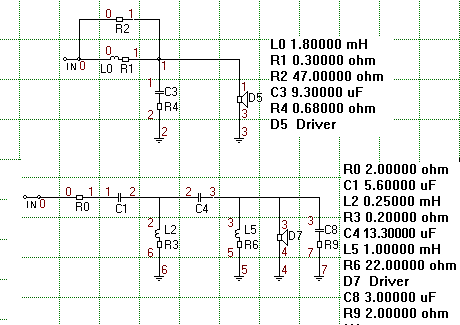
But I didn’t have or use a D25 tweeter. I’ll have to pull my build docs to find out. I may have substituted another Vifa tweeter in my youthful ignorance. Here is John Kreskovsky’s much better crossover.
yeah, that’s what I used. I had a Vifa D27TG tweeter on hand.
John K’s measurements show a pretty null, and the imaging was MUCH better than the original.