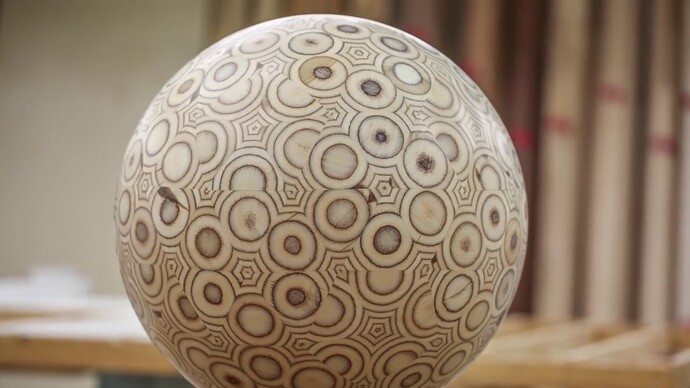
I am considering trying to build a speaker that has a “i” shape, that is a sphere on top of a traditional rectangular wooden box. I am just toying with some ideas at this time and would like input and practical advice especially if you have made or tried to make something similar yourself.
Project background: The driver components are (per side) two SB23MFCL45-4 8” woofers, two SB34NRX2-00 PRs and an SB15BAC30-8-COAX. Crossover points around 300Hz/2.5kHz.
WOOFER ENCLOSURE: I plan to put the woofers and PRs in their own enclosure of about 80L volume with the PRs on opposing sides to reduce vibration. With this particular combo you do not need to add any mass to the PRs to get some nice LF extension.
COAX ENCLOSURE: This would be the “sphere”. It would sit on top of the woofer enclosure.
THOUGHTS: I would like the sphere to be relatively large in order to get smooth diffraction down to a relatively low frequency. This also helps to keep the surface curvature low enough so that you can accommodate the driver diameter and not end up removing too much of the sphere to do that. I am thinking of something that is 20” across with the COAX flush mounted in the surface. But how to make a large sphere like that? One idea is to use pre-formed polystyrene spheres that come as two halves that are glued/assembled to create the sphere. In my area I can buy these for a reasonable cost. The material is relatively stiff and robust but being polystyene (EPS I assume) requires some new-to-me techniques for cutting, etc. I assume I would need to glue in a wooden mounting plate inside the sphere and cut a round hole for the driver in the PS. Has anyone worked with this material before? If so, or you are knowledgable about it, any tips/advice that you can give would be very helpful. It seems like a great way to make a nice sphere if it can be machined/cut as needed. Here is a link to the PS spheres on A-zon: RAYHER Polystyrene Ball, two halves, White, ø 50 cm : Amazon.de: Home & Kitchen
The sphere can be primed and painted with water based paints and then some lacquer applied as a final and more durable finish.
I want to get more comfortable with the PS material and how to cut it cleanly and finish it. Any advice on that is much appreciated.
If you have any other helpful comments or thoughts about the project in general, feel free to post them.
You could have an optic at Curt Campbell’s “Exclamations” on his Speaker Design Works” website:
Another idea, which I’d like to try, is to use various sizes of the “IKEA” bamboo ‘Blanda’ bowls: two joined together will make a sphere. Reasonably cheap, too.
Hi Geoff, thanks I checked out the Exclamations project. Unfortunately the writeup lacks any details on how the spheres were turned into the upper part of the speaker. He only mentions that he got them from a friend. Also, so much of the front of the sphere has to be cut away in the end it is like a hemisphere… I want to directly mount a 5.5” driver with no additional flat area, keeping as much as the spherical shape as possible.
The largest IKEA Blanda bowl is only 28cm and that is only about half as large as I want…
I think Nick @ugly_woofer had a teardrop shaped sub and/or spherical speakers, can’t seem to find a link or a image. I think it was made of fiberglass.
You can also try 3D printing in sections if the sphere is very big. Then glue and sand and paint.
Some of my inspiration comes from a project I saw and listed to at a past PE SDC. It was maybe 2-3 years ago now. Sounded really good, and if it was one of Nick’s projects the standard is always high…
For Coax I was considering the German Omnes I used last year in Dayton as I have another pair or something else, but that project is on the back burner for now.
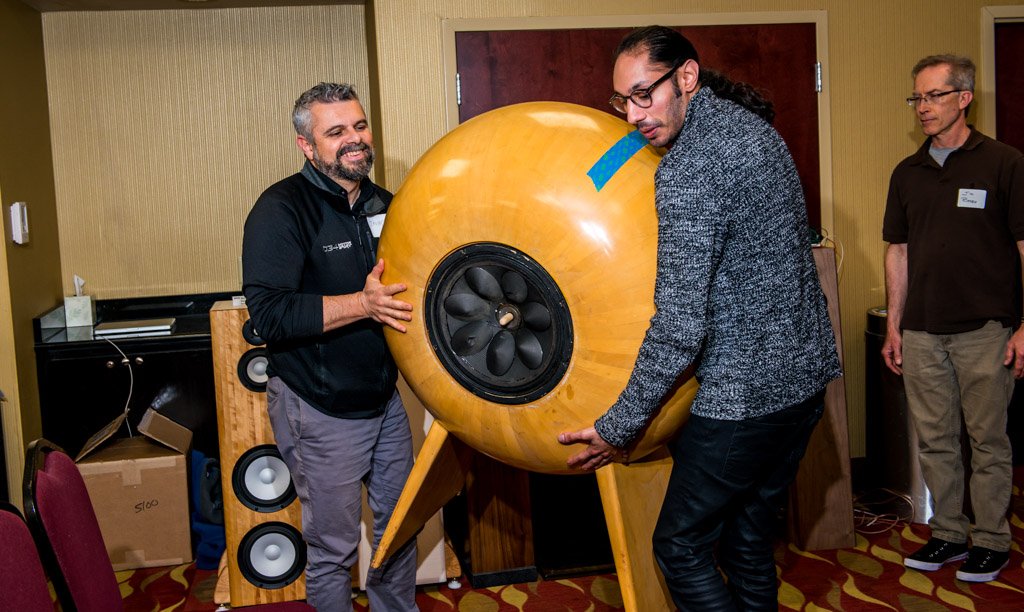
Curt got his from Wayne Wendel, and Wayne was very adamant about keeping the method a secret. Wayne was at the time thinking of going commercial. They were wooden construction.
Nick’s Stink-Eyes were maybe his second event at Dayton, so I doubt you heard those, maybe 2016?. The sub was loaded with either a HiVi F10 or F12, and painted metallic grey in a sealed-chemistry-flask shape. Looked like an alien eyeball. The satellites were a set of tapered bulbs with homemade RS coax drivers installed.
I don’t remember seeing anything round recently.
I would advise using a circular or triangular base for moving, machining, etc, or something that size will be trying to roll away on you. It is supremely awkward to handle.
Using a cutting wheel in a vertically mounted dremel or a drill press with true flat horizontal position can cut a flat face for your driver. You’ll need a pattern template to sit on the sphere to cut a recess and flat face.
I recommend a pole mount for a secure position atop your bass bin.
The polystyrene is also not that durable itself. I would recommend fiberglassing, paper mache with epoxy coat, or something else to make a strong shell. The face area should have an MDF or hardboard ring for strength.
I would not glue the hemispheres together until you are ready to finish it. It will be easier to manage the halves.
I’m pretty sure the speakers I am thinking of were at the PE SDC in 2023. But I can’t find any pics or other info. The top was not exactly a sphere but was very round and pretty wide, probably 18” or so IIRC with a very glossy finish I think.
As far as cutting the sphere, yes I would definitely keep the halves separated until all of that was finished. It is so much easier to access the eventual inside surfaces that way. I want to cut a round thru-hole in the PS just larger than the mounting flange. Then inside I would add a wood ring that the driver can be screwed down to. This would need to be glued into the half-sphere before assembling the two into the sphere. At least that is my best guess on how to proceed. I think I will need something like a hot-wire cutter to make a clean, round hole. Not sure.
I found a pic. It’s a project by Bill Schwefel (sorry if I got your last name wrong Bill!). Unfortunately, the image is too blurry to make out the project name.
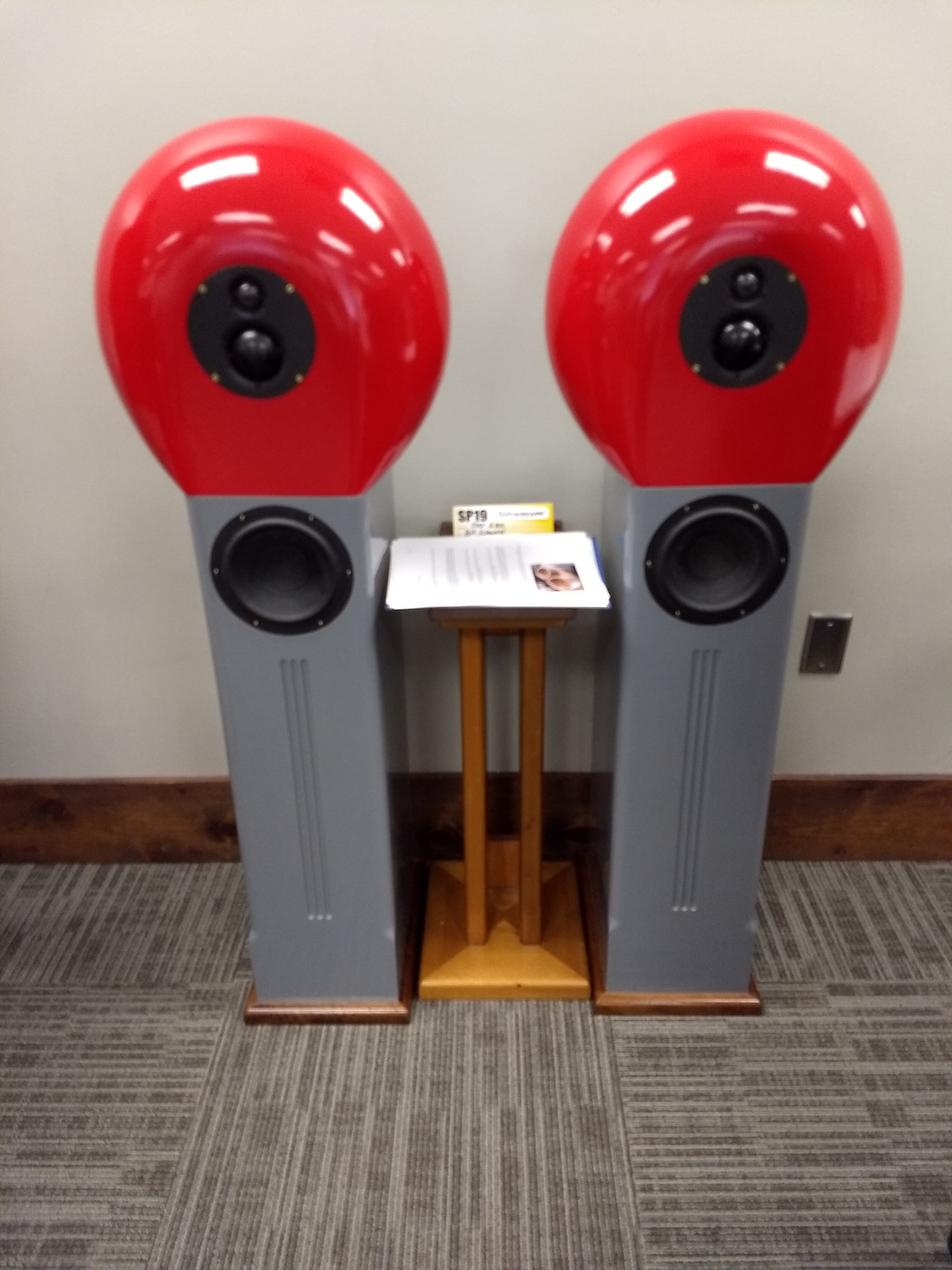
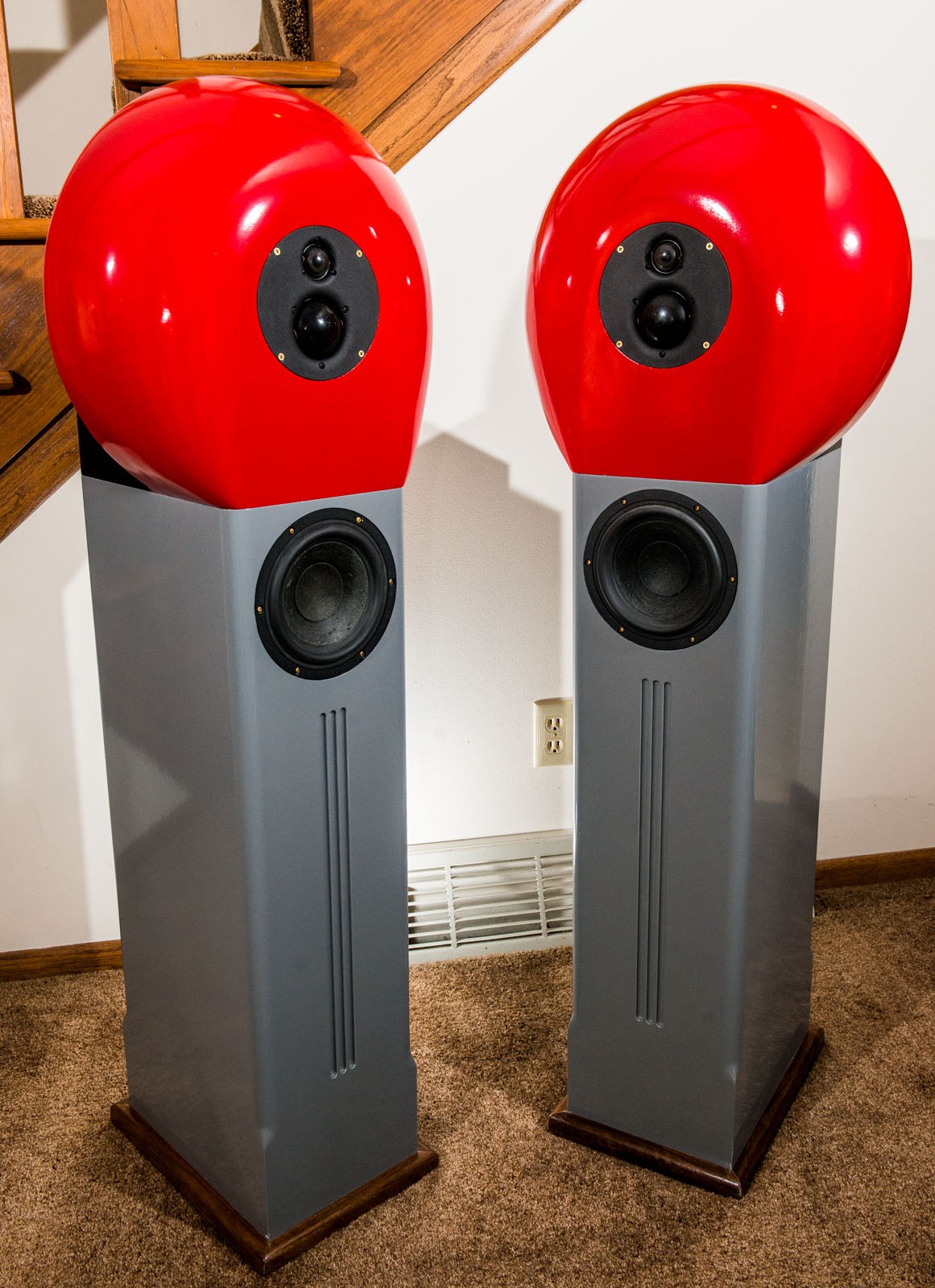
Here you go, Charlie. That would be one of my odd ball creations:
I originally named them “Doctor Diffraction.” (The cure for all your off-axis woes!). But after re-working the xovers with dual channel spin data, I decided to re-name them “Diffractorama.”
Paint: The donuts are Rust-oleum gloss Sunrise Red enamel (HVLP @ 30psi). The towers are Rust-oleum gloss Smoke Gray enamel. The lower edging is solid walnut, finished with danish oil and several coats of high gloss lacquer.
Do you have access to a 3d printer? It would be a lot of peices but i could assist with a design based on the size of the printer you have acces to. Would look linda like a basketball with the ways we would need to slice the shape.
In 2016 the cherry pi’s came in second to a similar shaped speaker at Midwest Audio Fest. It was all white and fiber glass. I can’t find a picture of it anywhere.
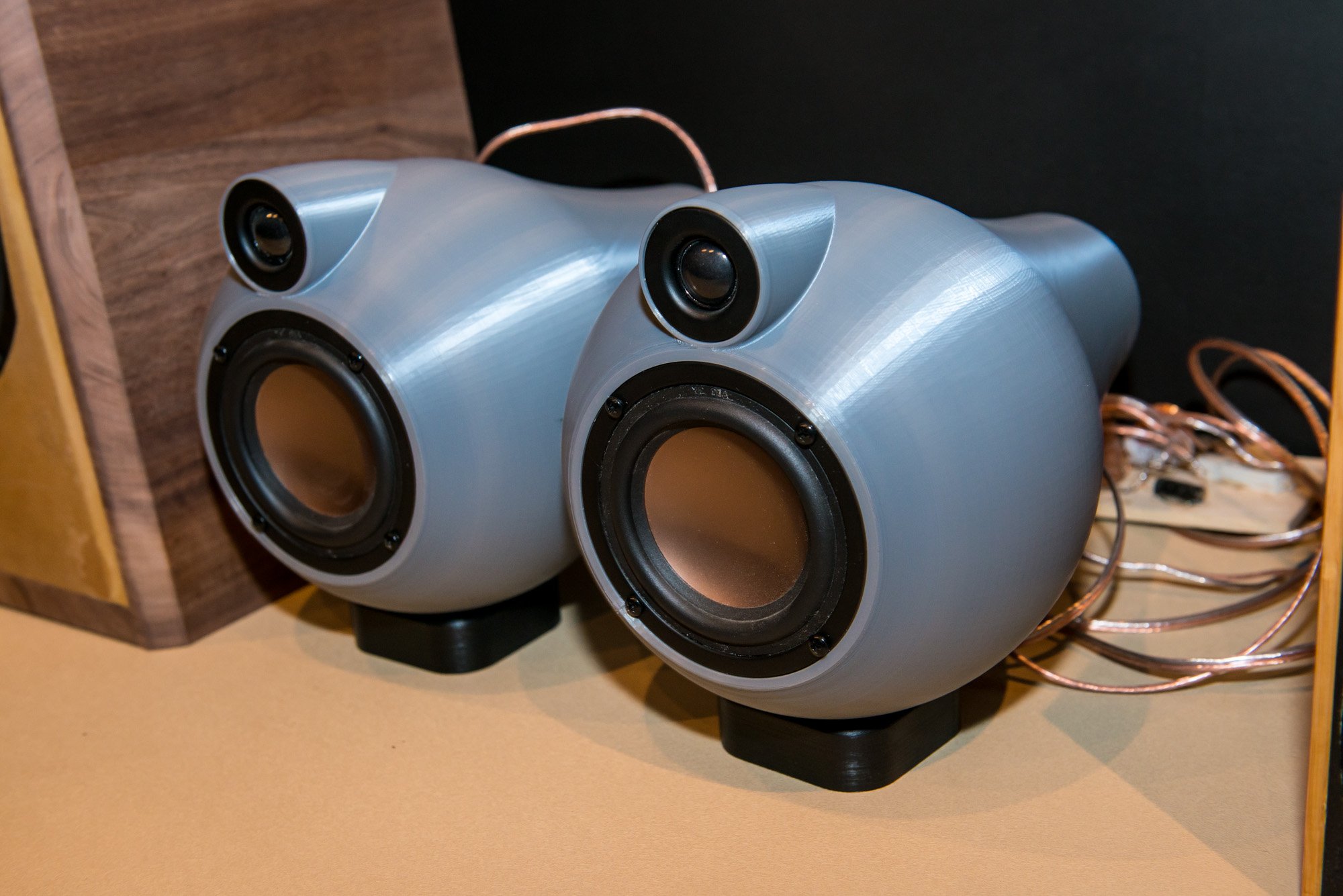
Here’s an example of a 3D printed sphere from DIYIowa 2017.
At the time I made these, I searched high and low for a big, hollow, wooden ball or bowl that I could simply buy and sand flat on one side to mount the drivers. But I came up empty. Most wooden salad mixing bowls are not perfectly round or large enough. So I decided to DIY my own with a belt sander. (I don’t have a 3D printer or wood lathe).
Another method that I have seen involves cutting multiple triangles with a miter saw and then gluing them all together into a big ball.