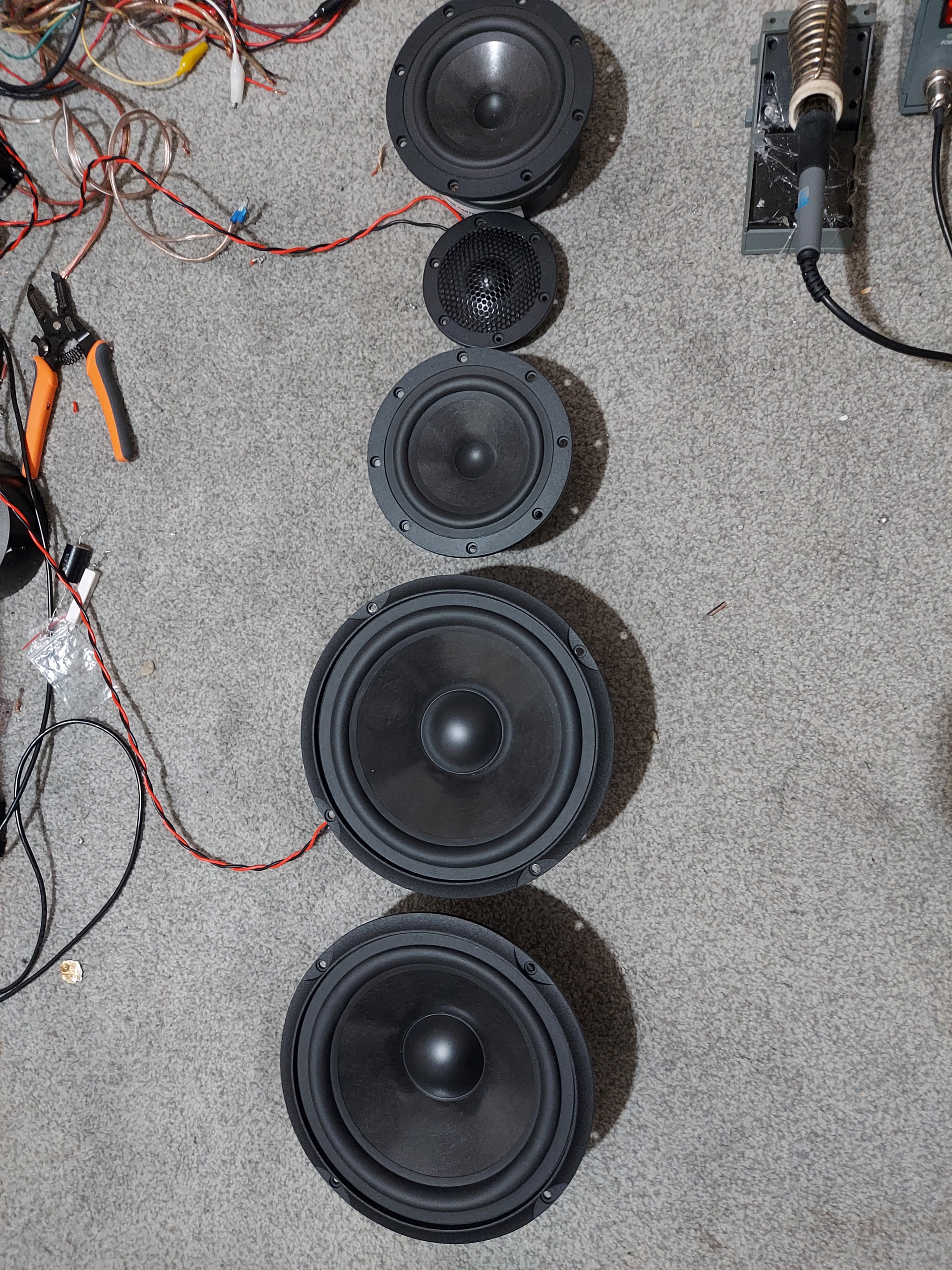
In the spring, I want to start on a tower speaker using two 8” Aurum Cantus woofers, two 5.25” Aurum Cantus mids and a Bliesma T34A tweeter.
I want the enclosure to be the best I have built, which will be easy, lol!
My idea was to use two 1/2” Baltic Birch plywood layers with carbon fiber in between them and at least for the baffle, use 5200 adhesive to mount it to the enclosure.
I’ve laminated plywood and MDF in a composite. My experience is that it is very involved, laborious, and messy.
I appreciate your enthusiasm to work with such difficult materials, and I share your ambition, but perhaps you should clarify your goals? I would argue pure stiffness may not be what you seek.
I thought about that, but I was thinking about how that would work with the rebates and wrapping it around the baffle on the back side.
I think I figured out a way to do it, though. If I do that, which I would love to, I would still want to do the sandwich thing.
I have the materials already.
By the way, are you saying I should put the 5200 between the plywood instead of the carbon fiber?
I have done laminations before and it is not difficult to me. I also have tons of experience with fiberglass in molds, over marine plywood and all sorts of different things. That maybe why.
Correct, you want to create a constrained layer that will damp the resonance between the two panels.
That said, I would be interested if anyone has objective data supporting an audible improvement with CLD construction or double thick sidewalls compared to just a standard 3/4” properly braced cabinet. I would personally be surprised if there was an audible difference, but I’m happy to be wrong as well.
I’m sure the details depend on the cabinet dimensions and bracing as far as what the greatest vibrational modes will be. But unless you have the software and time to model that you don’t know until you build it, which is too late by that point. So I suppose if you are willing to put in the effort, you place more insurance against it occurring.
In my opinion, he somewhat validated some of the long standing theory that rarely gets tested in our diy world. Of two important takeaways; CLD shows a reduction in sound transmission through enclosure walls, and driver isolation through novel mounting techniques.
To my knowledge, no one else has published to the diy world such comprehensive test results, but everybody still loves to argue about it! (me included)
Obviously more work could be done, and there are so many other interesting ideas in the same vein to pursue, but I’m grateful he’s shared and taken the initiative. So many boxes to build!
I’d personally love to try a compliant layer like butyl laminated between fiberglass, but then sheathed in plywood. For CLD to work well, you want the constrained layer extremely well bonded to a high modulus material so the shear stresses are imparted maximally into the constrained layer. Academic research has suggested the way these two layers are bonded can be a real world headache and a source of losses. I think the trick is to find a resin that will bond well to the compliant material. This can be really tricky because rubber sheets are often very slick and have a surface finish that does not bond well. My idea of then sheathing the construction in plywood is to facilitate “regular” construction of braces and butt joints and corners etc. From a wet-layup perspective, you should be able to build this in consecutive layers, but I’d venture vacuum-bagging may be required for best results.
Certainly a blast to consider!
I would also be remiss if I didn’t acknowledge that a speaker enclosure is not an isolated panel, but rather a complex shape and complete system with modes related to all the panels and driver acting together. KEF famously explains this well in their LS50 whitepaper and is the source of some of Brandon’s inspiration.
So many of you guys are EE experts and have me in spades there, but this mechanical stuff really gets my juices flowing.
Sorry, no comprehensive or objective A-B testing was performed or published but… when I built my Keramiska project I attached large pieces of ceramic floor tile (super cheap $) to the inside of every panel (MDF built box) between the braces with silicone caulk/adhesive. I believe that caulk is meant for kitchen and bathroom under countertop sink installs and stays somewhat flexible after curing. The tile not only added a lot of mass to all the panels, I’m pretty sure ceramic tile doesn’t flex at all until it breaks. I can only say those were the deadest sounding enclosures I’ve ever made… knuckle rap tests or hands on panels while doing slow sine sweeps. And it really wasn’t all that much work or cost. Just need to make the enclosures a 1/2" bigger (1/4" thick tile) in every dimension.
I almost brought up your case study, as I remembered it well. I remember some people initially dismissed the concept, but I’m a big fan. I was always of the opinion you created an incredibly effective CLD panel. Also agree the mass can be big deal as well!
It’s not CLD if the internal volume sees both inside and outside panels. It’s just mass loading.
I’ve done the same thing with 4” tiles. Draw an X with E6000, place tile on top rough dide down, draw long X atop to finish and prevent coming loose due to both sides being glued to side wall. They have not come loose.
But that’s interesting…. and I see your point. The tile would not see deformation, so its high modulus is somewhat wasted… I wonder if the tile helps the MDF panel wall impart shear into the silicone, since the other boundary of the silicone is bonded to the tile and does not have free degrees of movement. Interesting thought experiment!
I’d agree getting two stiff panels bonded to a central substrate without air pockets would be difficult. Initial brainstorming on the subject had me thinking of layering up thinner sheets of melamine/hardboard until reaching final desired thickness. Since it is thinner it could have a little bit of flex to better facilitate rolling out air pockets.