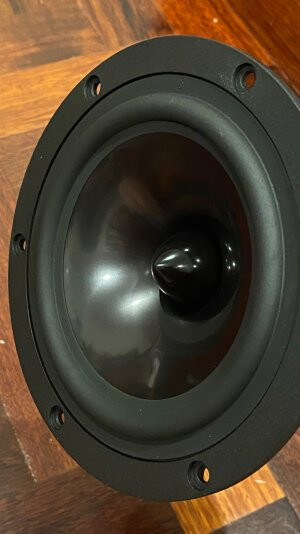
This is a plastic dust cap that moves with the cone.
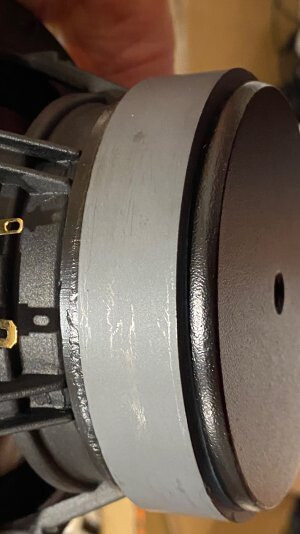
No under spider venting, small pole vent.
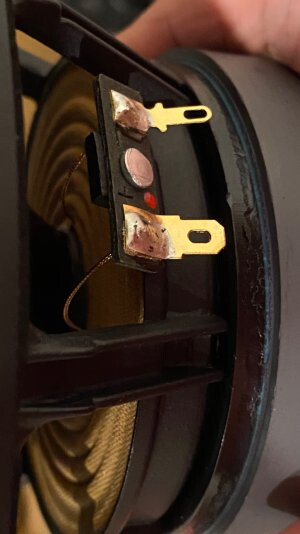
Despite a geometric x-max of “only” 4.4mm, the spider is quite large, with 11 corrugations.
Here is the free air impedance trace:
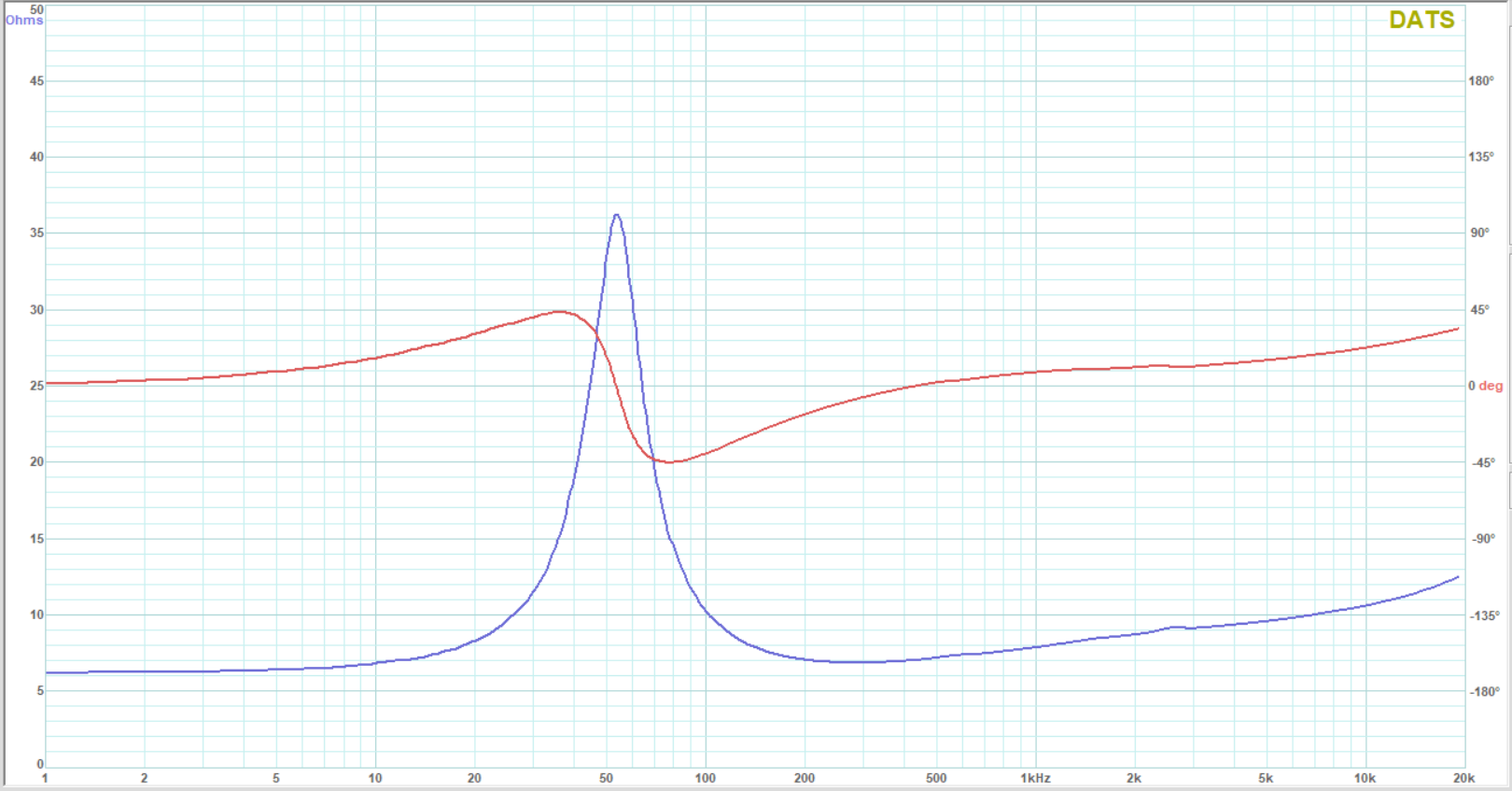
Note the lack of rise in impedance at high frequencies, thanks to the copper pole cap.
Compare that to the Dayton’s RS150-8
Log zoomed impedance trace:
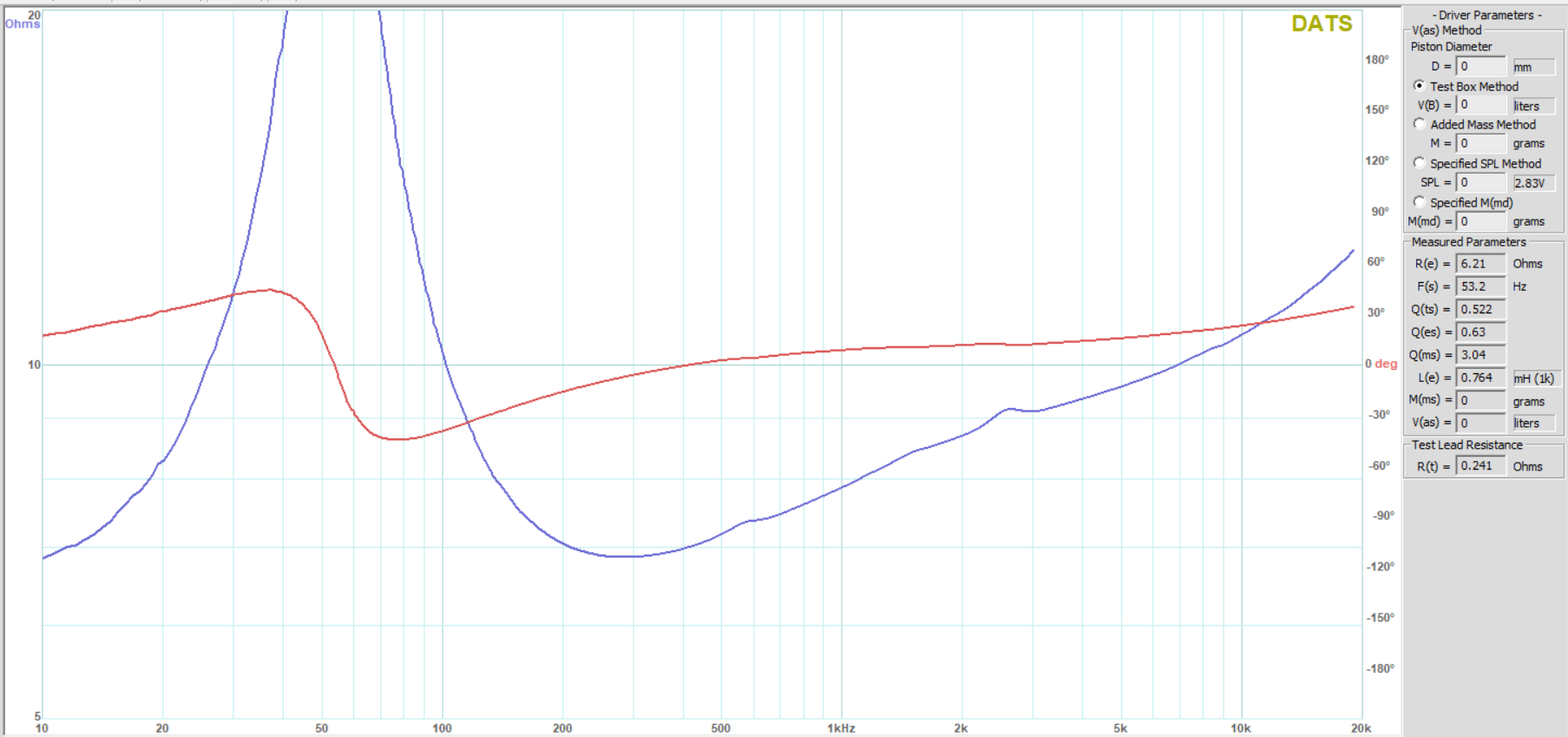
Note the blips in the impedance trace around 500Hz and 2.5KHz. We’ll come back to that later.
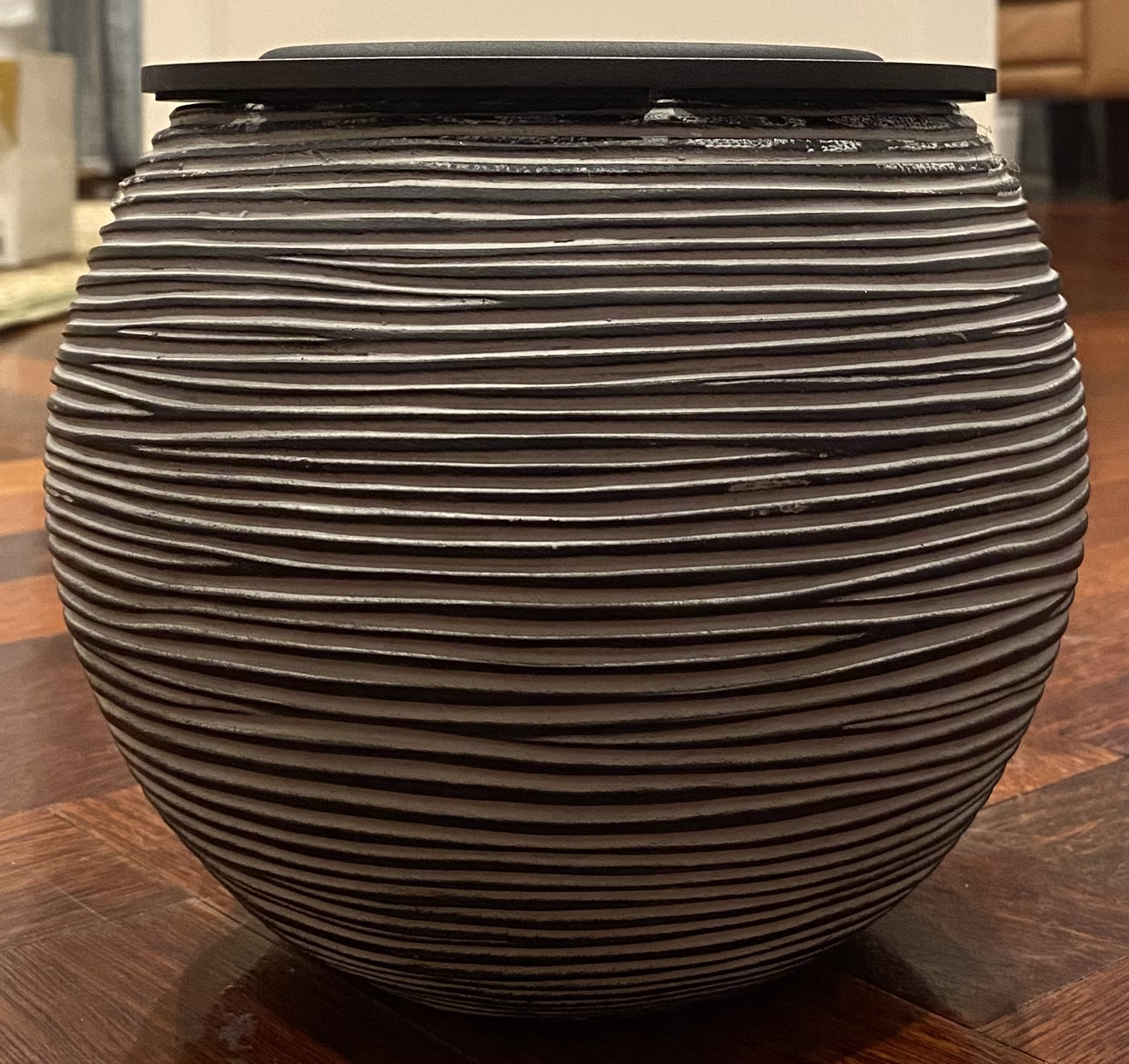
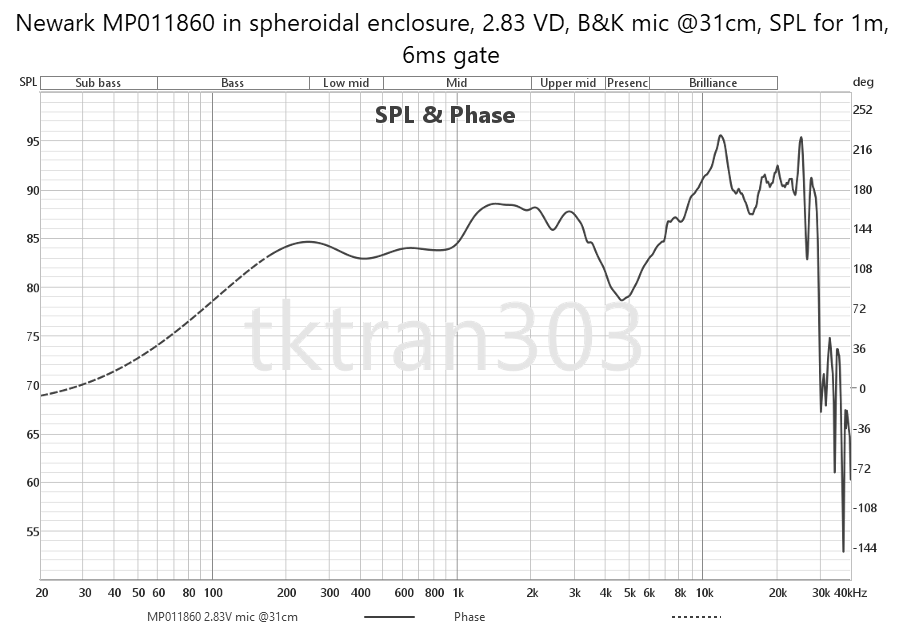
Far field measured in this pot-plant bespoke hand-made sealed spheroidal enclosure made of fibreglass 
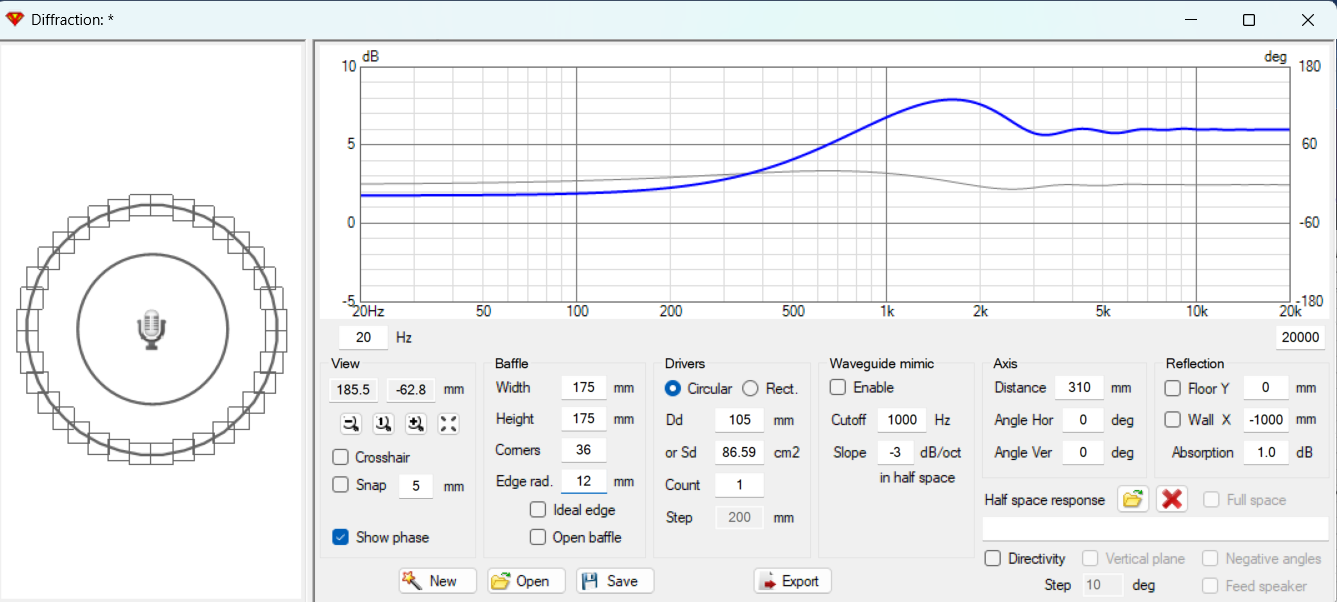
The effect on the amplitude response, compared to a infinite baffle is approximated by the below simulation-
Now we measure at 31cm and 20mm, in the Hificompass.com tradition, to determine the midrange and bass performance respectively.
Amplitude response 25dB/dec, monochrome; dashed line shows imprecision due the gate.
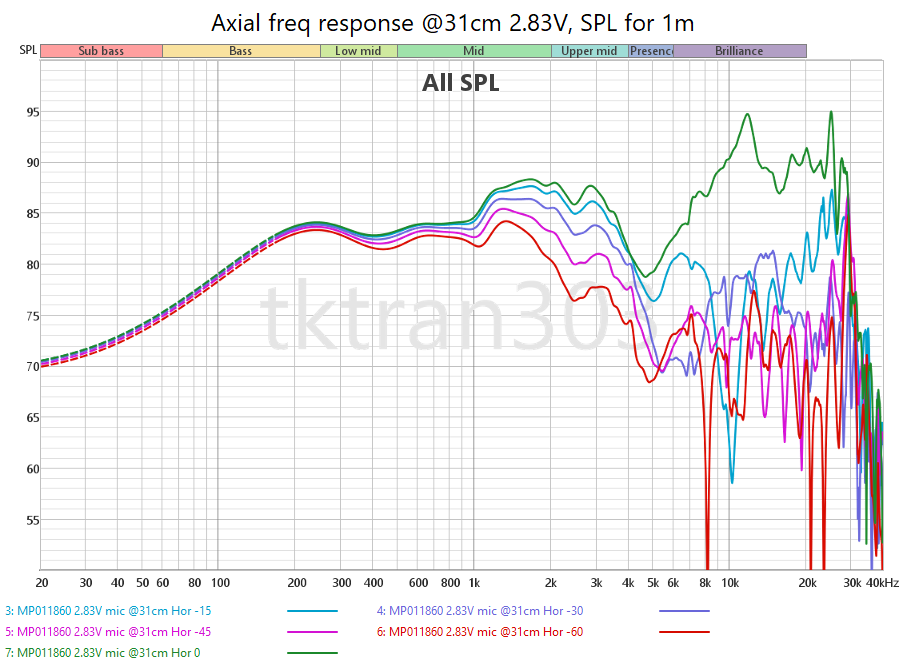
Here’s the off-axis:
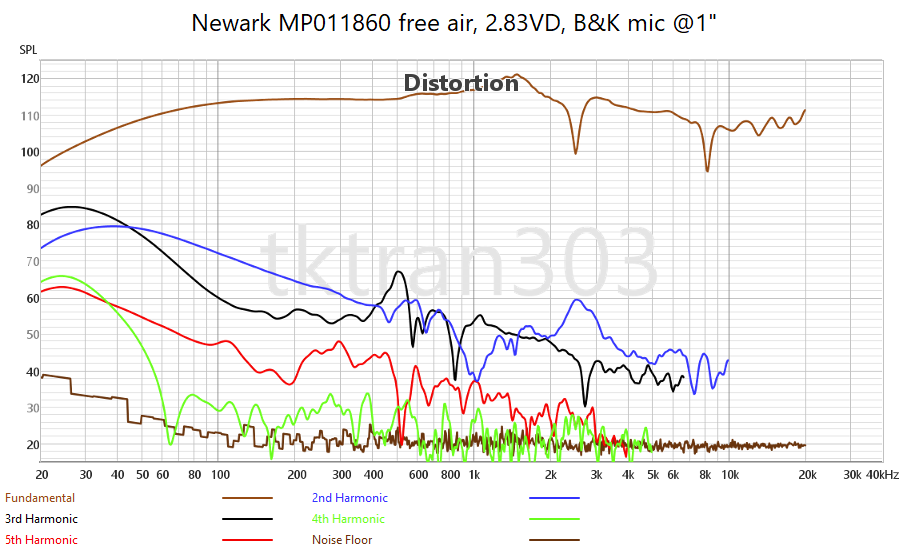
Harmonic distortion. Mic at 31cm to improve signal to noise, but SPL displayed for 1m:
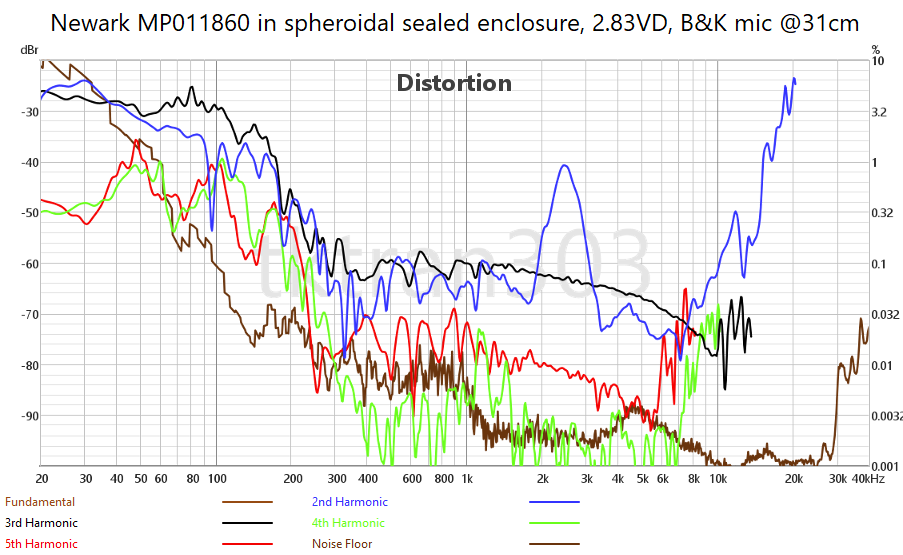
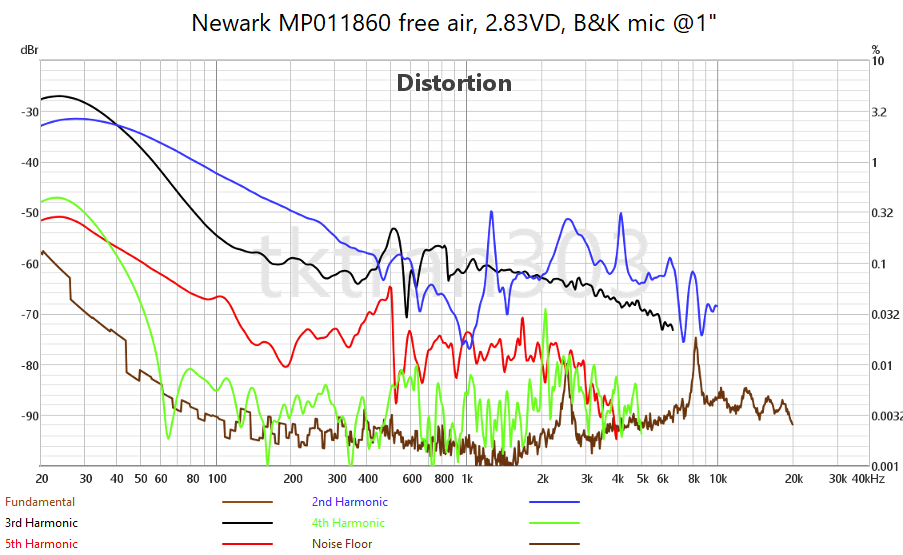
N.B. Distortion graphs in REW use a fixed 1/24th octave smoothing of the fundamental.
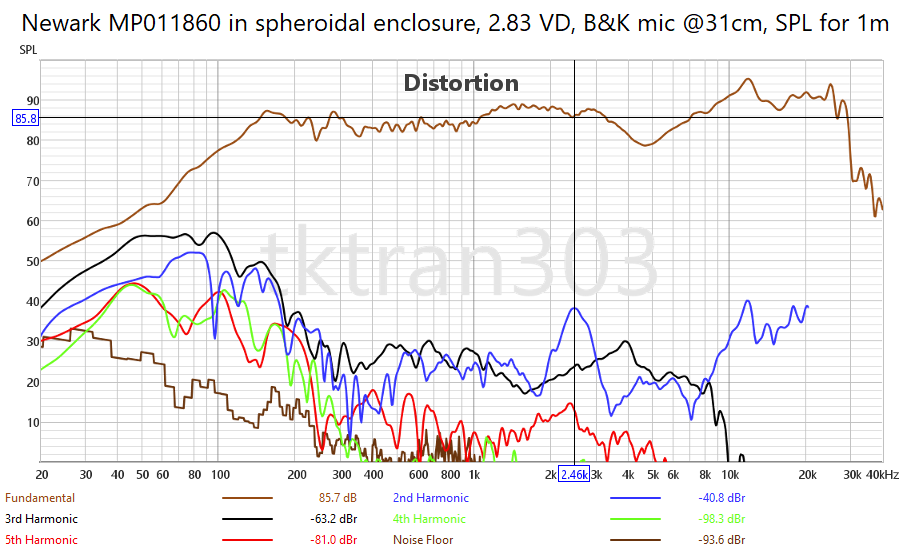
H3 and H5 are very low and decreasing with frequency, unlike the RS150. Higher order harmonics are completely below the chart.
Another view:
Now when mic is moved to the nearfield of the driver:
Conclusion:
5" mid-woofer of moderate sensitivity 86dB/2.83V (8 ohm nominal)
The good:
Aluminium frame, aluminium cone, large spider, copper pole cap, pointed dust cap
Low mid-bass (60-250Hz) distortions (< SB15C/NBAC) (c.f. Hificompass.com)
Very low midrange (250Hz - 2KHz) distortions (< RS150-8) (c.f. ZaphAudio.com)
The bad:
Amplitude response dip at 2.5KHz
Very slight chuffing around 500Hz, caused by air slug behind dust cap and pole vent (measurement/analysis not shown).
The ugly:
Datasheet’s graphs are unclear
Verdict:
Very good mid-woofer for use between 60Hz to 2.5KHz.
Excellent value at US$38 (Oct 2026)- incredible when it was on sale earlier this year for $20
A hidden gem.
Implementation ideas-
- suits BR or PR, ~1/4 cu ft, tuned around 50Hz
- crossover steeply e.g. acoustic LR4 below ~2.5KHz.
- low price allows/encourages use in multiples e.g. arrays, WMTMW

