Judging by the impedance plot and design I’m betting on spider or surround resonating. Not much else there to do it.
1 Like
That’s common on a lot of drivers, doubt we’d pick it out of a lineup.
1 Like
A lot of woven drivers have a resonance in that range.
1 Like
The Satori have a resonance around there.
Posted in error, apologies
The SB16 resonance is around 1.5k, and due to surround resonance last I checked.
The U18 has a blemish pretty similar to the 800Hz issue.
I doubt anyone would hear that. Very high Q. Usually a nasty frequency, not pleasant to the ears.
And what is it, 2 db?
Never in my life have I ever thought, “ I need to boost 800 hz in this mix”.
If it’s in the CSD/waterfall plot like it is for the U18, you will notice it. I’m betting that it is. It’s not a matter of magnitude per se, but a matter of how much change or difference.
In listening, it comes across as wooly, or unclear. Billy Corgan fans will not have the resolution of his whine that they desire or usually hear.
1 Like
Ah, I often forget that alot of woven cones are not set in thick hard resin and thus not quite as stiff. Though from what I’ve noticed cone resonances don’t seem to often show up to quite the magnitude as this one. And it probably would have been even more pronounced absent the copper cap… potentially producing a response peak instead of a valley. 
He does whine, doesn’t he? 
2 Likes
A dedicated midrange with expected 2mm of cone travel doesn’t need a large half-roll surround.
1 Like
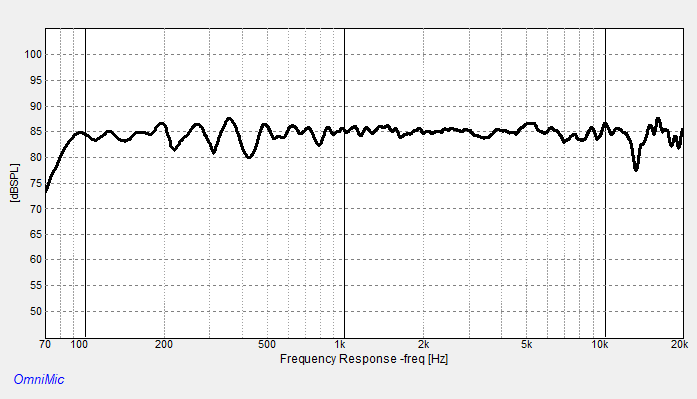
I tried hard to negate that resonance in early samples. This is a small prototype 2-way I threw together using these mids and the EC30-4 tweeters. I paired them with a pair of Signature 8’s with dual passives. Measured, not-blended and unsmoothed so everything below ~500 is not accurate. These have over 3mm Xmax and are good to around 70 Hz on the low end, so the larger surround is necessary.
5 Likes
what the measurement axis and distance and how high off the floor? Gating? the low end doen’t look too bad, and the 800hz dip, while there is about 2.5 dip, looks benign, would it be audible?
Did you make a passive XO or active and any peq other the XO? crossing to the sub at what freq? This looks like a decent 3 way. how does it sound?
Quasi-anechoic, measured in our chamber here at the office. Tweeter was ~52” off the floor, 2.83V/1m. Gating at 5ms. This was passive, paired to two subs high/low-passed at 80 with a pair of SPA500DSP’s. Source was a WIIM Mini, Fosi P4 and a sample ICE Power 2x100W amp kit we had laying around, so very clean. The dip was not audible in my listening. This system is currently collecting dust until I can finish it and get a dedicated space for it. Not much to look at, but they are solid. BB plywood (scraps believe it or not), double front baffle and braced, completely sealed. I have since finalized the crossovers with nicer components and got them all buttoned up. I don’t currently have a photo of the subs.
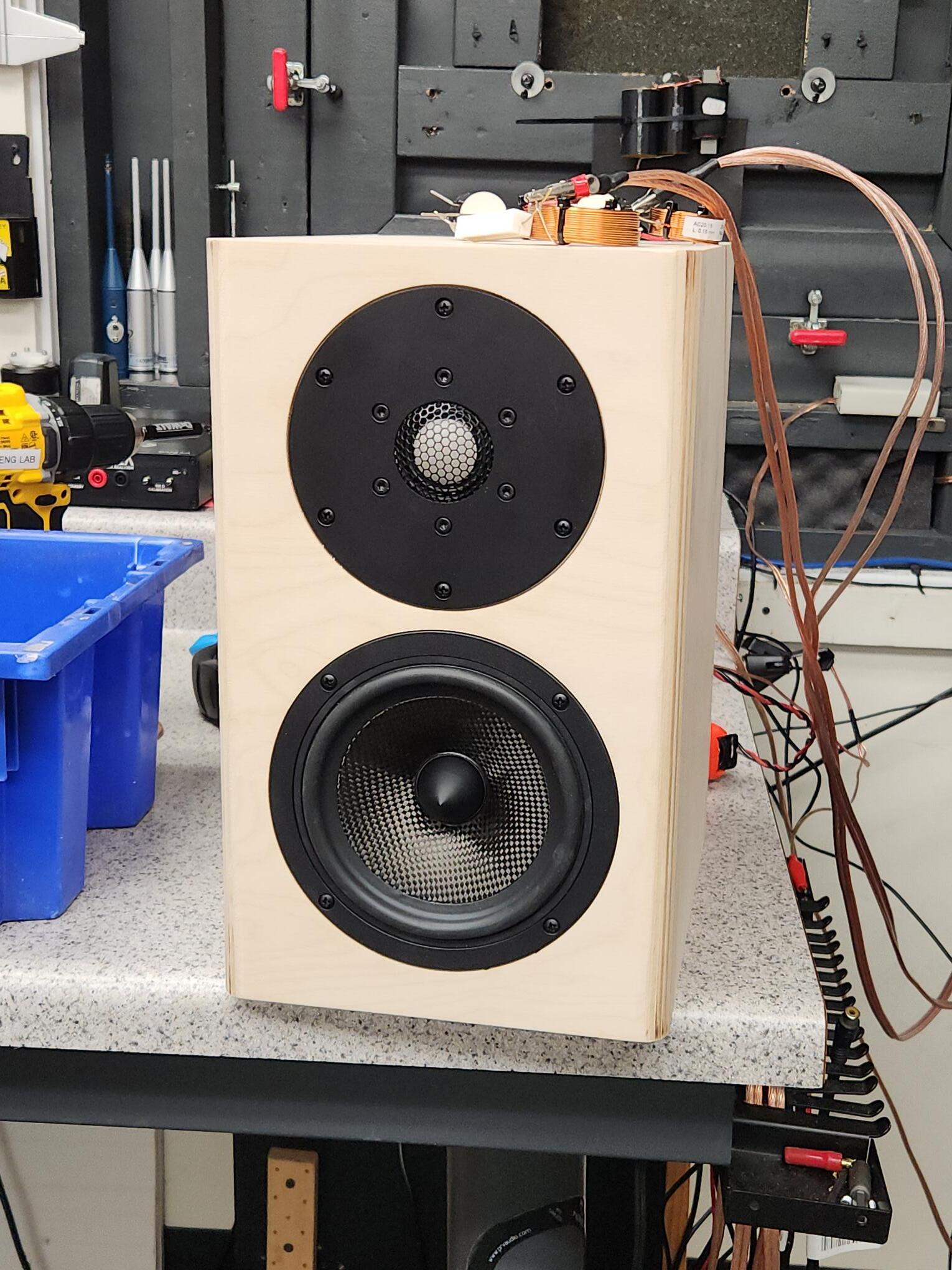
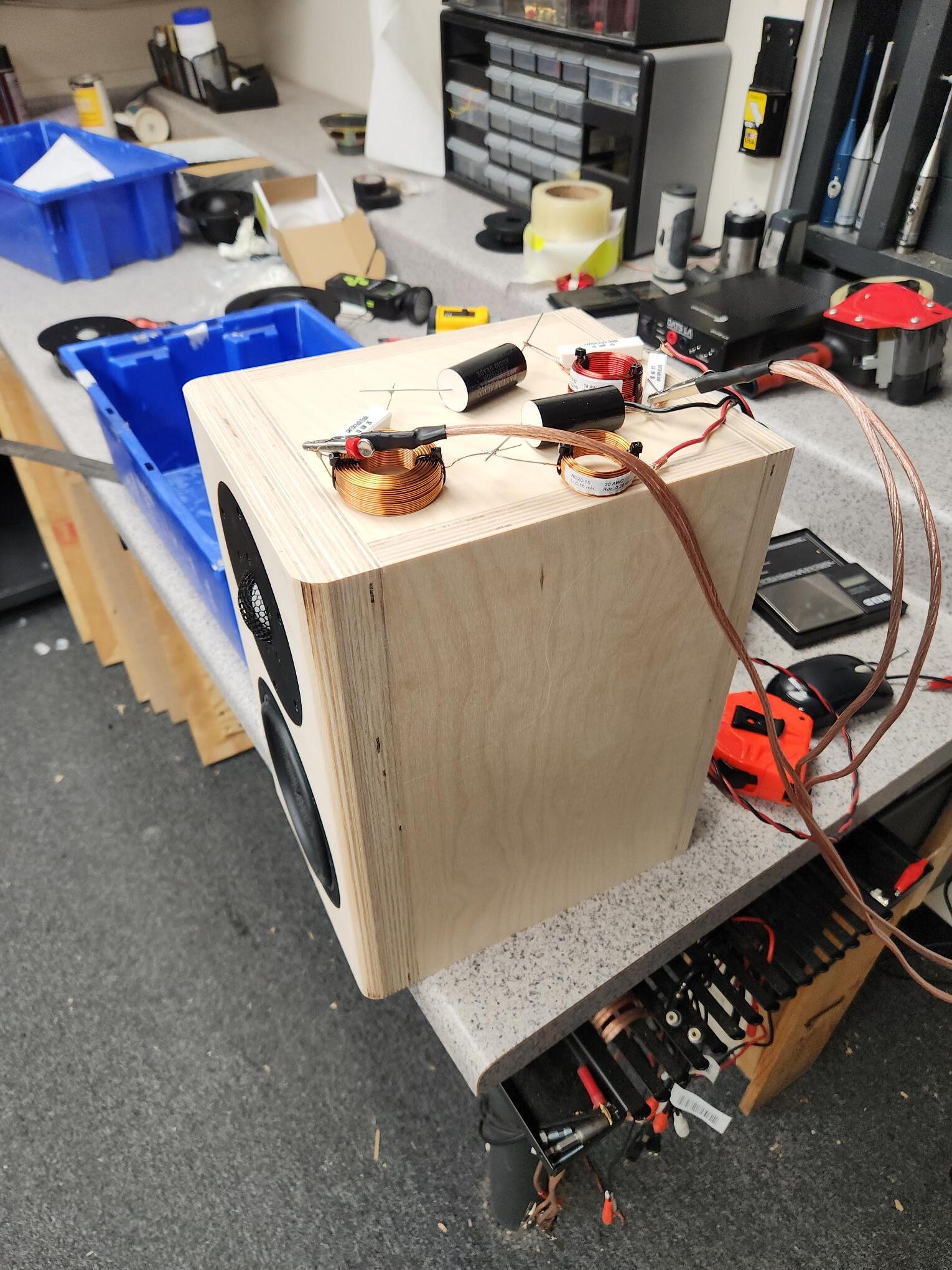
These mids are made to match the MMAG woofers aesthetically and round out the EPIQUE line. Expect them in a month or so, they are currently on their way here. Retail - $60.
4 Likes
I just bought a matched pair of the EC30-4 tweeters. Been looking around for a good midrange to go with them, so I will keep an eye out for these. Will the E150MR-4 also be available in an 8 ohm version? I’m concerned that if I attempt to passively pair the 4 ohm version up with a 4 ohm woofer, my amplifier may have problems driving the low impedance.
Your crossover will dictate that outcome, won’t it?
Hey Bill,
I hadn’t considered it but it would make sense with the rest of our lines to offer both options. I’ll see what I can do. (Don’t expect those anytime soon, however.)
1 Like
Yes. You can move the impedance up and down by changing the slopes, changing the overlap, changing the xover frequency, etc. As you move higher in frequency, for instance, the mid and woofer voice coil inductances will increase and raise the combined impedance. But what happens if you want to target a lower crossover frequency, where the two drivers impedance is still fairly low, but still well above the driver resonances. The crossover will Influence, not dictate, this outcome. Your amplifier output stage may not like it. Driver selection also influences the outcome.
All else being equal, using an 8 ohm midrange instead of a 4 ohm midrange, crossed over to a 4 ohm woofer, will allow you to use a lower crossover point before the overall impedance, as seen by the amplifier, becomes a problem.
1 Like
The midrange spans from ~250Hz to 4KHz, or 300Hz to 3KHz, depending on who’s definition you follow. But neither need more excursion than ~ +/-1mm. This is simply because above these frequencies, the SPL is thermally limited, not displacement limited.
So if we design for only 1mm of excursion, then we can have a small surround, small spider, short coil, which means the cone would need to be larger/ or have a different, or the frame to be smaller. This would enable high sensitivity and could eliminate the cone-surround edge resonance, but all of these changes would need retooling.
If we just shorten the voice coil and shorten the gap, but leave a large surround/spider for ~3mm excursion, then it is more of a midwoofer with less x-max and slightly higher sensitivity. And yet many manufacturers seem happy to do just this and call it a day. That is, marketed as midranges, not purpose built midranges. Scan-Speak- 15/8M, SB Acoustics MR13/16, SEAS ML15RCY-TP etc.
So Dayton calling this a Wide Band Midrange is probably fair.
2 Likes
Welp, ordered a pair of the Epique mids.
I have a plan.
3 Likes