It’s fantastic that you, I, and others here are supported by a loving spouse that while not always getting our latest build, gets that it brings us joy.
Still, if you have pics of how you went about this I’d certainly like to see. Impressive.
It’s fantastic that you, I, and others here are supported by a loving spouse that while not always getting our latest build, gets that it brings us joy.
Still, if you have pics of how you went about this I’d certainly like to see. Impressive.
I am not too good at documentation, so you may have to take a trip to southern Indiana.
THIS ^ sounds like a worthwhile trip . . .
I found some components that I thought I might have thrown away, I acquired them in 1984 probably. A 1K metal film resistor and a 39K carbon film I think. I used some small value caps. from my crossover parts stash and it works. The bass is too strong especially considering I am only listening to one speaker. I plan to order a 1/4 watt metal film assortment and a 100 volt polyprop cap assortment. It’s on the subwoofer so it should be fine. Correct?
My subs hit the hex grills. I should have used Xmech instead of Xmax as my design criteria. Oopsies.
I fix it.
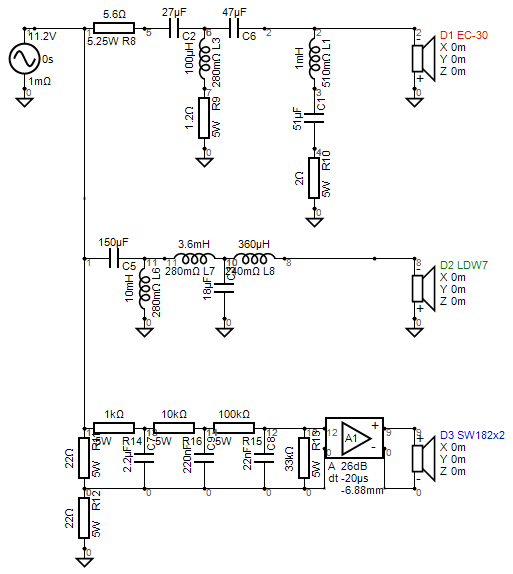
Shenanigan Dan was right when he told me that his LDW7 woofers made excellent midranges. Two thumbs up.
Getting closer. I always seem to try 2nd ord. acoustic slopes and when that doesn’t work I try 3rd ord slopes. I thought I had a BW3 XO but I could hear the mid ringing at its 1st breakup.
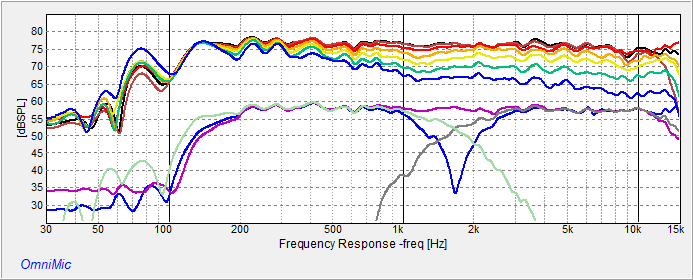
I even had a funny comment in my head about how Butterworth slopes sounded sweeter but with my limited experience It looks like I am going to end up with LR4 at 1600, which is about 3/4 wavelength driver spacing
Do not obsess over the reverse null. It shows only a sliver. Power response and directivity, that’s the stuff. I am talking to myself.
And on axis, of course. For the people who sit in the middle.
I have heard of speaker builders employing asymmetrical slopes to improve power response. Do they not pay attention to phase tracking? I’m sure they are aware of it, but they probably have given it less priority. Afterall if the slopes are relatively steep the handoff is relatively quick.
It is not “settled science” but the research of Toole and Olive finds little evidence that people are sensitive to reasonable phase errors. Thus, focusing more on On-axis and Predicted-in-room responses is given a higher priority by some. (I’m not opining on the truth of this, just summarizing the research, as I have seen posts by people who swear they can hear the very smallest phase alignment differences and weight it extremely heavily.)
Good stuff. It reminds of my favorite definition of science. Making observations and comparing notes.
My 1 and ½ cents
Phase is an on-axis relative to off-axis issue. Crossover orders (combinations) can be selected for either- but some filter combos are less prone to shifts than others.
I think of it this way. Why cant a single driver satisfy us? It would be much simpler if it were possible. But it is not. So we attempt the impossible. Because trying is good
Asymmetrical slopes with regard to electrical filters a lot of times lead to an in phase acoustic summation due to drivers’ relative acoustic offsets.
So, to answer the question-
Asymmetrical elec slopes are more often than not required to achieve in phase alignments. In phase alignments however do not have to have bad power response. There is a power response dip at the xover freq in standard LR4 summations, followed by the ‘bunching’ and upper treble power response rolloff. Just a little attenuation in the bunching area can yield results favorable to both groups.
When hifijim did his 2 setting active DSP demo at InDIYana this past Spring, I found I preferred the focus of the LR4 in phase summation over the flatter power response. I do feel though that there can be more of a middle ground between the 2 than was portrayed.
Single driver systems can come ‘close’ to being what multiway systems approximate- in terms of imaging, being cohesive, and being minimum phase.
Where the problems are;
Clarity in complex music passages is lacking due to IMD.
Off axis response is abysmal in larger units.
Bass extension is horrid in the smaller units with better off axis response.